Growing Okra: Planting, Harvest Timing & Pest Guide
title: "Growing Okra: Complete Garden Guide"
—- title: "Growing Okra: Complete Garden Guide" slug: growing-okra hub: vegetables category: Vegetable description: "How to grow okra from seed: soil warming, planting depth, spacing, harvest frequency, and managing common pests. Sourced from Extension research." date: 2026-06-10 updated: 2026-06-10 author: "Thomas A." reading_time: 8 —-
I don't grow okra at my Long Island plot — the crop is more associated with zones 7—11, and while it will produce in zone 7a, the season is shorter than it would be in the mid-Atlantic or South. This guide is sourced from NC State Extension, Clemson HGIC, Texas A&M AgriLife Extension, and Cornell Cooperative Extension, which collectively offer the most thorough published guidance on home okra production.
Okra is one of the most heat-tolerant vegetables available to home gardeners in the eastern United States. In the right climate — zones 7—10, with sustained summer heat — it is also one of the most productive: a well-maintained plant can produce pods daily through the entire summer. The management requirement is simple but non-negotiable: harvest every 1—2 days once production begins, or pods become fibrous and inedible within 24—48 hours.
Variety selection
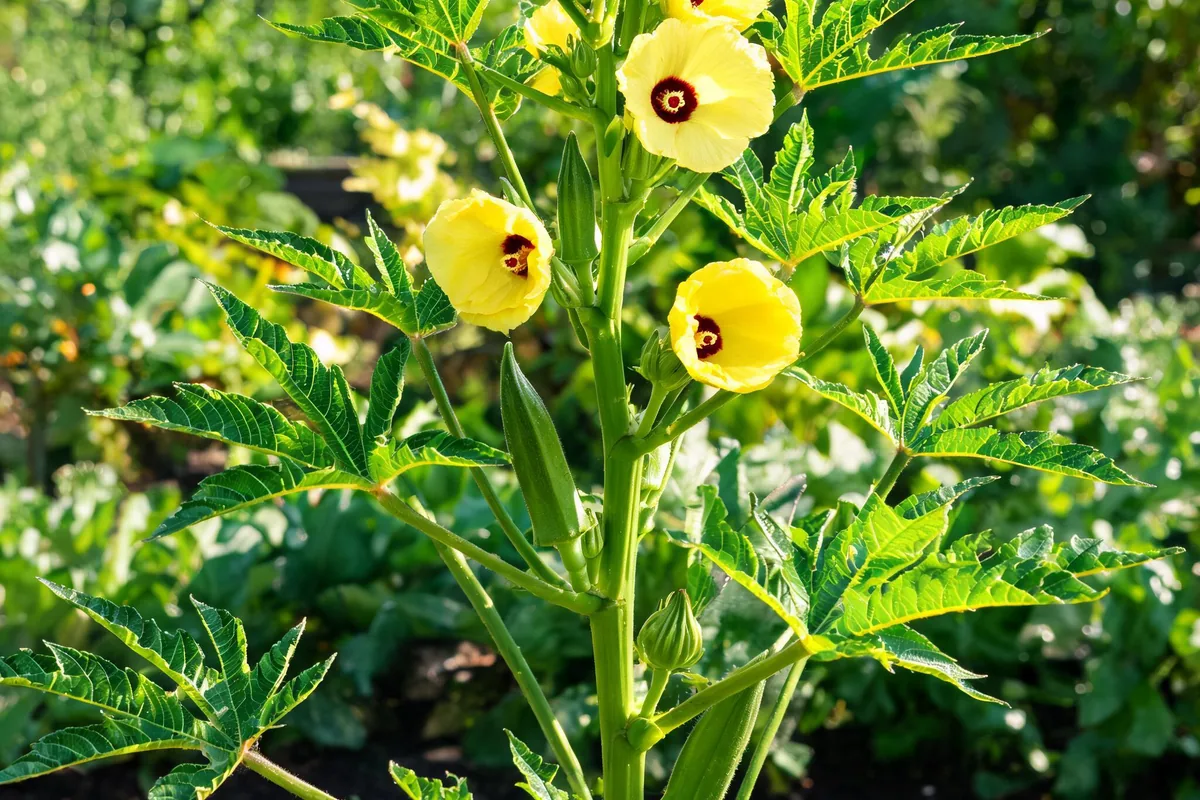
Abelmoschus esculentus is the cultivated okra. Standard varieties grow 4—8 feet tall with large leaves and hibiscus-like flowers.
'Clemson Spineless 80' (55 days): The standard home garden variety, developed by Clemson University. Per Clemson HGIC, 'Clemson Spineless 80' is \"the most popular home garden variety\" and remains the benchmark for pod quality and reliability across zones 6—10.
'Jambalaya' (50 days): Compact (3—4 feet), highly productive, well-suited to smaller gardens and containers. Per Johnny's Selected Seeds, 'Jambalaya' is among the best-performing short-season varieties for zones 6—7.
'Burgundy' (60 days): Ornamental red pods and stems. Pod quality is similar to green types; red color is mostly lost in cooking. Grows 4—5 feet.
'Louisiana Green Velvet' (65 days): Southern heirloom, productive in zones 8—10.
'Annie Oakley II' (52 days): AAS winner; early and prolific, useful for shorter seasons in zones 6—7.
Days to maturity: 50 days ('Jambalaya', 'Annie Oakley II') to 65 days ('Louisiana Green Velvet').
USDA zones and temperature requirements
Okra is grown as a warm-season annual in USDA zones 6—12. Per NC State Extension, okra grows best at air temperatures of 75—90°F and is among the most heat-tolerant vegetables for home gardens. Germination requires soil temperatures of at least 65°F; per Clemson HGIC, optimal germination is at 85—95°F. At soil temperatures below 60°F, seeds rot before germinating.
Per Texas A&M AgriLife Extension, okra is sensitive to frost at all stages. Plant after all danger of frost has passed and soil has thoroughly warmed.
In zone 7a (Long Island): plant direct seed in late May to early June, once soil has reached 65°F. The season is approximately 110—120 frost-free days, sufficient for most varieties but shorter than the 150—180 days available in zones 8—9 where okra truly thrives.
Starting from seed
Scarification: Okra seeds have a hard seed coat. Per NC State Extension, soak seeds in warm water for 12—24 hours before planting to soften the seed coat and improve germination rate. Alternatively, nick the seed coat lightly with a knife or sandpaper (scarification) on the opposite end from the hilum.
Direct seeding: Per Clemson HGIC, sow seeds 1 inch deep, 3 inches apart in rows 3 feet apart. Thin to 18—24 inches apart when plants are 4—6 inches tall.
Transplanting: Okra has a long taproot and does not transplant well. Per Johnny's Selected Seeds, if starting indoors, use soil blocks or peat pots and transplant no later than 3 weeks from germination to minimize root disturbance. Direct seeding into warm soil typically produces better results than transplanting in most zones.
Spacing and planting depth
Per Clemson HGIC, final spacing: 18—24 inches within the row, 3 feet between rows. Closer spacing (12 inches) is sometimes used for early-season production but reduces airflow and increases disease pressure.
Soil and fertilizing
Per NC State Extension, okra grows in a wide range of well-drained soils with a pH of 6.0—6.8. Heavy clay should be amended with compost to improve drainage.
Per Clemson HGIC, incorporate 2—3 pounds of 10-10-10 fertilizer per 100 square feet before planting. Side-dress with nitrogen every 4—6 weeks during active production: 1 tablespoon of 10-10-10 per plant, or 1/4 cup Espoma Plant-tone 5-3-3 per plant. Per Texas A&M AgriLife Extension, avoid excess nitrogen once pods begin forming — it promotes vegetation at the expense of pod production.
Watering
Per NC State Extension, okra needs 1 inch of water per week during active growth. It is more drought-tolerant than most vegetables once established but produces more and better pods with consistent moisture. Per Texas A&M AgriLife Extension, water stress during pod development causes pods to become fibrous faster.
Soaker hose irrigation at the base reduces foliar wetness and disease pressure.
Harvesting: the management-critical step
Harvest frequency is the defining management variable in okra. Per Clemson HGIC, pods should be harvested when 3—4 inches long, within 4—5 days after the flower opens. At this size, pods are tender and seeds are underdeveloped. Per NC State Extension, pods that are left on the plant signal the plant to reduce flower production — unharvested pods tell the plant it has fulfilled its seed-production goal.
Per Texas A&M AgriLife Extension, harvest every 1—2 days at peak production. Pods grow from 1 inch to over 6 inches within 48—72 hours in hot weather. A pod missed at 3 inches on Monday will be woody and fibrous by Wednesday.
Handling: Okra plants have small spines on stems and pods (even \"spineless\" varieties have small hairs). Wear gloves and long sleeves; the hairs cause skin irritation in sensitive individuals.
After harvesting, pods should be refrigerated and used within 2—3 days. They do not store well.
Cutting back for second-flush production
Per NC State Extension, when okra plants become very tall (5—6 feet) in late summer and production declines, cut the main stem back to 24—36 inches. Apply a light side-dressing of nitrogen. Plants will branch and produce a second flush of pods in 3—4 weeks. This practice is common in zones 8—10 where the season extends into November; in zone 7a, it may only be practical if plants are cut back by early August, leaving enough time for regrowth before first frost.
Pests and diseases
Corn earworm and armyworm: Per NC State Extension, caterpillar pests can damage pods and foliage. Monterey BT (Bacillus thuringiensis (BT spray)) is the OMRI-listed biological treatment for caterpillar pests; apply when larvae are small.
Root-knot nematodes (Meloidogyne spp.): Per Clemson HGIC, root-knot nematodes are serious in sandy soils in zones 7—10. Severely affected plants show stunted growth, yellowing, and knotted root galls. Rotate with non-host crops; incorporate high-organic-matter amendments; per NC State Extension, resistant varieties ('Clemson Spineless 80' has some tolerance) can reduce impact. Beneficial nematodes (HB) do not control root-knot nematodes — they target different pest species.
Fusarium wilt: Per Clemson HGIC, causes wilting and yellowing that doesn't recover; vascular discoloration visible when stem is cut. Rotate out of solanaceous crops; choose varieties with wilt tolerance.
Aphids and whiteflies: Per Texas A&M AgriLife Extension, aphid and whitefly populations can build rapidly in hot weather. Safer insecticidal soap applied in early morning manages populations without harming beneficial insects.
Common problems
| Symptom | Most likely cause | Fix |
|---|---|---|
| Seeds rot without germinating | Soil too cold (<65°F); no scarification | Wait for warm soil; soak seeds 12—24 hours before planting |
| Woody, inedible pods | Harvested too late; pods over 4—5 inches | Harvest every 1—2 days at 3—4 inches |
| Production decline mid-summer | Unharvested old pods on plant | Remove all old pods; cut back if very tall; side-dress nitrogen |
| Stunted plants, yellow leaves, root galls | Root-knot nematodes | Soil solarization; rotate; organic matter amendments |
| Skin irritation after harvesting | Okra spines/hairs | Wear gloves and long sleeves when harvesting |
| Wilting that doesn't recover | Fusarium wilt or root-knot nematodes | Remove plant; soil test; long rotation away from okra |
Recommended gear: Best Soaker Hose for Vegetable Gardens (2026) — our buyer's guide covering picks for every budget, ranked by Extension publication consensus and personal use.
Frequently asked
Why is my okra producing tough, woody pods?
Per Clemson HGIC, okra pods become fibrous rapidly after reaching 4—5 inches. The window between \"tender\" (3—4 inches) and \"woody\" (6+ inches) is only 24—48 hours in hot weather. The solution is to harvest every 1—2 days, not weekly. When first starting with okra, check plants daily until you understand how fast the pods grow in your conditions.
Can I grow okra in zone 7a?
Yes, with appropriate variety selection and timing. Per Johnny's Selected Seeds, short-season varieties like 'Jambalaya' (50 days) and 'Annie Oakley II' (52 days) are specifically suited to shorter-season areas. In zone 7a (Long Island), direct-sow after soil reaches 65°F in late May to early June and expect production through September to early October. The crop will not be as prolific as in zone 9 conditions, but it is achievable.
How tall does okra get?
Standard varieties grow 4—8 feet tall per NC State Extension. In zone 7a with a shorter growing season, plants typically reach 4—5 feet. Compact varieties like 'Jambalaya' stay at 3—4 feet and are better suited to small gardens. The large hibiscus-like flowers are ornamental; some gardeners integrate okra into mixed beds where its height and flower are assets.
Should I stake okra plants?
Per Clemson HGIC, okra stems are generally self-supporting even at 5—6 feet, but in areas with regular summer wind or heavy rain, staking the main stem can prevent breakage. Standard tomato stakes (4—6 feet) driven beside the plant and loosely tied with twine are sufficient. In small gardens, growing okra along a fence provides both support and a productivity-per-square-foot advantage.