Scale Insects on Shrubs, Fruit Trees & Ornamentals
title: "Scale Insects on Shrubs, Fruit Trees, and Ornamentals"
—- title: "Scale Insects on Shrubs, Fruit Trees, and Ornamentals" slug: scale-insects-outdoor hub: problems category: Problem description: "Scale insects on shrubs, fruit trees, and ornamentals: how to identify armored vs. soft scale, when to treat with dormant oil, and how to manage infestations." date: 2026-06-10 updated: 2026-06-10 author: "Thomas A." reading_time: 8 —-
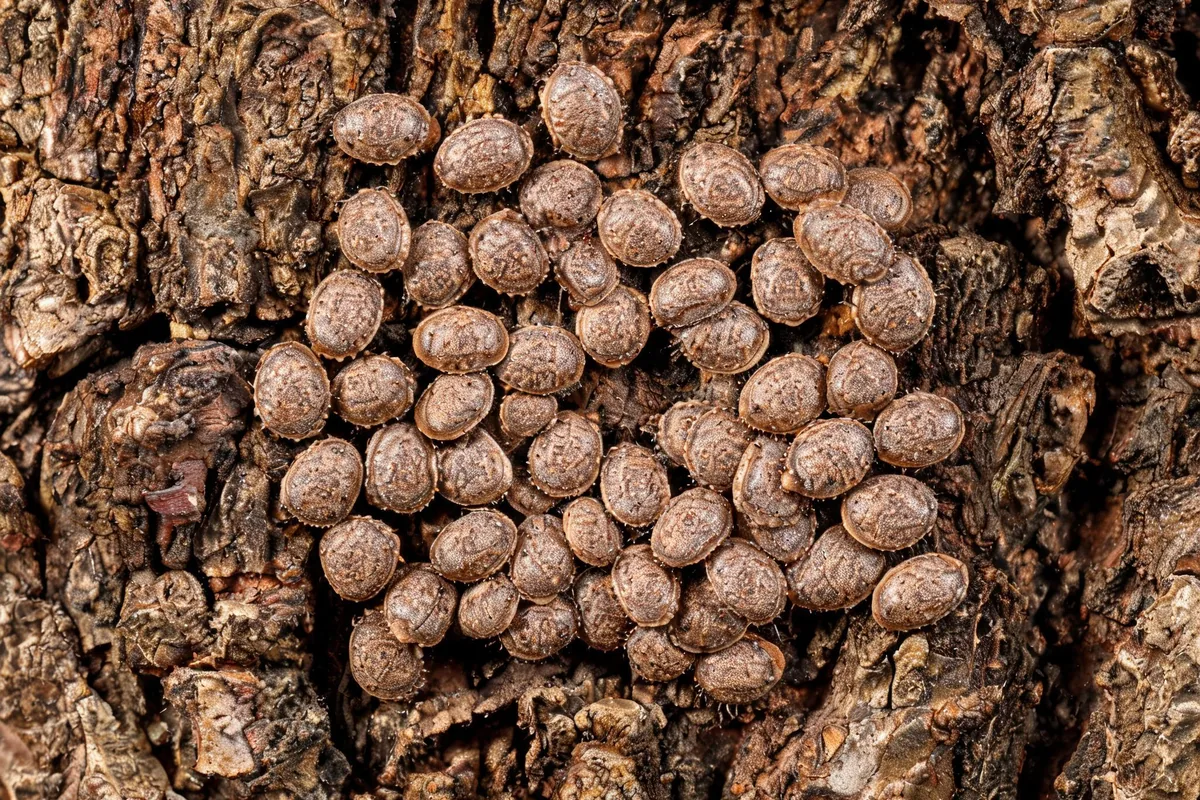
Scale insects are easy to misidentify because they don't look like insects at all. The protective covering that gives them their name disguises the insect underneath. Gardeners often assume they are looking at disease, a bark abnormality, or plant growths before they realize they are seeing an insect infestation that may have been building for years.
Per UC IPM, scale insects are among the most common and damaging plant pests in ornamental and fruit gardens. They feed by inserting piercing-sucking mouthparts into plant tissue and extracting plant sap. Heavy infestations cause yellowing, dieback, and can kill young or stressed plants over time.
Scale insect biology
Scale insects are classified into two major groups based on whether they have a detachable shell:
Armored scales produce a hard, waxy shell (the "scale") that is separate from the insect's body. Per UC IPM, this shell is made of wax secretions plus the cast skins from previous molts and is firmly attached to the plant surface. The shell protects the insect from many pesticides.
Soft scales produce a waxy covering that is fused to the body. They are larger than armored scales, do not have a detachable shell, and produce honeydew — a sticky sugary excretion that attracts ants and supports sooty mold growth.
Per Missouri Botanical Garden, most scale species overwinter as eggs under the protective covering of the mother. In spring, eggs hatch into "crawlers" — tiny mobile first-instar nymphs that are the only stage that moves and the primary stage susceptible to contact pesticides.
Common scale species by host
Per Cornell Cooperative Extension:
| Scale Species | Type | Primary Hosts |
|---|---|---|
| Oystershell scale (Lepidosaphes ulmi) | Armored | Apple, pear, lilac, ash, dogwood, willow |
| San Jose scale (Comstock aspidiotus perniciosus) | Armored | Apple, pear, cherry, plum, ornamental trees |
| Euonymus scale (Unaspis euonymi) | Armored | Euonymus, bittersweet, pachysandra |
| Pine needle scale (Chionaspis pinifoliae) | Armored | Pine, spruce, fir |
| Cottony maple scale (Pulvinaria innumerabilis) | Soft | Maple, linden, euonymus, oak |
| Brown soft scale (Coccus hesperidum) | Soft | Citrus, hollies, many ornamentals |
| Magnolia scale (Neolecanium cornuparvum) | Soft | Magnolia, tulip tree |
| Calico scale (Eulecanium cerasorum) | Soft | Elm, hackberry, oak |
Per Penn State Extension, oystershell scale and San Jose scale are among the most damaging scale species in Pennsylvania and the surrounding region, including Long Island. San Jose scale can cause serious damage to apple and pear orchards within 2—3 generations.
Identification
Armored scales
Per Missouri Botanical Garden, armored scale look like hard bumps, dots, or oyster-shell-shaped objects on bark or leaves. Individual scales are 1/16 to 1/8 inch. Oystershell scale specifically resembles small oyster shells packed tightly on bark surfaces.
Testing: scrape a scale body with your fingernail. An armored scale will leave the shell behind as a separate structure; a soft scale shell stays with the body.
Soft scales
Soft scales are more rounded and bumpy. The cottony maple scale has a distinctive white cottony egg mass that extends from the body in late spring/early summer, making it among the easiest scale species to identify.
Damage symptoms
- Yellow or pale leaves
- Branch or twig dieback
- Sooty mold (black coating) on leaves below infested branches — from soft scale honeydew
- Ants trailing up the trunk (tending soft scales for honeydew)
- Reduced vigor over several seasons
Per UC IPM, light scale infestations on large established trees cause minimal long-term damage. Heavy infestations on young trees, stressed plants, or plants like euonymus (which rarely recover from heavy scale) require active treatment.
Treatment timing
The crawler stage is the key to effective chemical control. Per Penn State Extension, monitoring crawler emergence is important for timing. Crawlers are tiny (often barely visible to the naked eye), pinkish or yellowish, and move across bark and onto foliage.
Detection method: Wrap a piece of double-sided tape around a branch in the area of the infestation in late spring. Check it every few days. When crawlers appear on the tape, the treatment window has opened.
Crawler emergence timing varies by species and location. For Long Island:
- Oystershell scale: late April to June (two generations)
- San Jose scale: late April to May (first generation); second generation July to August
- Euonymus scale: May to June
- Pine needle scale: May
Dormant oil: Per Missouri Botanical Garden, dormant oil applied in late winter to early spring (before bud break) suffocates overwintering scales and eggs. This is among the most effective and least toxic treatments available. Apply thoroughly to all bark surfaces. Dormant oil should not be applied when temperatures are below 40°F or above 90°F, or if rain is expected within 24 hours.
Summer oil: Horticultural oil applied at a lower concentration (2% rather than 4%) during the growing season kills crawlers and young scale. Per UC IPM, oil sprays are among the most effective treatments for scale during the growing season.
Insecticides: Per Penn State Extension, contact insecticides including insecticidal soap and pyrethrins are effective against crawlers but not adults protected by the scale covering. Systemic insecticides (imidacloprid) move through plant tissue and can reach feeding scales, but should not be applied to flowering plants due to bee toxicity.
A neem oil application at crawler emergence provides some control. Safer insecticidal soap is effective on soft scales.
Prevention
- Monitor early. Per Cornell Cooperative Extension, catching infestations early — when scale populations are small — makes management far easier. Inspect bark of susceptible plants annually in late winter.
- Prune heavily infested branches. For localized heavy infestations, pruning removes a large portion of the population and the bark substrate they are feeding on.
- Encourage natural enemies. Per UC IPM, parasitic wasps and predatory beetles provide significant scale control in unsprayed landscapes. Broad-spectrum insecticide applications kill these natural enemies.
- Maintain plant health. Stressed plants (drought, compaction, inappropriate pH) are more susceptible to scale damage.
Common problems table
| Symptom | Cause | Fix |
|---|---|---|
| Hard bumps on bark, branch dieback | Armored scale (oystershell, San Jose) | Dormant oil in late winter; monitor for crawlers in spring |
| Sticky leaves, sooty mold, ants on trunk | Soft scale honeydew | Treat soft scale; control ants separately; summer oil spray |
| White cottony masses on maple twigs in June | Cottony maple scale egg masses | Dormant oil the following late winter; insecticidal soap now |
| Scale on euonymus, severe browning | Euonymus scale | Prune heavily infested branches; dormant oil; consider replacing with less-susceptible species |
| Pine with white crusts on needles | Pine needle scale | Dormant oil in late winter; confirm crawler timing for summer treatment |
Frequently asked
Why didn't my insecticide spray work on scale?
The most common reason: adult armored scales are covered by a shell that most contact insecticides cannot penetrate. Per Penn State Extension, contact insecticides are effective only against crawlers. If you sprayed after the crawler window closed, you treated shells rather than living insects. Dormant oil in late winter is more reliable than summer sprays of contact insecticides against adult scale.
What is the sooty mold on my plants under the tree?
Per Missouri Botanical Garden, sooty mold is a black fungal growth that lives on the honeydew excreted by soft scales (and aphids). It does not directly infect the plant but can reduce photosynthesis if coverage is heavy. The mold disappears on its own when the scale infestation is controlled. Wash sooty mold off leaves with a gentle spray of water.
Can scale spread from one plant to another in my garden?
Yes — through the crawler stage. Per UC IPM, crawlers are dispersed by wind, birds, and on infested plant material. Purchasing infested nursery stock is the most common way scale is introduced to a garden. Inspect new plants thoroughly before installing them near existing susceptible shrubs.
Is dormant oil safe for all trees and shrubs?
Most, with some exceptions. Per Missouri Botanical Garden, blue spruce, Japanese maple, and some other ornamentals can be damaged by oil applications. Always check the product label for sensitivity warnings and test a small area before treating the entire plant. Do not apply to drought-stressed plants or in freezing temperatures.
Recommended gear: Best Neem Oil for Gardens: How It Works and When to Use It — our buyer's guide covering picks for every budget, ranked by Extension publication consensus and personal use.
Sources
- UC IPM — <a href="https://ipm.ucanr.edu/PMG/PESTNOTES/pn7408.html">Scale Insects</a>
- Penn State Extension — <a href="https://extension.psu.edu/scale-insects">Scale Insects</a>
- Missouri Botanical Garden — <a href="https://www.missouribotanicalgarden.org/gardens-gardening/your-garden/help-for-the-home-gardener/advice-tips-resources/insects-pests-and-problems/insects/scale">Scale Insects</a>
- Cornell Cooperative Extension — <a href="https://cals.cornell.edu/new-york-state-integrated-pest-management/outreach-education/whats-wrong-my-plant/trees-shrubs/scale-insects">Scale Insects on Trees and Shrubs</a>