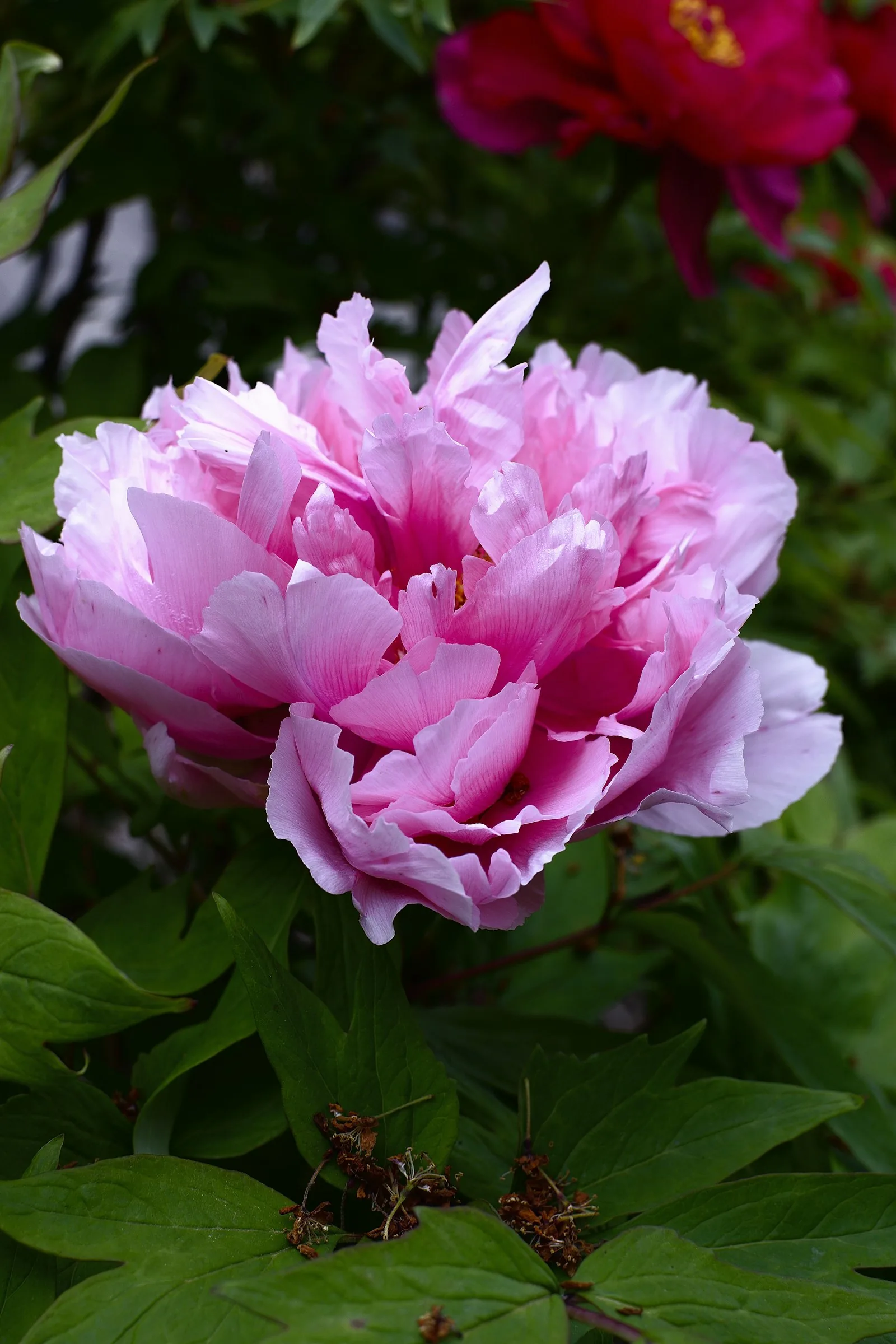
Peony Care: From Bareroot to Thirty-Year Bloom
The most common reason peonies fail to bloom is planting too deep. Get the eyes 1 inch below the surface, give them sun and drainage, and the plant will outlive you.
—- title: "Peony care" slug: peony-care hub: plants category: Species guide description: "A peony planted correctly will outlive you. There are documented herbaceous peonies in old Pennsylvania farmhouse yards that have been blooming continuously for over a hundred years. The first peony." date: 2026-06-10 updated: 2026-06-10 author: "Thomas A." reading_time: 12 scientific: "Paeonia lactiflora" zones_min: 3 zones_max: 8 sun: "full sun" deer_resistant: true native: false pollinator: true bloom: "spring" height_min: 2 height_max: 4 —-
A peony planted correctly will outlive you. There are documented herbaceous peonies in old Pennsylvania farmhouse yards that have been blooming continuously for over a hundred years. The first peony I planted at my parents' Long Island house in 2014 still throws fifteen blooms every Memorial Day weekend. The investment in getting the planting right is small. The return is generational.
Three kinds of peony — and they are not interchangeable
When people say "peony" they usually mean herbaceous peony — the kind that dies to the ground every winter and re-emerges from the crown in spring. There are actually three types in cultivation, with meaningfully different care.
Herbaceous peonies (Paeonia lactiflora and hybrids)
The classic peony. Per Penn State Extension, herbaceous varieties grow 2–4 feet tall, die back completely in winter, and bloom in late spring (May–early June in zones 5–7). The big-flowered cultivars — Sarah Bernhardt, Festiva Maxima, Karl Rosenfield — are all P. lactiflora selections.
USDA hardiness: Zones 3–8. Per Missouri Botanical Garden, "best performance typically occurs in USDA Zones 5–7, but plants often perform well in the northern parts of Zone 8." In zones 8 and warmer, the chilling requirement becomes harder to meet and many cultivars fail to bloom reliably.
Tree peonies (Paeonia suffruticosa and related species)
A woody shrub, not a herbaceous perennial. Per Penn State Extension, tree peonies "can grow 3 to 7 feet tall" and the woody stems persist year-round. Flowers are typically larger than herbaceous types (some over 9 inches across) and bloom slightly earlier in the season.
USDA hardiness: Zones 3–8 per NC State Extension Plant Toolbox.
Planting depth differs: Per Clemson Extension and Penn State Extension, "if the root is grafted, the graft union should be 4 to 6 inches below the soil surface." This is the opposite advice from herbaceous peonies — tree peonies must be planted deep, herbaceous peonies must be planted shallow.
Intersectional (Itoh) peonies
A cross between tree and herbaceous peonies, named for the Japanese breeder Toichi Itoh. Per Penn State Extension, intersectionals grow 2–2.5 feet tall, have the strong stems of tree peonies (so they don't flop), the cold-hardiness of herbaceous peonies, and very large flowers. They are expensive ($60–$150 per plant is common) and worth it if you want a structural peony that holds its blooms.
Planting depth: Per Penn State Extension, intersectional roots have a herbaceous crown — treat like herbaceous, with eyes 1–2 inches below the surface.
Site selection
Peonies are planted once. If you plant them in the wrong spot, you'll either live with a non-blooming plant or do the work of moving a mature crown — which is a real job, not a casual one. Get the site right.
Sun: Per NC State Extension Plant Toolbox, peonies "do well in full sun to light shade." Six hours of direct sun minimum. Plants in heavy shade survive but don't bloom — per Missouri Botanical Garden, "planted in too much shade" is one of the top causes of bloom failure.
Soil: Per Penn State Extension, peonies "prefer a pH of neutral to slightly alkaline. Peonies need good fertility and require excellent drainage; they do not tolerate wet feet." Clemson Extension specifies pH 6.5–7.0 as ideal. In clay soils, amend deeply with compost or pine bark fines before planting. If your soil is genuinely waterlogged, build a raised bed or choose a different plant — peonies will not survive consistently soggy soil.
Air circulation: Per NC State Extension Plant Toolbox: "Locate them in an area that gets good air circulation, not up against a home or a wall." This matters for botrytis blight prevention. Peonies planted tight against a south-facing wall in humid climates almost always develop botrytis.
Spacing from trees: Per NC State Extension, "Peonies are outcompeted by tree roots when planted close to trees." Give them at least 8–10 feet from the dripline of any mature tree.
Spacing between plants: 3–4 feet apart. Crowded peonies develop botrytis and have reduced bloom.
Planting — the part everyone gets wrong
Per Clemson Extension and Penn State Extension, the planting process for herbaceous peonies:
- Plant in fall. Per Penn State Extension, "Autumn is the best time to plant peonies, since it coincides with the beginning of the plant's dormancy." Mid-September through October in zones 5–7. Spring-planted peonies usually skip a year of bloom.
- Dig a hole 12–18 inches deep and 12 inches wide. Larger than you think. Mix the excavated soil with 2–3 inches of compost.
- Build a cone of amended soil at the bottom. Spread the roots over the cone.
- Set the crown so the eyes are no more than 1 inch below the soil surface. Per Clemson Extension: "Most failures to bloom are caused by deep planting." If you can't see the pink/red bumps (eyes) when the soil is filled in, you've planted too deep. Better to plant slightly too shallow than too deep.
- Firm the soil around the roots to eliminate air pockets.
- Water thoroughly. Settle the soil. Add more soil if it sinks below the eyes after watering.
- Mulch lightly with 1–2 inches of compost or shredded leaves — not heavy bark mulch over the crown.
Expect no blooms the first year, partial blooms the second, full display by year three. Per NC State Extension Plant Toolbox: "They can take quite a while to establish and often will not produce flowers for the first year or two after transplanting." This is normal. Don't dig the plant up because it didn't bloom in year one.
Watering and fertilizing
Water: Per Clemson Extension, "Water peonies thoroughly and deeply once every 10 to 14 days. Deep watering will encourage deep rooting. Once established, peonies are very drought resistant." The plant needs the most water during spring leaf-out and bud development. Once flowering finishes and stems harden off, mature peonies tolerate dry summer conditions well.
Fertilizer: Per Clemson Extension: "Apply a low-nitrogen complete fertilizer, such as 5-10-5 or 5-10-10, at a rate of two to three pounds per 100 square feet in the spring, when the stems are about two or three inches high. Well-rotted manure can improve soil if applied to the soil surface in a 1- to 2-inch layer. Never let fertilizer or manure come into contact with the plant's stems."
Do not over-fertilize with nitrogen. Per Missouri Botanical Garden's botrytis blight guidance, "excessive amounts of nitrogen… can cause tender growth that is very susceptible to the fungus."
Botrytis blight — the disease that kills bloom
Botrytis blight is the disease peony growers actually need to worry about. The symptoms per Missouri Botanical Garden: "Leafy shoots may wilt suddenly and fall over. Black or brown rot may be noticed at the base of the affected shoots. Flowers may begin to open, only to turn brown or develop a covering of gray mold."
It is especially common in cool, wet springs. Once established in a peony bed, it returns year after year unless you break the cycle.
Prevention per Missouri Botanical Garden:
- Cut down all old leaves and stalks to ground level in early fall. Destroy the debris — do not compost it. Botrytis overwinters on old peony stems and leaves.
- Apply 1–2 inches of fresh mulch after fall cleanup to bury any remaining spores.
- Plant in well-drained soil. Amend heavy clay with compost or organic matter.
- Space plants at least 3 feet apart for air circulation.
- Avoid overhead watering. Water at the base of the plant only.
- Avoid excessive nitrogen fertilizer.
- Buy clean stock. Only buy from reputable nurseries or take divisions from disease-free mature plants.
If botrytis is already in your bed, fungicide options per Missouri Botanical Garden include "copper, captan, chlorothalonil, mancozeb, sulfur, and thiophanate methyl" applied as a protectant before symptoms appear, starting when shoots first emerge in spring and continuing every 10–14 days through mid-June.
The ants question
Every peony bud is covered in ants in May. Every new peony grower asks if this is a problem.
Per NC State Extension Plant Toolbox: "Ants may be present on flower buds (attracted to nectar secreted on the outside of the bud), but they are totally harmless. Shake flowers to dislodge insects before bringing flowers inside."
The ants are eating sugar that the peony secretes from the buds — they do not "open" the flowers, do not damage anything, and do not require treatment. Old wives' tale: harmless commensal relationship.
Pruning, staking, fall cleanup
Pruning during the season: Per Missouri Botanical Garden, "Remove spent flowers after bloom" — deadhead by cutting the stem just above the first healthy leaf. This redirects energy from seed production back into the crown.
Staking: Per Penn State Extension, "Tall herbaceous peonies with large, full flowers and long stems require staking to remain upright. Herbaceous peonies with smaller, fewer flowers and short, sturdy stems (e.g., single, Japanese, anemone flower forms) require less support." A peony cage or grow-through grid set in place when the plant is 6 inches tall is far better than trying to stake floppy stems in bloom. Tree peonies don't need staking; intersectionals usually don't either.
Fall cleanup: Per Missouri Botanical Garden's botrytis guidance, cut herbaceous peony foliage "to the ground and remove from the garden in fall after frost." This is non-optional if you want to prevent disease. Tree peonies are different — do not cut tree peony stems to the ground; they are the framework of the plant. Only prune tree peonies to shape.
Dividing established peonies
Don't, unless you have to. Per Missouri Botanical Garden, peonies "do not need to be divided and can be left undisturbed for years." A peony will bloom better in year 30 than it did in year 3 if left alone.
If you must divide — usually because you're moving or the plant has spread beyond its space — do it in fall, after foliage has died back. Per Penn State Extension:
- Carefully dig up the plant, getting as much of the root system as possible.
- Wash off the soil to expose the eyes (the pink/red buds on top of the crown).
- Using a sharp knife, divide the crown into wedges with at least 3–5 eyes and 1–2 main roots per wedge.
- Replant immediately at the same shallow depth — eyes 1 inch below the surface.
Divisions with fewer than 3 eyes will take 3–5 years to bloom again. Bigger divisions reach full bloom faster.
Why your peony won't bloom
Per Missouri Botanical Garden, the diagnostic checklist when a peony fails to bloom:
- Planted too deep. The most common cause. Dig and reset the crown so eyes are 1 inch below the surface.
- Planted too shallow. Less common but possible. Eyes exposed to direct sun and air can desiccate.
- Planted in too much shade. Needs 6+ hours of direct sun.
- Late frost killed the buds. Common in zones 5–6 with early-blooming varieties when a hard frost hits in late April. The plant looks fine but flowers don't open. Per Missouri Botanical Garden, this is "bud blast" — buds reach pea-size, then dry up.
- Plant is too young or recently moved. Give it 2–3 years to establish.
- Crowded by tree roots. Move at least 10 feet from trees.
- Excess nitrogen. Lush leaves, no flowers. Switch to low-nitrogen fertilizer.
- Crown is overcrowded. Old peonies can have crowns so dense they stop blooming. Lift and divide.
Common problems
| Symptom | Most likely cause | Fix |
|---|---|---|
| Buds form but never open ("bud blast") | Late frost, dry conditions during bud development, or excessive shade | Site selection; deep watering during bud development |
| Buds covered in gray fuzz; brown rotting stems | Botrytis blight | Sanitation, fungicide, air circulation |
| Stems flop over with heavy blooms | Variety with weak stems; no staking | Stake at 6" growth; consider intersectional varieties |
| Lush foliage, few or no flowers | Too much nitrogen; planted too deep; too shaded | Stop nitrogen; lift and reset depth; relocate to sun |
| Powdery white coating on leaves | Powdery mildew (common late-season) | Sanitation; usually cosmetic, doesn't reduce next year's bloom |
| Ants on buds | Normal — feeding on extrafloral nectar | Ignore. Per NC State Extension, "totally harmless" |
| Yellow leaves mid-summer | Normal late-season decline, or root rot | Check drainage; otherwise normal |
| Plant fails to emerge in spring | Vole damage to crown; root rot from waterlogged winter soil | Check soil drainage; install vole protection |
Recommended gear: Best Raised Garden Bed Kits: Cedar vs. Metal vs. Fabric — our buyer's guide covering picks for every budget, ranked by Extension publication consensus and personal use.
Frequently asked
How deep should I plant a peony?
For herbaceous peonies and intersectional (Itoh) peonies, the eyes — the pink or red buds on top of the crown — should sit no more than 1 inch below the finished soil surface. Per Clemson Extension, "most failures to bloom are caused by deep planting." For tree peonies (woody shrub type), the opposite advice applies: per Penn State Extension, if the plant is grafted, the graft union should be 4–6 inches below the soil surface. When in doubt with a herbaceous peony, plant slightly too shallow rather than slightly too deep.
When do peonies bloom?
In zones 5–7, herbaceous peonies bloom in late May through early June. Per Missouri Botanical Garden, Paeonia lactiflora is "a late blooming species (May-early June)" and individual plants flower for about 7–10 days. Tree peonies typically bloom 1–2 weeks earlier than herbaceous types. Intersectionals bloom around the same time as herbaceous. You can extend the total peony season in a garden to about 6 weeks by planting a combination of early, midseason, and late cultivars.
Are peonies deer-resistant?
Per Penn State Extension's deer-resistant plant lists, peonies are rated as moderately deer resistant. Per NC State Extension Plant Toolbox, tree peonies specifically are "shunned by deer." In high deer-pressure areas (much of Long Island, central New Jersey, the Hudson Valley), herbaceous peonies are occasionally browsed in early spring when new shoots are tender, but mature plants are usually left alone. Tree peonies are more reliably ignored. Hydrangeas, hostas, and tulips in the same yard will be eaten long before deer turn to peonies.
Why are there ants on my peony buds?
Ants feed on sugary nectar that peonies secrete from the outside of developing flower buds. Per NC State Extension Plant Toolbox, "ants may be present on flower buds (attracted to nectar secreted on the outside of the bud), but they are totally harmless. Shake flowers to dislodge insects before bringing flowers inside." Ants do not open peony flowers — the old myth that peonies need ants to bloom is false. The relationship is opportunistic on the ants' side and irrelevant to the plant.
Sources
- Penn State Extension — The Beloved Peony.
- Clemson Cooperative Extension — How to Grow Peonies in South Carolina.
- NC State Extension Plant Toolbox — Paeonia — Herbaceous Types.
- NC State Extension Plant Toolbox — Paeonia — Woody Types.
- Missouri Botanical Garden — Paeonia lactiflora Plant Finder.
- Missouri Botanical Garden — Botrytis Blight of Peony.
- Missouri Botanical Garden — Why did my peonies fail to bloom? FAQ.