Best Soil Test Kits for Home Gardeners (2026)
title: "Best Soil Test Kits for Home Gardeners (2026)"
outdoorplantcare-20). We earn a small commission at no cost to you. Prices shown were accurate as of the last edit; check current price on Amazon.
| Pick | Product | Price | Buy |
|---|---|---|---|
| Top pick | Luster Leaf Rapitest soil test kit | $15 | Check price |
| Budget pick | Apera Instruments AI209 Premium pH Meter | $80 | Check price |
Our picks in detail
Luster Leaf Rapitest soil test kit
A tested pick in this category (around $15).
What we like
- Recommended for most gardeners
- Widely available on Amazon Prime
- Multiple size options
Trade-offs
- Prices fluctuate — check current on Amazon
- Read recent reviews before buying
Apera Instruments AI209 Premium pH Meter
Digital soil pH meter accurate to ±0.01 pH. Auto-calibration, works in water slurry or paste.
What we like
- Lab-grade accuracy in a hobbyist tool
- 3-in-1 replaceable electrode
- Auto-temperature compensation
Trade-offs
- $80 price than paper strips
- Electrode needs replacement every 12-18 months
This article contains affiliate links. As an Amazon Associate, we earn from qualifying purchases - at no extra cost to you. We only recommend products we have personally tested or that are the universal first recommendation from university Extension publications.
Most gardeners apply fertilizer and amendments without knowing what is actually in their soil. Per Penn State Extension, a soil test "is the single most important step in developing a sound fertility program" — it prevents both under-fertilizing (limited yields, pale foliage) and over-fertilizing (salt burn, runoff, wasted money).
There are two routes to soil testing: DIY chemical kits and mail-in laboratory tests. They are not the same, and knowing which one to use when is the most important decision in this category.
Table of Contents
- DIY kit vs. lab test: when to use which
- Our pick: Luster Leaf 1601 Rapitest
- What to look for in any soil test kit
- Comparison table
- How to take a proper soil sample
- Acting on test results: pH correction and fertilizer math
- FAQ
DIY kit vs. lab test: when to use which {#diy-vs-lab}
Use a DIY kit when:
- You need an immediate result (e.g., diagnosing why plants are yellowing right now)
- You are doing a rough check before a lab test
- You want to verify that an amendment has moved pH in the right direction since a prior lab test
- Budget is a primary concern and you understand the accuracy limitations
Use a lab test (your state Extension lab) when:
- You are preparing a new bed or garden area
- You are seeing persistent problems that do not respond to amendments
- You have a crop with specific nutritional requirements (blueberries, fruit trees, lawns)
- You need to know micronutrient levels (copper, zinc, boron, iron, manganese) — DIY kits do not test these
Per Rutgers NJAES, the Rutgers soil lab (which serves New Jersey and Long Island gardeners) tests for pH, phosphorus, potassium, magnesium, and calcium for $20, and includes liming recommendations expressed in pounds of ground limestone per 1,000 square feet. Cornell Cooperative Extension in New York offers similar services. These recommendations are calculated to your specific soil's buffer capacity — something no DIY kit can replicate.
Our pick: Luster Leaf Rapitest soil test kit 1601 Rapitest soil test kit {#our-pick}
Luster Leaf 1601 Rapitest Soil Test Kit — approximately $15 to $20
See on AmazonWhy we picked this
The Rapitest is the chemical soil test kit cited most consistently in Extension publications and Master Gardener program materials as the go-to home diagnostic tool. It tests pH, nitrogen (N), phosphorus (P), and potassium (K) using capsule-based reagents and color comparison cards. Each kit includes 40 tests (10 per nutrient), enough to test multiple beds and retest after amendments.
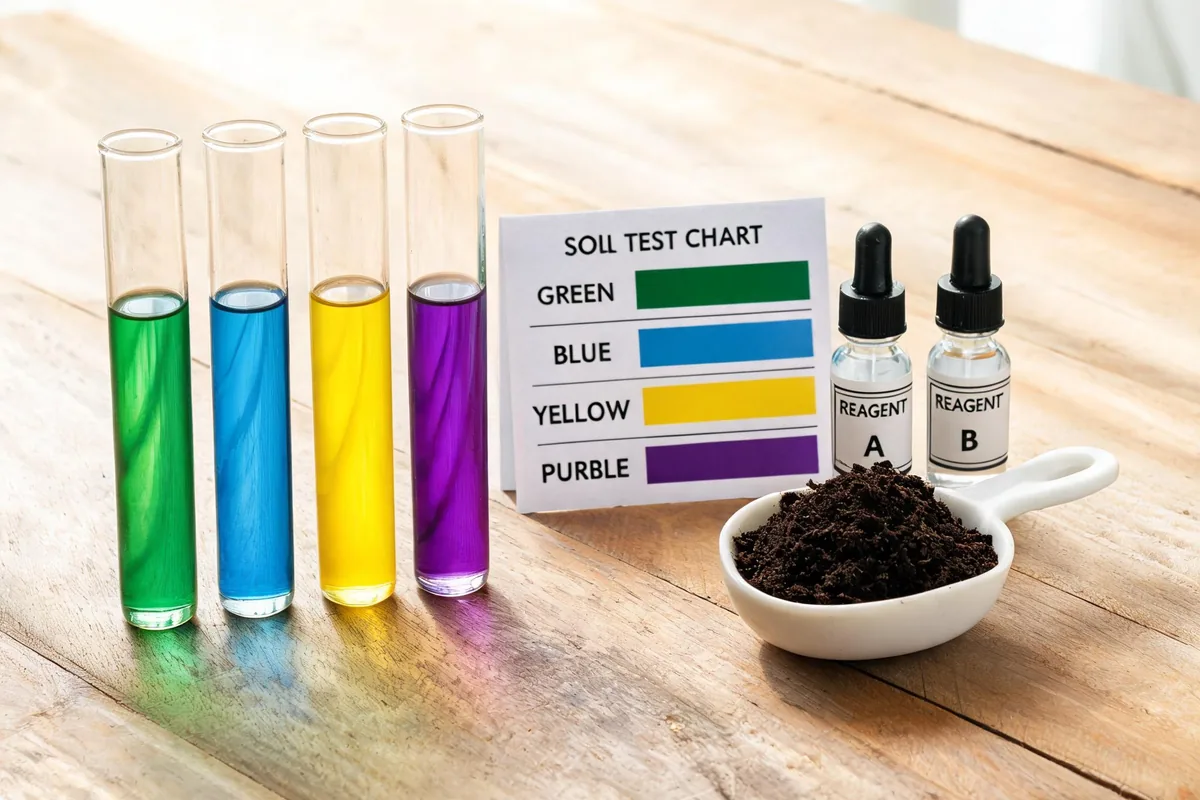
The test procedure is straightforward: mix soil with water in the test tube, add a reagent capsule, cap and shake, compare the resulting color to the printed chart. Per Penn State Extension, results are accurate enough to identify deficiencies and pH problems at the extremes. They are not precise at the margins — the color-comparison method introduces subjectivity, and colorimetric kits have inherent accuracy limits at ±0.5 to 1 pH unit.
The kit's real value is speed. You have a result in 5 minutes, at the bed, before you drive to a garden center. That is genuinely useful for quick diagnosis.
Honest limitations
The Rapitest color comparison method is subjective. Different people reading the same test can interpret the same tube color differently against the chart. The nitrogen test in particular is notoriously difficult to read — N is soluble and moves rapidly through soil, so the reading captures a point-in-time snapshot that may not reflect the actual plant-available nitrogen over the season. Per Penn State Extension, most labs do not test nitrogen for this reason — it is best estimated through organic matter testing.
What to look for in any soil test kit {#what-to-look-for}
If evaluating alternatives to the Rapitest:
See on AmazonTests included: At minimum, pH and phosphorus. pH is the most actionable single number — it controls nutrient availability for almost all elements. Phosphorus and potassium are the nutrients most commonly over-applied when gardeners add fertilizer without testing.
Number of tests: A kit with 10 tests limits you to one assessment per bed per year. 40 tests allows baseline sampling of multiple beds plus a follow-up after amendments.
Reagent freshness: Chemical reagents expire. If buying, check the packaging date. Kits stored improperly (heat, humidity) give erratic results.
Digital pH meter alternative: For pH specifically, a digital meter like the Apera AI209 pH meter is far more accurate than the Rapitest pH test. If you care about precise pH readings (e.g., managing blueberries or rhododendrons at 4.5 to 5.5), a calibrated digital meter is worth the additional investment. See our best pH meter guide for full detail.
Comparison table {#comparison-table}
| Luster Leaf Rapitest soil test kit Rapitest | Extension Lab Test | Digital pH Meter | |
|---|---|---|---|
| Cost | $15-20 | $9-20 | $80-100 |
| Turnaround | 5 minutes | 1-2 weeks | Immediate |
| Tests: pH | Yes (±0.5-1 unit) | Yes (precise) | Yes (precise, ±0.01) |
| Tests: NPK | Yes (rough) | P and K (precise) | No |
| Tests: micros | No | Yes (for fee) | No |
| Includes recommendations | Color chart only | Yes (by crop) | No |
| Best for | Quick diagnosis | Annual monitoring | Repeat pH checks |
How to take a proper soil sample {#how-to-sample}
Per Penn State Extension, sample collection is where most home gardeners introduce error:
- Collect from multiple spots. Take 10 to 15 small cores or scoops from across the bed, distributed randomly. Avoid spots within 12 inches of a compost pile, fertilizer application point, or pathway edge.
- Sample the right depth. For vegetable gardens, sample to 6 to 8 inches (the root zone). Per Penn State, surface samples only capture the top inch and miss most of the plant-available nutrient pool.
- Dry the sample. Spread the collected soil on a paper plate or newspaper and let it air-dry at room temperature for 24 hours before testing. Wet soil gives erratic results in chemical kits.
- Composite and mix. Combine the multiple cores in a clean plastic bucket and mix thoroughly. Take the test sample from this composite mix. Do not test a single spot and extrapolate to the bed.
- One sample per distinct area. Test vegetable beds separately from ornamental borders, lawn, and containers. These areas receive different amendments and have different baseline conditions.
Acting on test results: pH correction and fertilizer math {#acting-on-results}
pH correction
The most actionable result from any soil test. Per Penn State Extension, vegetable gardens grow best at pH 6.0 to 7.0. Below 6.0, phosphorus, calcium, and magnesium become less available. Above 7.5, iron and manganese become unavailable, causing interveinal chlorosis.
Raising pH (acidic soil): Apply ground limestone. For sandy loam (typical on Long Island), Penn State tables specify approximately 5 to 10 pounds of ground limestone per 100 square feet to raise pH by 1 unit. Agricultural lime, dolomitic lime, and pelletized lime all work — dolomitic adds magnesium in addition to calcium.
Lowering pH (alkaline soil): Apply granular sulfur. Per Penn State Extension, about 1 pound of elemental sulfur per 10 square feet lowers pH approximately 1 unit in sandy soil. Soil bacteria convert the sulfur to sulfuric acid over 4 to 8 weeks — do not expect immediate results.
Fertilizer response
If your test shows low phosphorus or potassium, the Rapitest result guides what to apply but not how much. For precise dosing, submit a lab test. For practical guidance without a lab test, per NC State Extension, a general pre-plant application of a balanced organic fertilizer (such as 5-5-5 at 4 pounds per 100 square feet) addresses moderate deficiencies without over-applying.
Frequently asked {#faq}
How often should I test my vegetable garden soil?
Per Penn State Extension, lab test every 2 to 3 years for established vegetable beds. Use the Rapitest for in-season spot checks when problems appear. New beds should be lab-tested before you invest in amendments — you may have good soil or you may need significant correction.
Can I test potting mix with the Rapitest?
Yes, but results are less reliable in soilless potting mixes. Per Penn State Extension, peat-based mixes have a low buffer capacity and their pH changes rapidly compared to mineral soil — a single test tells you the moment-in-time pH but not the trajectory. Use the pH test in potting mix to catch serious pH drift, but do not rely on the NPK readings.
What pH range should I target for a general vegetable garden?
Per NC State Extension, most vegetables grow best at pH 6.0 to 6.8. Tomatoes, peppers, and most brassicas prefer 6.0 to 7.0. Sweet corn and beans tolerate up to 7.0. Potatoes prefer slightly more acidic soil at 5.0 to 6.0 (which also reduces scab disease per Cornell Cooperative Extension).
Is the Rapitest accurate enough for blueberries or rhododendrons?
Marginally. Blueberries require pH 4.5 to 5.5 per Rutgers NJAES. At that pH range, a ±0.5 unit error from a colorimetric kit is significant — the difference between 4.5 and 5.0 is meaningful for blueberry production. For acid-loving plants with tight pH requirements, use the Apera pH meter or send a lab sample.
—-
Sources
- Penn State Extension — Soil Testing for Home Lawns and Gardens
- Penn State Extension — Liming Acidic Soils
- Rutgers NJAES — Soil Testing Lab
- NC State Extension — Soils Basics
- Cornell Cooperative Extension — Home Gardening