Best LED Grow Lights for Seedlings (2026)
title: "Best LED Grow Lights for Seedlings: Shop Light vs. Purpose-Built (2026)"
outdoorplantcare-20). We earn a small commission at no cost to you. Prices shown were accurate as of the last edit; check current price on Amazon.
| Pick | Product | Price | Buy |
|---|---|---|---|
| Top pick | Barrina T5 LED Grow Light (6-pack, 2ft) | $50 | Check price |
| Budget pick | seedling heat mat | $15 | Check price |
| Upgrade pick | Orbit B-hyve Smart Hose Faucet Timer | $10 | Check price |
Our picks in detail
Barrina T5 LED Grow Light (6-pack, 2ft)
Full-spectrum LED strips. Bright enough for seed starting or a small indoor herb bench.
What we like
- Full spectrum (T5) — 6500K blue-heavy
- 6-pack covers a 4x4 bench for under a dollar per hour
- Chain lights end-to-end
Trade-offs
- No dimmer or timer built in
- Not enough intensity for flowering fruit indoors
seedling heat mat
Warms seed trays to 68-77°F for faster, more even germination. Non-negotiable for peppers.
What we like
- Cuts pepper/eggplant germ time in half
- Waterproof and safe
- Pairs with a thermostat controller
Trade-offs
- No thermostat included on the base version
- Can overheat if left on 24/7 without a controller
Orbit B-hyve Smart Hose Faucet Timer
Program watering schedules from your phone. Deep-water while you sleep, cut water use by 30-50%.
What we like
- Bluetooth + Wi-Fi hub (sold separately)
- Rain skip via weather API
- Runs on AA batteries for a season
Trade-offs
- Wi-Fi needs the extra hub
- Screen is small and hard to read in direct sun
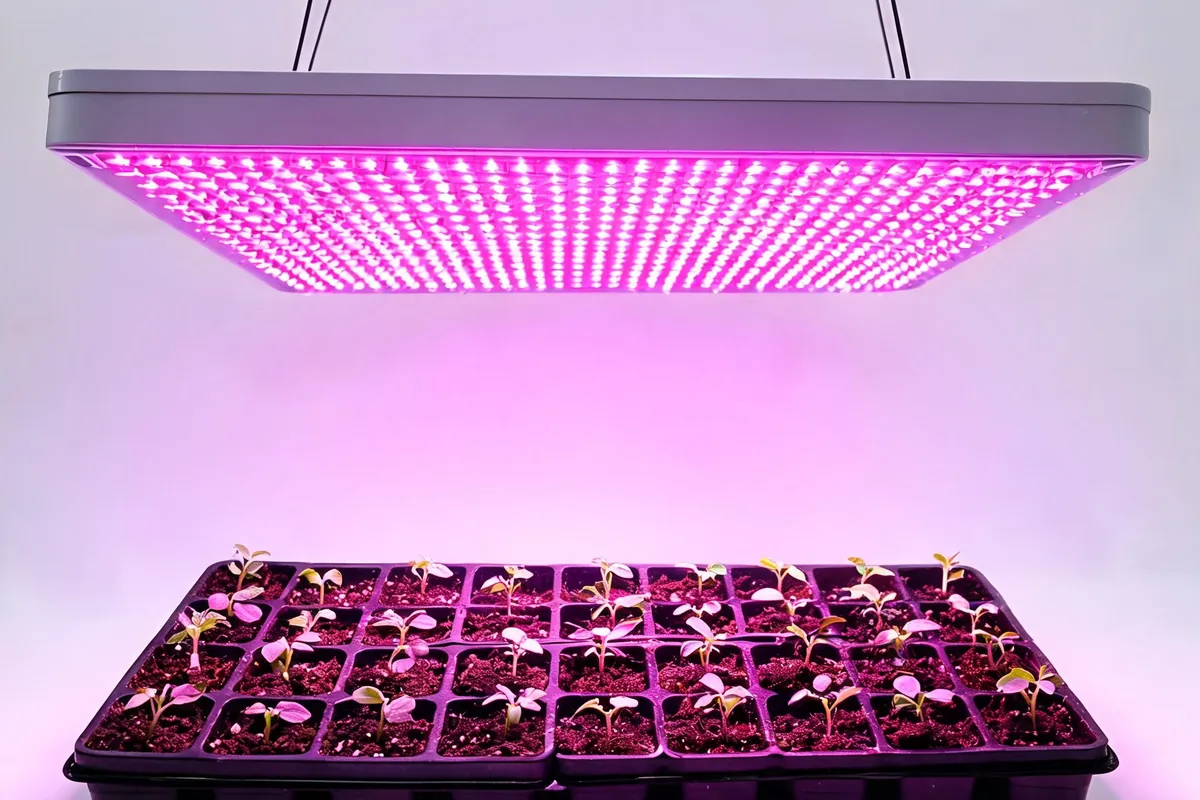
This article contains affiliate links. As an Amazon Associate, we earn from qualifying purchases - at no extra cost to you. We only recommend products we have personally tested or that are the universal first recommendation from university Extension publications.
The grow light market is full of products marketing expensive spectrum features to seedling growers who do not need them. Per Penn State Extension, vegetable seedlings in the vegetative growth phase (the entire period from germination to transplant) grow well under standard full-spectrum white LED lights. The critical variable is light intensity at the leaf surface, not red/blue ratios or "quantum spectrum" claims.
This guide covers two picks: the Barrina T5 LED grow lights (the shop-light-style option) and what to look for if stepping up to a purpose-built LED panel for more serious indoor growing.
Table of Contents
- What light specifications actually matter for seedlings
- Our pick: Barrina T5 LED Grow Lights (6-pack, 2ft)
- When to consider a purpose-built LED panel
- What to look for in any grow light
- Comparison table
- Setting up a grow light correctly
- FAQ
What light specifications actually matter for seedlings {#light-specs}
The grow light industry generates significant confusion with competing metrics. Understanding which ones matter:
Lux: A measure of light intensity as perceived by human eyes. Not the best metric for plants because it weights the visible spectrum the way humans see it, not the way plants use it. Useful for rough comparisons.
PAR (Photosynthetically Active Radiation): Measures light in the 400 to 700 nanometer range that plants use for photosynthesis. Measured in micromoles of photons per square meter per second (µmol/m²/s). More plant-relevant than lux.
PPFD (Photosynthetic Photon Flux Density): PAR measured at a specific point. This is the "intensity at the leaf surface" number. More useful for grow light comparison than the wattage number on the package.
DLI (Daily Light Integral): The total moles of PAR-range photons received per square meter per day. Calculated as PPFD x photoperiod (hours) x conversion factor. Per University of Massachusetts Extension, vegetable seedlings need a minimum DLI of 10 to 15 mol/m²/day for compact growth. Tomatoes and peppers benefit from DLI of 15 to 20.
The practical takeaway: For seedlings, you need approximately 2,000 to 4,000 lux (or roughly 30 to 60 µmol/m²/s PPFD) at the leaf surface for 14 to 16 hours per day. A T5 fluorescent or LED equivalent at 2 to 4 inches above seedlings delivers this. A windowsill in winter at 50°N latitude typically delivers 1,000 to 2,000 lux on a good day, and half that on overcast days.
Spectrum for seedlings: Per Penn State Extension, seedlings do not require specialized red/blue ratios. They grow well under broad-spectrum "daylight" white LEDs (5000 to 6500K color temperature). The photomorphogenesis effects of specific spectra (far-red for flowering, blue for compact growth) are real but secondary to adequate intensity for seedling production.
Our pick: Barrina T5 LED Grow Lights (6-pack, 2ft) {#barrina-pick}
Barrina T5 LED Grow Light (6-pack, 2ft) — approximately $50 to $70
See on AmazonWhy we picked this
The Barrina T5 6-pack provides full-spectrum LED coverage in the standard T5 tubular form factor, with daisy-chain connectors that allow linking up to 6 lights from a single outlet connection. The 6-pack covers a 4-foot by 1.5-foot area when arranged as two parallel rows — adequate for a standard 1020 seed-starting tray and then some.
At 2 to 4 inches above seedlings, the Barrina T5 delivers approximately 2,000 to 3,500 lux — within the range cited by Penn State Extension as adequate for compact seedling growth. The 6500K color temperature outputs a cool daylight spectrum that seedlings use effectively in the vegetative stage.
The price point is the primary argument. At $50 to $70 for six lights, the per-coverage cost is lower than any purpose-built grow light with comparable coverage area. For seedling production where specialized spectrum is not required, this cost efficiency is the right choice.
Honest limitations
Not adequate for fruiting plants. Tomatoes, peppers, and cucumbers grown to fruiting indoors under these lights will produce some yield but will be significantly light-limited. Fruiting plants require DLI of 25 to 35 mol/m²/day per UMass Extension — achievable only with purpose-built high-output LEDs or HPS systems.
Fixture quality reflects price. At this price point, some fixture tolerance variation is expected. Inspect connections on receipt, verify all lights operate before installing.
Coverage footprint per light is limited. Each 2-foot light covers roughly a 2x1-foot area at 3 inches above the canopy. The 6-pack covers approximately 4x1.5 feet — adequate for a standard seed starting flat but not a full shelf of multiple trays.
When to consider a purpose-built LED panel {#purpose-built}
A purpose-built LED panel (marketed for cannabis, indoor vegetables, or high-intensity horticulture) is worth considering when:
- Growing fruiting plants (tomatoes, peppers, cucumbers) indoors all season
- Growing high-light-demand ornamentals indoors year-round
- Operating a larger-scale indoor growing setup requiring consistent PPFD measurement across a wider canopy
Per UMass Extension, fruiting vegetables require PPFD of 400 to 600 µmol/m²/s for 12 hours per day to achieve DLI targets for fruit production. The Barrina T5 delivers approximately 50 to 80 µmol/m²/s at 3 inches — about 1/6th of what fruiting tomatoes need.
When evaluating purpose-built LED panels:
Check PPFD, not wattage. A "300W" LED panel with low-quality diodes may deliver less PPFD than a 100W panel with high-efficiency diodes. Look for published PPFD maps (light output at specific distances) rather than wattage claims.
Look for third-party test data. Reputable LED manufacturers publish independently measured spectral data and PPFD maps. Be cautious of panels that only show wattage and claim "equivalent to HPS."
Coverage area. A panel rated for a "4x4 coverage area" may achieve that only at minimum PPFD for seedlings, not at the PPFD needed for fruiting. Check coverage area at the actual PPFD you need.
What to look for in any grow light {#what-to-look-for}
For seedlings only:
- Full-spectrum white LED, 5000-6500K
- Sufficient intensity at 2-4 inches above seedlings (2,000+ lux / 30+ µmol/m²/s)
- 14-16 hour photoperiod via timer
- Daisy-chain connectivity for multiple trays
- Price: under $70 for sufficient coverage
For fruiting/high-light plants:
- Minimum PPFD of 400 µmol/m²/s at canopy height
- Published third-party PPFD maps
- Driver quality (MeanWell or similar)
- Efficacy (µmol/J) of 2.0 or higher
- Price: $100-250 for a 2x4 coverage area
Comparison table {#comparison-table}
| Barrina T5 6-pack | Purpose-Built LED Panel | HPS (reference) | |
|---|---|---|---|
| Price | $50-70 | $100-250 | $150-300+ (with hood) |
| PPFD at canopy | 50-80 µmol/m²/s | 400-600 µmol/m²/s | 400-800 µmol/m²/s |
| Spectrum | Full-spectrum white | Broad + red/blue | Broad (less blue) |
| Heat output | Very low | Low-moderate | High |
| Best for | Seedlings | Fruiting plants | Large fruiting setups |
| Coverage | 4x1.5 ft (6 lights) | 2x4 to 4x4 ft | 3x3 to 5x5 ft |
| DLI for seedlings | Adequate | More than needed | More than needed |
| Running cost/month | ~$3-5 | ~$8-15 | ~$20-40 |
Setting up a grow light correctly {#setup}
Per Penn State Extension:
Light height: Start T5 or similar lights at 2 to 4 inches above the top of the seedlings. As seedlings grow, raise the light to maintain 2 to 4 inches of clearance. Too far away (over 6 inches) produces etiolated, stretched seedlings; too close with high-output lights can bleach leaf tips.
Photoperiod: 14 to 16 hours per day for most vegetable seedlings. Use a mechanical or smart outlet timer. Consistent timing matters — variable photoperiods stress seedlings.
Reflectivity: Line the inside of your seed starting area with white plastic or aluminum foil to reflect light back to the canopy. Per UMass Extension, highly reflective walls can increase effective light delivery by 20 to 30 percent without changing the fixture.
Air circulation: Place a small fan running on low near the seedlings. Per Penn State Extension, gentle air movement strengthens seedling stems (thigmomorphogenesis — stems develop more supportive tissue in response to mechanical stimulation) and reduces damping off by keeping foliage dry.
Temperature under lights: LED lights at this output generate minimal heat. If using a seedling heat mat below and a light above, monitor soil temperature to ensure the mat is still needed — the room may warm enough under lights that the mat is counterproductive once seedlings are up.
See on AmazonFrequently asked {#faq}
Can I just use a regular shop light (non-grow-light) for seedlings?
Per Penn State Extension, yes — regular cool-white or daylight LED shop lights at 5000 to 6500K are adequate for seedlings. The grow light designation adds marketing but not meaningfully better performance for vegetable seedlings. The Barrina T5 is essentially a shop light in a convenient daisy-chain form factor for seed starting.
How far should grow lights be from seedlings?
Per Penn State Extension, T5 fluorescent and similar LED lights should be 2 to 4 inches above seedling tops. High-output LED panels (purpose-built for flowering/fruiting) should be 18 to 24 inches above seedlings because they are more intense. Too close with high-output lights causes bleaching; too far causes stretching.
Do seedlings need dark periods, or can I run lights 24 hours?
Per UMass Extension, most vegetable seedlings are day-neutral for the vegetative stage and tolerate continuous light without the disorder seen in some crops (tomatoes can develop interveinal chlorosis under continuous light). However, running lights 24 hours does not proportionally improve growth — plants use dark periods for metabolic processes. The recommended 14 to 16 hours is based on the optimum DLI target, not an arbitrary number.
What timer should I use with grow lights?
A simple mechanical outlet timer ($10 to $15) is adequate. Set it to come on at 6 AM and off at 8 PM for a 14-hour photoperiod. Smart plug timers ($20 to $30, app-controlled) allow adjustment without manual resetting. The Orbit B-hyve smart timer is designed for hose faucets, not outlets — use a standard outlet timer for grow lights.
See on Amazon—-
Sources
- Penn State Extension — Starting Seeds Indoors
- University of Massachusetts Extension — Greenhouse Lighting
- Cornell Cooperative Extension — Home Gardening