Best Soaker Hose for Vegetable Gardens (2026)
title: "Best Soaker Hose for Vegetable Gardens (2026)"
outdoorplantcare-20). We earn a small commission at no cost to you. Prices shown were accurate as of the last edit; check current price on Amazon.
| Pick | Product | Price | Buy |
|---|---|---|---|
| Top pick | soaker hose | $10 | Check price |
| Budget pick | Orbit B-hyve Smart Hose Faucet Timer | $10 | Check price |
Our picks in detail
soaker hose
A tested pick in this category (around $10).
What we like
- Recommended for most gardeners
- Widely available on Amazon Prime
- Multiple size options
Trade-offs
- Prices fluctuate — check current on Amazon
- Read recent reviews before buying
Orbit B-hyve Smart Hose Faucet Timer
Program watering schedules from your phone. Deep-water while you sleep, cut water use by 30-50%.
What we like
- Bluetooth + Wi-Fi hub (sold separately)
- Rain skip via weather API
- Runs on AA batteries for a season
Trade-offs
- Wi-Fi needs the extra hub
- Screen is small and hard to read in direct sun
This article contains affiliate links. As an Amazon Associate, we earn from qualifying purchases - at no extra cost to you. We only recommend products we have personally tested or that are the universal first recommendation from university Extension publications.
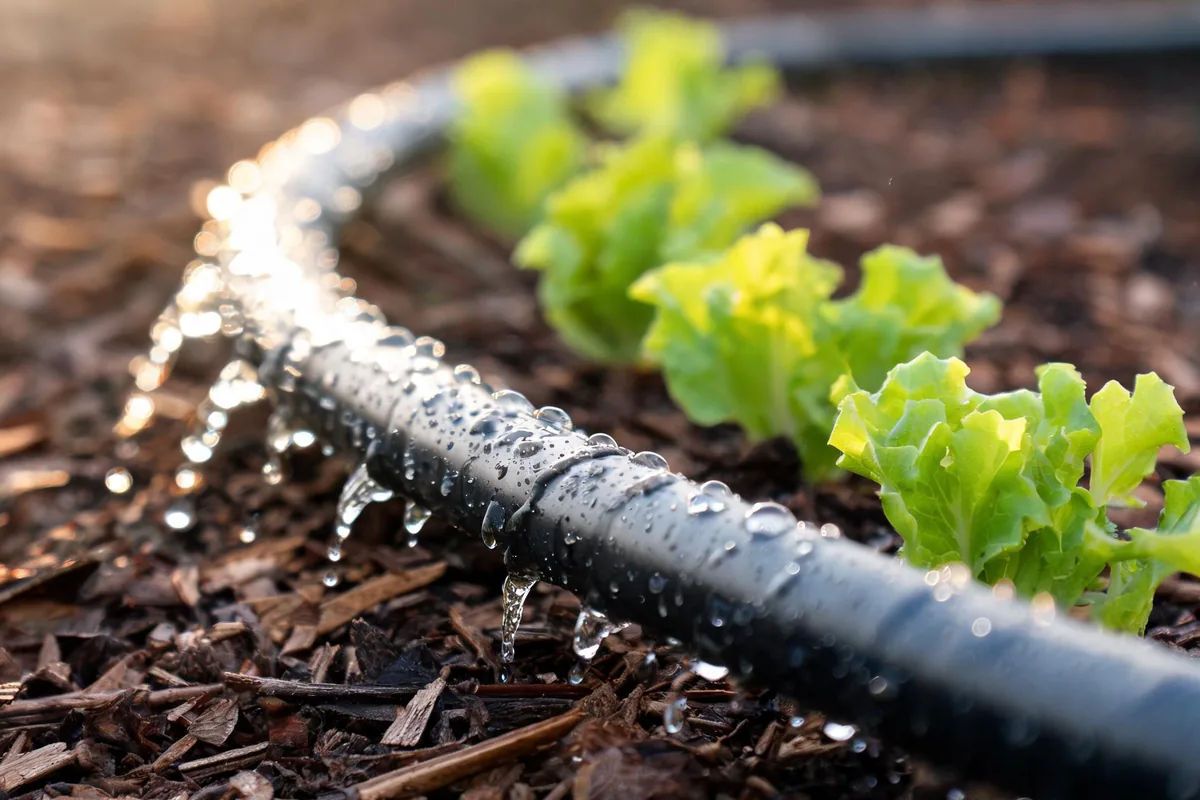
Soaker hoses are the practical alternative to drip emitter systems for vegetable row crops. Where drip systems with individual emitters make sense for container gardens and mixed raised beds with different-sized plants, soaker hoses are faster to set up, simpler, and cheaper per linear foot for long straight rows of beans, lettuce, carrots, or any crop planted in continuous bands.
Per NC State Extension, soaker hoses and drip tape share the core advantage of all subsurface-adjacent irrigation: water reaches the root zone without wetting foliage, which reduces fungal disease pressure. Early blight (Alternaria solani) on tomatoes and angular leaf spot on cucumbers both spread faster when foliage stays wet. A soaker hose buried or mulched into the row keeps foliage dry.
Table of Contents
- Soaker hose vs. drip emitters: which to use
- Our pick: Rocky Mountain Goods Flat Soaker Hose
- What to look for in any soaker hose
- Comparison table
- Installation and runtime
- FAQ
soaker hose vs. drip emitters: which to use {#soaker-vs-drip}
Both deliver water at low flow rates to the root zone. The differences come down to application:
See on AmazonSoaker hoses are better for:
- Row crops planted at even spacing (beans, peas, onions, carrots, lettuce, brassicas)
- Single-crop raised beds
- Situations where you want a simple, low-part-count solution
- Budget-conscious setups — a 50-foot soaker hose costs $20 to $30 versus $40 to $60 for a comparable drip kit
Drip emitter systems are better for:
- Mixed beds where plants are different sizes and have different water needs
- Containers where a single emitter per pot makes more sense than a hose
- Situations where you need precise placement and adjustable flow rates per plant
Per Clemson HGIC, soaker hoses wet a band roughly 12 to 18 inches wide on each side of the hose, depending on soil type. In sandy soils (like the loam common in Nassau County, Long Island), the wet band is narrower — roughly 10 to 12 inches per side. In clay or loam, it widens to 18 to 24 inches. This is why spacing the hose no more than 18 inches from plant stems is the standard guidance.
Our pick: Rocky Mountain Goods Flat soaker hose (50 ft) {#our-pick}
Rocky Mountain Goods Flat Soaker Hose (50 ft) — approximately $20 to $30
See on AmazonWhy we picked this
The Rocky Mountain Goods flat soaker hose is UV-resistant recycled rubber, which matters for outdoor longevity in sun-exposed gardens. At 10 PSI (well within the range of most residential spigots when paired with a pressure regulator), it delivers approximately 1 gallon per foot per hour — a predictable output that makes calculating run time straightforward.
Flat soaker hoses are easier to coil, store, and maneuver around stakes than round rubber hoses. They lie flat against the soil surface, which makes them simple to cover with mulch — a step that extends hose life by reducing UV degradation and improving water delivery efficiency by reducing surface evaporation.
The 50-foot length covers a standard 4-by-8-foot raised bed plus an 8-by-4-foot extension, or can be looped to water a wide single bed. Couplings allow connecting two hoses in series, though per Clemson HGIC, maximum run length for soaker hoses is typically 100 feet before pressure drop at the far end becomes significant.
Honest limitations
Flat soaker hoses have lower longevity than round rubber soaker hoses, typically 3 to 5 seasons with care versus 5 to 10 for premium round rubber. This is partially offset by cost — at $20 to $30, replacing it every few seasons costs less than a single premium round hose. Also: UV degradation is accelerated without mulch cover. If you run the hose exposed on bare soil in full sun, expect the shorter end of its lifespan.
What to look for in any soaker hose {#what-to-look-for}
When evaluating soaker hoses beyond this pick:
Material: Recycled rubber is the standard. Higher rubber content (expressed as a percentage on some products) generally correlates with durability and consistent pore distribution. Avoid cheap vinyl soaker hoses — they crack in cold weather within a season or two.
Wall thickness: Thicker walls hold pressure more consistently and resist kinking at corners. Look for at least 3/16-inch wall thickness in round hoses.
Fittings: Standard 3/4-inch garden hose threads allow connecting to any spigot, timer, or hose splitter. Female-to-female couplers for joining hoses in series should be included or easy to find.
Flow rate specification: A product that states a specific GPH per foot at a stated pressure is more trustworthy than one that just says "low flow." This makes run-time planning possible.
UV resistance: Any hose exposed to direct sun needs UV stabilization in the material. Hoses that list "UV resistant" or "UV stabilized" in specifications last significantly longer outdoors.
Comparison table {#comparison-table}
| Rocky Mtn Flat Soaker | Round Rubber Soaker | Drip Emitter Kit | |
|---|---|---|---|
| Best use | Row crops, raised beds | Same + orchard trees | Mixed beds, containers |
| Price (50 ft) | $20-30 | $25-45 | $40-60 |
| Longevity | 3-5 seasons | 5-10 seasons | 5-10+ years (emitters replaceable) |
| Setup complexity | Very low | Very low | Moderate |
| Precision | Band (12-18 in.) | Band (12-18 in.) | Per-plant (exact placement) |
| Clog risk | Low | Low | Moderate (emitters) |
| Max run length | 100 ft | 100-200 ft | 200+ ft (with supply line) |
Installation and runtime {#installation}
Installation steps
Per NC State Extension:
- Attach a pressure regulator at the spigot if your line pressure exceeds 25 PSI. Soaker hoses are designed for low pressure — running them at full residential pressure (60+ PSI) causes uneven weeping, overwatering, and blowouts at fittings. A 10 to 15 PSI regulator costs $10 to $15 and extends hose life.
- Connect a filter (150-mesh inline) to reduce sediment-driven clogging.
- Lay the hose parallel to plant rows, 6 to 12 inches from the stem base for established transplants. For small transplants, place the hose end within 6 inches.
- End the hose with a figure-eight or fold-and-cap end closure to prevent free-end drainage.
- Cover with 2 to 3 inches of mulch to reduce evaporation and UV degradation.
Calculating run time
Per Clemson HGIC, most vegetable crops need 1 to 1.5 inches of water per week. One inch of water over a 4-foot-wide bed requires about 2.5 gallons per linear foot of bed. At 1 GPH per foot from the soaker hose, a 30- to 60-minute run every two to three days in summer delivers approximately the right amount in sandy loam. In heavier soils, reduce frequency and increase duration.
Practical approach: Place a tuna can between the hose and the nearest plant, run the hose for 30 minutes, and measure the collected water depth. Adjust run time to deliver 1 to 1.5 inches per week across three to four watering events.
Winterizing
Per Cornell Cooperative Extension, drain soaker hoses before the first hard freeze. Disconnect, hold one end up, and walk to the other end to clear standing water. Coil loosely and store in a garage or shed — extreme cold and freeze-thaw cycles shorten lifespan when water is trapped in the hose. Do not store in a tight coil that creates sharp bends.
Frequently asked {#faq}
How far apart should I space soaker hose rows?
Per Clemson HGIC, space rows no more than 18 to 24 inches apart in loam or clay soils, and 12 to 18 inches in sandy soils. In a standard 4-foot-wide raised bed, one hose down the center wets both sides adequately in loam; in sandy soil, running two hoses spaced 18 inches apart ensures both edges of the bed receive moisture.
Does it matter if the soaker hose is on top of the soil or buried?
Mulched (on surface) is standard for vegetable beds. Per NC State Extension, covering the hose with 2 to 3 inches of mulch reduces evaporation from the soil surface and extends hose life. Shallow burial (1 to 2 inches) works but makes the hose harder to inspect and replace. Deep burial risks root intrusion into the pores and uneven distribution.
What water pressure should I use for a soaker hose?
Per Clemson HGIC, 10 to 15 PSI is the ideal operating range for most soaker hoses. Residential water pressure is typically 40 to 80 PSI — far too high for a soaker hose without a pressure regulator. At high pressure, hoses weep too fast near the inlet and too little at the far end, and fittings fail prematurely. A $10 inline pressure regulator set to 10 to 15 PSI is the single most useful addition to a soaker hose system.
Can I use a soaker hose with a timer?
Yes. Connect the timer to the spigot, then the pressure regulator and filter, then the soaker hose. The Orbit B-hyve smart timer works well — it connects to Wi-Fi and auto-skips after rain. See our best hose timer guide for comparison of timer options.
See on Amazon—-
Sources
- NC State Extension — Drip Irrigation for Home Gardens
- Clemson HGIC — Drip Irrigation
- Cornell Cooperative Extension — Home Gardening