This article contains affiliate links. As an Amazon Associate, we earn from qualifying purchases, at no extra cost to you. We recommend products based on university Extension guidance, manufacturer labels and long-term owner reports, never on commission rates. See our full disclosure.
Side by side
| Scotts DiseaseEx | BioAdvanced Fungus Control (RTS) | Bonide Infuse granules | |
|---|---|---|---|
| Active ingredient | Azoxystrobin | Propiconazole | Thiophanate-methyl |
| FRAC group | 11 (QoI, strobilurin) | 3 (DMI, triazole) | 1 (MBC, benzimidazole) |
| Format | Granules | Hose-end liquid | Granules |
| Best for | Brown patch on tall fescue | Rotation; dollar spot and brown patch | Rotation; dollar spot |
| Use | Preventive or at first symptoms | Preventive or at first symptoms | Preventive or at first symptoms |
| Resistance risk | High if not rotated | Medium; documented in dollar spot | High; documented in dollar spot |
| Check price |
Start with the cause, not the cure
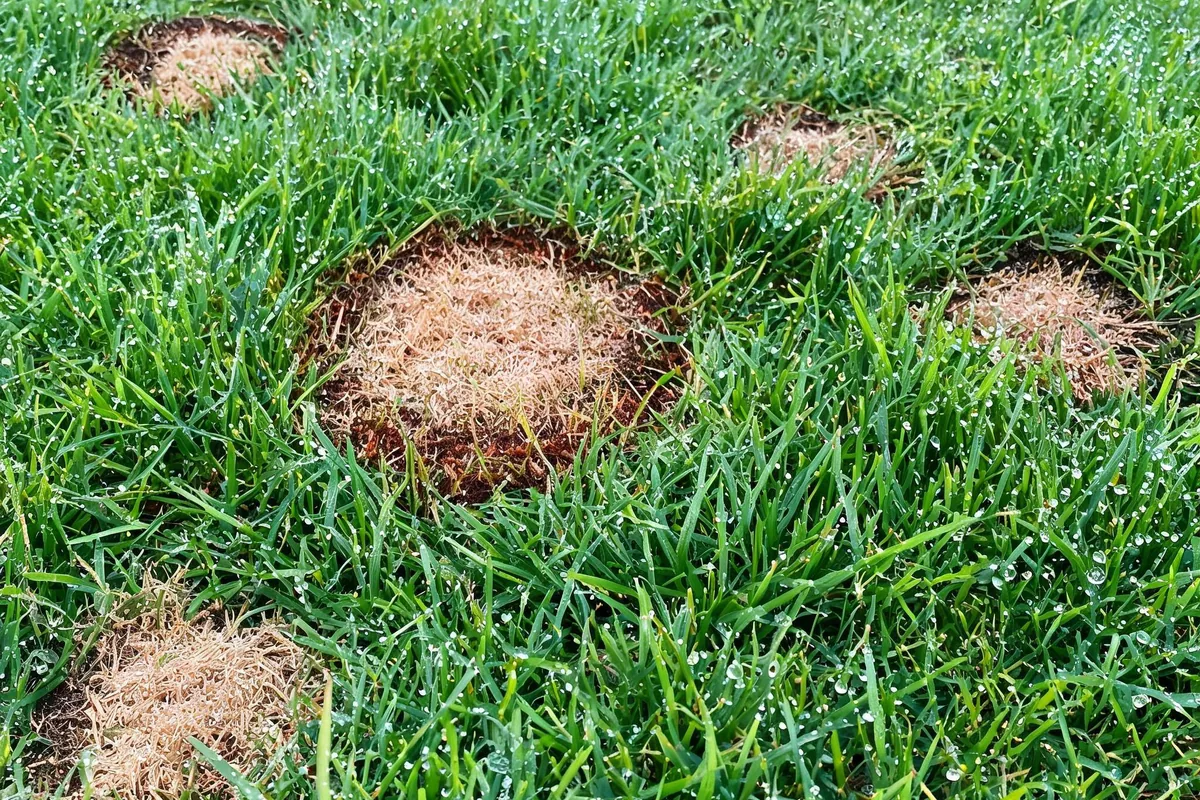
Brown patch, caused by Rhizoctonia solani, is in nearly every lawn's soil. It turns into a problem when hot, humid nights keep the grass wet for hours and the leaves are soft from too much nitrogen. Per NC State Extension, tall fescue is the most susceptible cool-season lawn grass, and outbreaks track warm nights and long leaf wetness.
That matters because a fungicide does nothing about those conditions. Per Penn State Extension, fungicides protect healthy tissue; they do not revive blades that are already dead. In most summers the lawn recovers on its own once nights cool in September. For identification and the full disease picture, see our brown patch guide.
The practical upshot: a fungicide buys a few weeks of protection during the worst weather. It is a bridge to cooler nights, not a fix. If the same lawn needs a fungicide every summer, the watering schedule, the fertilizer calendar or the grass itself is the real problem. Newer turf-type tall fescue varieties differ in how much brown patch they get, so when you overseed in fall, a blend chosen for disease tolerance is worth the effort. Our tall fescue care guide covers seeding and upkeep.
Cultural controls that do most of the work
These are the changes that cut brown patch and dollar spot year after year, per Penn State and NC State Extension:
- Water early in the morning, so leaves dry during the day. Evening watering stretches leaf wetness right through the hours brown patch likes best.
- Skip summer nitrogen on tall fescue. Fast-release nitrogen in June, July and August feeds brown patch. Put most of your nitrogen down in fall. Our lawn fertilization schedule lays out the timing.
- Mow high with a sharp blade. Keep tall fescue around 3 to 4 inches; see the mowing height guide.
- Open up airflow and drainage. Shade, thatch and compacted soil all keep the canopy wet longer.
Dollar spot is the odd one out: per Penn State Extension, it is worst on nitrogen-starved turf, so a modest feeding in late spring or early fall is often the first fix. Our dollar spot guide covers the details.
When a fungicide actually makes sense
For most home lawns, a fungicide is optional. It earns its place when:
- The lawn is tall fescue or perennial ryegrass with a history of severe brown patch, and a run of hot, humid nights is forecast.
- You have just seeded or sodded, and young turf would be set back badly by an outbreak.
- Disease is spreading quickly and cultural changes have not slowed it.
Per NC State Extension, brown patch fungicides work best when applied preventively, starting when night temperatures stay warm and before symptoms spread. A tall fescue lawn that browns every July is a candidate for a preventive program; a lawn that had a few spots once is not.
If you manage a large tall fescue area and want the professional view, the USGA Green Section has a detailed article on managing brown patch in turf-type tall fescue.
Active ingredients and FRAC groups, in plain terms
Every fungicide label lists a FRAC group number. It tells you the mode of action, and it is the number that matters for rotation. Per UC IPM's guide to fungicide properties for turfgrass, the common homeowner groups are:
- FRAC 11, QoI or strobilurins: azoxystrobin (Scotts DiseaseEx). Strong on brown patch and broad-spectrum, but a single-site mode of action with high resistance risk.
- FRAC 3, DMI or triazoles: propiconazole (BioAdvanced Fungus Control for Lawns ready-to-spray) and related triazoles such as myclobutanil and tebuconazole. Good on dollar spot and useful on brown patch.
- FRAC 1, MBC or benzimidazoles: thiophanate-methyl (Bonide Infuse Lawn & Landscape granules). Most useful against dollar spot.
All three are systemic to some degree, which means they move into the plant and are less easily washed off than contact fungicides. None of them is a cure for tissue that is already dead.
Preventive vs curative use
Lawn fungicides are mostly preventive tools. Applied before or at the very first symptoms, they protect the leaves that are still healthy. Applied after a lawn is half brown, they can slow spread, but the brown grass stays brown until it regrows from the crowns.
In practice, that means two ways to use them:
- Preventive: on a high-risk tall fescue lawn, start when warm, humid nights set in and repeat at the label interval while those conditions last.
- Curative (really, early-curative): on a lawn without a history, apply at the first sign, such as smoke rings in morning dew or the first tan patches, and reassess after one interval.
Either way, the label sets the rate and the minimum days between applications. Do not shorten the interval or raise the rate to make up for a missed spray.
Rotate to avoid resistance
Single-site fungicides lose effectiveness when the same group is used over and over. Per Penn State research, dollar spot populations resistant to several fungicide classes are already a problem on golf courses, where spraying is heavy.
Homeowners spray far less, but the rule is the same: alternate FRAC groups between applications rather than repeating one product all summer. A simple rotation is DiseaseEx (11), then propiconazole (3), then back to DiseaseEx. Check the label for the maximum number of applications per year, and treat it as a hard limit.
Which product fits your lawn
A quick way to choose:
- Tall fescue lawn that browns out most summers. Start DiseaseEx when warm, humid nights arrive, then alternate with the propiconazole spray at label intervals until nights cool. Fix evening watering and summer feeding at the same time, or you will be doing this every year.
- A few tan spots on a lawn with no history. Change watering to early morning, hold off on nitrogen and watch it for a week or two. Spray only if it keeps spreading.
- Small, scattered silver-dollar spots on a thin, hungry lawn. That is likely dollar spot. Feed lightly first if it is late spring or early fall. If you do need a fungicide, propiconazole or thiophanate-methyl are the better fits, alternated rather than repeated.
- New seed or sod going into summer. Young tall fescue is the most vulnerable turf you will own. A preventive application during a hot, humid stretch is easier to justify here than on an established lawn.
If you are not sure which disease you have, identify it before you buy anything. Brown patch, dollar spot and Pythium need different responses, and a photo sent to your county Extension office is free.
Applying it properly
Most homeowner lawn fungicide failures come from coverage and timing, not the product.
- Granules need a calibrated spreader and usually light watering afterward to move the fungicide off the leaves, per the DiseaseEx label page; follow the watering direction on whatever product you use.
- Liquids need enough water to cover the canopy evenly. A hose-end bottle is fine for spot work; a pump sprayer gives more even coverage.
- Keep people and pets off until sprays have dried or granules have been watered in, as the label directs.
- Wear the protective equipment the label lists, usually long sleeves, pants, shoes and gloves.
The label is the law. Use only products labeled for lawns, at the labeled rate, for the diseases listed.
Granules or liquid?
Both work when applied properly, and the choice is mostly about the equipment you already own.
- Granules such as DiseaseEx and Infuse go on with the same broadcast spreader you use for fertilizer. They are easy to apply at the labeled rate across a whole lawn, and there is no mixing.
- Hose-end liquids such as BioAdvanced's ready-to-spray bottle are fastest for treating a few patches and their borders. Even coverage over a whole lawn takes more care, because the spray rate changes with water pressure and walking speed.
Whichever you use, treat a band of healthy-looking turf around each patch, not just the brown area. The fungus is already active at the edges, and that green margin is the tissue the fungicide can still protect.
Other diseases these products cover
The same three groups are labeled for several other lawn diseases, including red thread, rust, leaf spot and summer patch, depending on the product. Check the label for your specific disease before you buy. Per Clemson Extension, warm-season grasses get a related Rhizoctonia disease, large patch, in spring and fall rather than summer, so timing differs in the South.
One exception worth knowing: Pythium blight is caused by a water mold, not a true fungus, and it is managed differently. Do not assume a brown patch product covers it; check whether Pythium is listed on the label. See our Pythium blight guide and the red thread guide for those specific problems.
How we choose
These picks are research-based. We did not test these products; we compared them against university Extension guidance on turf disease (Penn State, NC State, Clemson and UC IPM), the USGA Green Section, current product labels, and owner reports on ease of application. Picks had to be sold to homeowners, labeled for brown patch on lawns, and, as a set, cover three different FRAC groups so you can rotate. The author, Thomas Joseph, gardens in zone 7a on Long Island, where tall fescue and brown patch are both common, but nothing here is based on personal trials. We put cultural controls first because Extension does, and we never recommend off-label use.
Frequently asked
What is the best fungicide for brown patch in tall fescue?
Azoxystrobin, sold to homeowners as Scotts DiseaseEx, is the strongest single homeowner option. Rotate it with a propiconazole product rather than using it alone all summer.
Will fungicide make brown patches green again?
No. Per Penn State Extension, fungicides protect healthy tissue but do not revive dead blades. The lawn usually regrows from surviving crowns once nights cool in September.
When should I apply lawn fungicide?
Preventively, when warm humid nights set in on lawns with a history of disease, or at the first symptoms otherwise. Reapply only at the interval on the label.
Do I need to rotate lawn fungicides?
Yes. Alternate FRAC groups, for example azoxystrobin (11) and propiconazole (3), to slow resistance, which is already documented in dollar spot.
Should I fertilize a lawn with brown patch?
Not in summer. Fast-release nitrogen in June through August makes brown patch worse on tall fescue; save nitrogen for fall. Dollar spot is the exception, since it is worse on low-nitrogen turf.
Sources
- Brown Patch in Turf, NC State Extension
- Turfgrass Diseases: Brown Patch (Rhizoctonia solani), Penn State Extension
- Turfgrass Diseases: Dollar Spot (Clarireedia jacksonii), Penn State Extension
- General Properties and Use of Fungicides (Turfgrass), UC IPM
- Brown Patch and Large Patch Diseases of Lawns, Clemson Cooperative Extension HGIC
- Managing Brown Patch in Turf-Type Tall Fescue, USGA Green Section Record
- Golf course managers challenged by fungicide-resistant turfgrass disease, Penn State
- Scotts DiseaseEx Lawn Fungicide, Scotts