Brown Patch Disease in Lawns
Brown patch is the most widespread fungal disease of turfgrass in the eastern United States. It is caused by Rhizoctonia solani, a soil-borne pathogen that is present in virtually every lawn — it only becomes destructive
—- title: "Brown Patch Disease in Lawns" slug: brown-patch-lawn hub: lawn category: Lawn guide description: "Brown patch is the most widespread fungal disease of turfgrass in the eastern United States. It is caused by Rhizoctonia solani, a soil-borne pathogen that is present in virtually every lawn — it." date: 2026-06-10 updated: 2026-06-10 author: "Thomas A." reading_time: 8 —-
Brown patch is the most widespread fungal disease of turfgrass in the eastern United States. It is caused by Rhizoctonia solani, a soil-borne pathogen that is present in virtually every lawn — it only becomes destructive when temperature and humidity conditions combine to trigger an outbreak. Understanding those conditions is the key to both prevention and timing any treatment.
Identifying brown patch
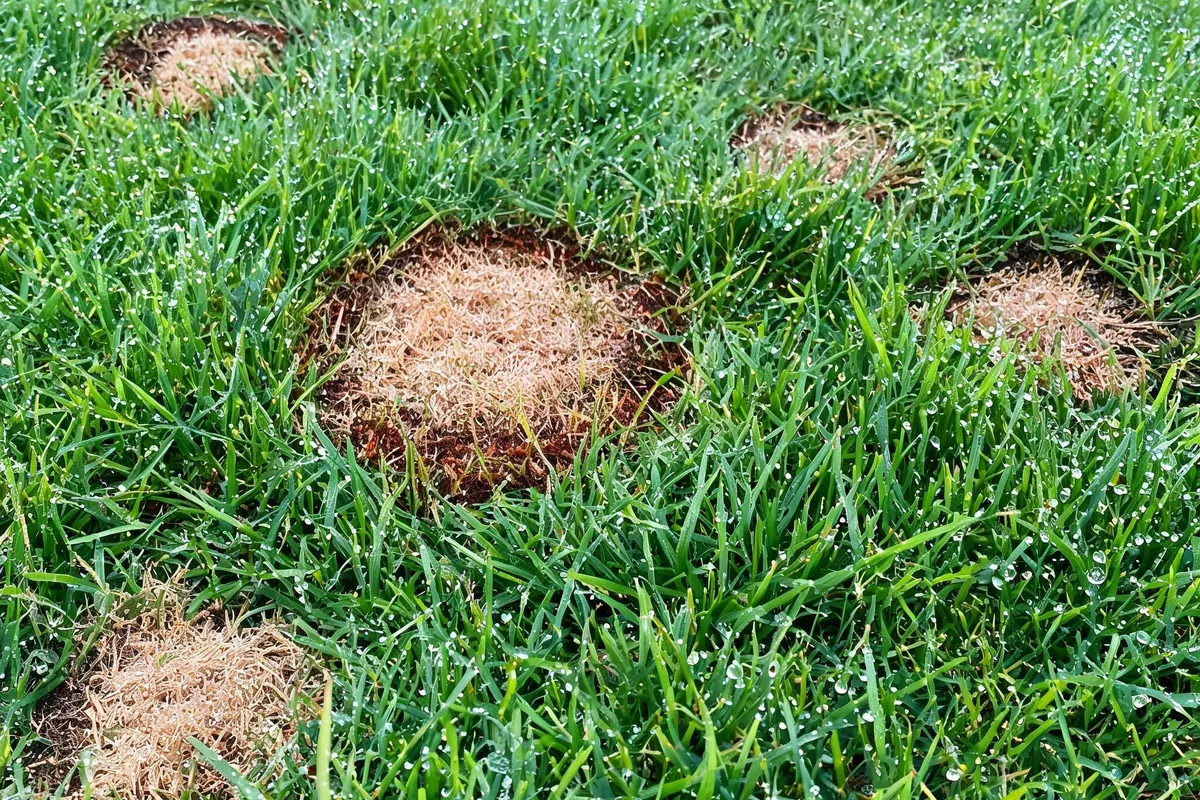
Per Penn State Extension's turfgrass disease guide, brown patch appears as roughly circular patches of blighted turf ranging from a few inches to several feet in diameter. In morning dew conditions, look for a dark "smoke ring" — a ring of darker, water-soaked grass at the advancing edge of the patch. This ring disappears as the dew dries.
Individual infected blades show a characteristic symptom: a tan lesion with an irregular brown border, sometimes described as having a "chocolate brown" margin on a light tan center. The blade dies back from the tip.
Cool-season vs. warm-season susceptibility
Per NC State Extension TurfFiles, susceptibility differs by species:
Highly susceptible cool-season species:
- Tall fescue (Festuca arundinacea) — the most severely affected cool-season species; can see complete patch death
- Perennial ryegrass (Lolium perenne)
Moderately susceptible:
- Kentucky bluegrass (Poa pratensis) — can develop brown patch but typically less severe; often recovers more quickly
Susceptible warm-season species:
- Zoysiagrass (Zoysia japonica) — "large patch" disease is a related Rhizoctonia disease in warm-season grasses; see below
- St. Augustinegrass — susceptible to a related form
Fine fescues and creeping bentgrass are also susceptible but in different temperature ranges.
Important distinction: In warm-season grasses, Rhizoctonia causes "Large Patch" (formerly called Zoysia patch or brown patch of warm-season grasses), which has different temperature requirements — it occurs when soil temperatures fall in the 50—70°F range (spring and fall), not in summer heat. Per NC State Extension, large patch on zoysiagrass is primarily a fall disease in the Carolinas and Mid-Atlantic.
Disease development conditions
Per Penn State Extension, brown patch development requires specific conditions:
- Air temperature: 80—95°F daytime; nighttime temperatures consistently above 68—70°F
- Leaf wetness: Grass blades continuously wet for 10+ hours (from irrigation, rain, or dew)
- Relative humidity: Above 95% for extended periods
- Nitrogen: High soluble nitrogen availability in the leaf tissue
Per Cornell Cooperative Extension, the critical environmental trigger is warm nights combined with long leaf wetness periods. A hot, dry summer with low humidity does not produce brown patch even at high temperatures. The disease is primarily a problem in humid eastern climates, coastal areas, and during periods of extended wet weather.
Conditions that increase risk
Per NC State Extension TurfFiles, the following cultural practices increase brown patch risk:
- Evening irrigation. Watering in the afternoon or evening extends leaf wetness duration through the night, creating ideal conditions for infection. Morning irrigation allows leaves to dry during the day.
- Excess nitrogen. High nitrogen — especially from fast-release sources — produces lush, tender tissue that is more susceptible to pathogen invasion. Per Penn State Extension, avoid applying fast-release nitrogen to tall fescue or perennial ryegrass from June through August.
- Thatch. A thatch layer over 0.5 inch increases the microclimate humidity around leaf bases and harbors inoculum. See dethatching lawn.
- Low mowing. Mowing below 2.5—3 inches on cool-season grass reduces air circulation at the canopy level and extends leaf wetness. See mowing height guide.
- Compacted soil. Poor drainage from compaction keeps the root zone saturated, stressing the grass and creating favorable conditions. See lawn aeration guide.
The summer nitrogen rule for cool-season lawns
Per Penn State Extension, applying soluble nitrogen fertilizer to cool-season grass in June, July, or August increases brown patch severity. The susceptibility window coincides exactly with peak nitrogen application times for homeowners who fertilize by calendar rather than by grass growth cycle.
The correct approach: do not apply nitrogen to cool-season grass from June 15 through August 31 in the Northeast and Mid-Atlantic. If fertilization is needed in late summer (late August to early September), use a slow-release product that doesn't produce the rapid flush of soluble nitrogen that favors disease. See lawn fertilization schedule.
Fungicide treatment
Per Penn State Extension, fungicides are preventive, not curative — they protect healthy tissue from infection but do not restore already-killed leaf tissue. The existing dead patches will not green up after fungicide application. Recovery requires the grass to regrow from crowns and tillers after conditions cool.
Fungicide timing: Apply at first signs of disease OR when nighttime temperatures are forecast to remain above 70°F for extended periods on high-risk lawns (tall fescue lawns in humid mid-Atlantic climates with a history of severe brown patch).
Effective active ingredients for brown patch:
| Active ingredient | Mode of action | Consumer product examples | Application interval |
|---|---|---|---|
| Azoxystrobin | QoI (strobilurin) | Scotts DiseaseEx, Heritage | 14—28 days |
| Propiconazole | DMI (triazole) | Bonide Infuse, various | 14—21 days |
| Myclobutanil | DMI (triazole) | Spectracide Immunox, others | 14—21 days |
| Trifloxystrobin | QoI (strobilurin) | Compass, others | 21—28 days |
| Thiophanate-methyl | MBC (benzimidazole) | Cleary 3336, others | 14—21 days |
Per NC State Extension TurfFiles, rotate between fungicide classes (QoI and DMI are different modes of action) to prevent resistance development. Using only one mode of action through an entire season selects for resistant pathogen populations.
Application requirements: Most fungicide labels specify applying in 3—4 gallons of water per 1,000 sq ft to ensure adequate canopy penetration. Follow label instructions for dilution and re-entry intervals.
Recovery after brown patch
Per Penn State Extension, cool-season lawns damaged by brown patch in summer typically recover when temperatures cool in September. The pathogen does not kill the entire plant in most cases — it kills leaf tissue but leaves the crown and roots intact. As temperatures drop below 70°F at night and the stress of summer heat recedes, new leaf growth emerges from surviving crowns.
Recovery timeline:
- Mild infection (individual blades dead, patch less than 12 inches): recovers without overseeding within 3—4 weeks of cooling weather.
- Moderate infection (patch dead to crown level, bare soil visible): overseed in late August or September. Per Penn State Extension, "an overseeding should be applied in early fall to fill in large damaged areas."
- Severe infection (more than 50% of lawn affected): combination of fungicide application to protect remaining grass, followed by overseeding of bare areas in fall.
Common problems table
| Symptom | Cause | Fix |
|---|---|---|
| Circular brown patches, smoke ring in morning dew | Active Rhizoctonia brown patch | Improve morning irrigation; reduce N; apply fungicide if warranted |
| Patches persist through fall after temperatures cool | Possible concurrent grub damage or drought injury; or deep crown death | Scout for grubs; assess crown viability; overseed dead areas |
| Fungicide applied but patches keep growing | Applied after infection established; wrong timing; resistance | Apply preventively; rotate mode of action; check application rate |
| Brown patch appears every year in same spots | Soil drainage issues; compaction; shading creating persistent humidity | Core aerate; check drainage; prune overhead canopy if possible |
| Similar symptoms but disease peaks in spring or fall | Could be large patch on warm-season grass; or Pythium blight (different conditions) | Confirm grass species; check temperature conditions; consult extension diagnosis |
Frequently asked
How do I tell brown patch from dollar spot?
Both diseases cause patches and tan-colored leaf lesions, but the patterns differ. Per Penn State Extension, brown patch creates large, roughly circular patches (often 1—5 feet or more in diameter) with a smoke ring at the leading edge during humid mornings. Dollar spot creates small, silver-dollar-sized spots (3—6 inches), and the lesion on individual blades shows a bleached hourglass shape with distinct brown borders at both ends. See dollar spot disease guide.
Does brown patch kill the grass permanently?
In most cases, no. Per Penn State Extension, Rhizoctonia kills the leaf tissue but typically leaves the crown intact in established cool-season grasses. When conditions cool, new growth emerges. The exception is severe, prolonged infection on stressed tall fescue lawns — in a worst-case summer with 6 weeks of continuous warm nights and wet conditions, crown death can occur. Overseed dead areas in early fall.
Should I bag my clippings when brown patch is active?
Per NC State Extension TurfFiles, mowing when brown patch is active can spread Rhizoctonia inoculum via the mower. Bag clippings and clean the mower deck between passes when disease is severe. During moderate infection in a large lawn, this is impractical — focus instead on improving cultural practices.
Is brown patch worse in shade?
Yes. Per Penn State Extension, shaded areas stay wetter longer after rain or irrigation, extending leaf wetness duration and creating conditions favorable for brown patch. If your lawn chronically develops brown patch in shaded areas under trees, pruning lower tree limbs to increase air circulation can help reduce disease pressure.
—-
Sources
- Penn State Extension — <a href="https://extension.psu.edu/brown-patch-of-turfgrasses">Brown Patch of Turfgrasses</a>.
- NC State Extension TurfFiles — <a href="https://turffiles.ncsu.edu/problems/brown-patch/">Brown Patch</a>.
- NC State Extension TurfFiles — <a href="https://turffiles.ncsu.edu/problems/large-patch/">Large Patch</a>.
- Cornell Cooperative Extension Turfgrass — <a href="https://turf.cals.cornell.edu/">Turfgrass Resources</a>.
- UMass Extension Turfgrass — <a href="https://extension.umass.edu/landscape/factsheets/lawn-care">Lawn Care Factsheets</a>.