Lawn

White Grubs in Lawn: Identification and Treatment

White grubs are the larvae of several scarab beetle species. They feed on turfgrass roots from midsummer through fall, and a severe infestation can kill large patches of lawn quickly enough that you mistake it for drough

garden soil and dirt for planting
Photo: Unsplash on Unsplash

—- title: "White Grubs in Lawn: Identification and Treatment" slug: lawn-grubs hub: lawn category: Lawn guide description: "White grubs are the larvae of several scarab beetle species. They feed on turfgrass roots from midsummer through fall, and a severe infestation can kill large patches of lawn quickly enough that you." date: 2026-06-10 updated: 2026-06-10 author: "Thomas A." reading_time: 9 —-

White grubs are the larvae of several scarab beetle species. They feed on turfgrass roots from midsummer through fall, and a severe infestation can kill large patches of lawn quickly enough that you mistake it for drought damage until you lift the sod and find the culprits. The good news is that not every grub population warrants treatment — the threshold matters, and the timing of treatment is as important as the product used.

Identifying white grubs

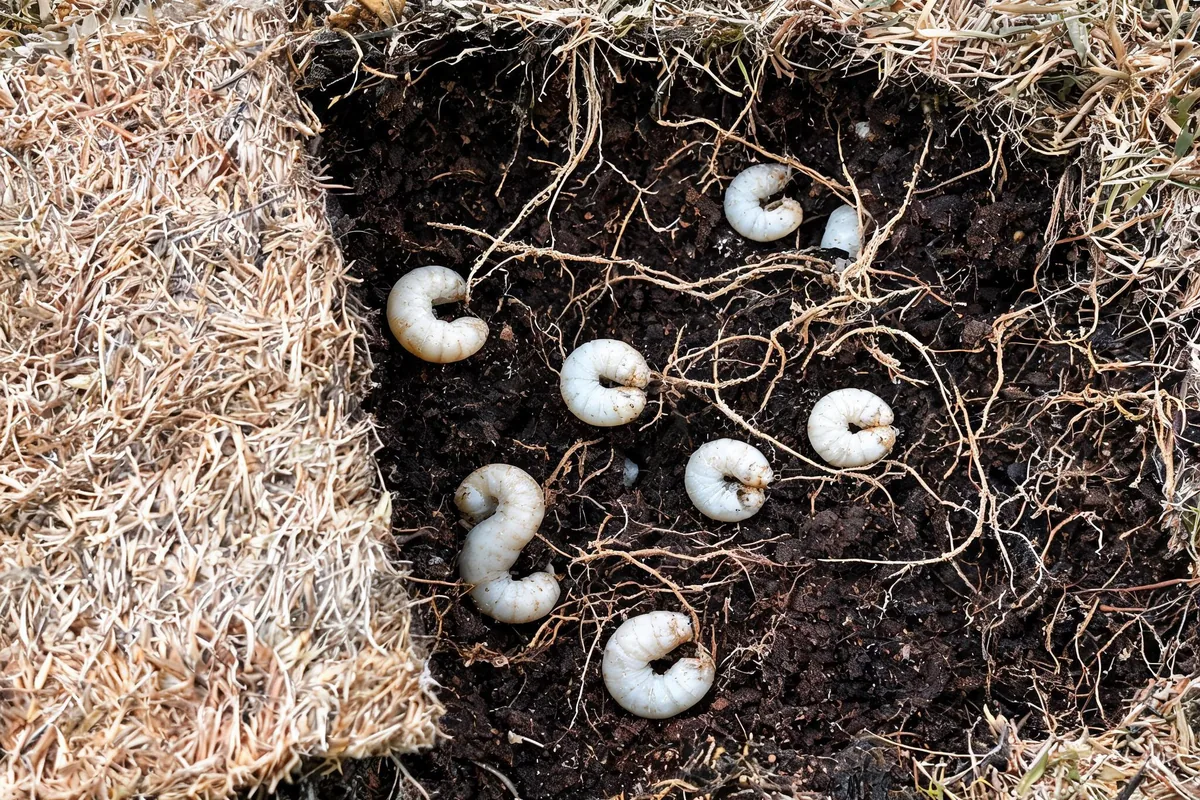
All white grubs share a general appearance: a C-shaped creamy white larva with a tan-brown head capsule and three pairs of legs near the head. They range from 0.5 inch (first instar) to 1.5 inches (third instar, fully grown) depending on species and life stage.

The most reliable way to distinguish species is by examining the raster pattern — the arrangement of spines on the underside of the grub's last abdominal segment (the raster). This requires a hand lens or magnification.

Per Penn State Extension's white grub identification guide:

SpeciesRaster patternAdult timingNotes
Japanese beetle (Popillia japonica)Two parallel rows of spines forming a V or zipperJune—August adultsMost common in Northeast; also spreads through Midwest
Masked chafer (Cyclocephala spp.)Scattered random spines, no distinct patternJune—July adults (nocturnal)Very common in Midwest, South
Oriental beetle (Anomala orientalis)Two rows of spines with hairy patch betweenJuly—August adultsCommon in Northeast, especially sandy soils
European chafer (Rhizotrogus majalis)Two parallel rows of spines forming a VJune adultsCommon in NY, PA, New England
Green June beetle (Cotinis nitida)Crawls on back, not in C-shapeJune—July adults (daytime)Southeast; large; damage different (loose sod)

For accurate species ID, collect a grub and compare its raster with extension publication diagrams. Per Penn State Extension, species identification matters for timing treatment correctly.

Scouting: how to determine if you have a problem

Per Penn State Extension, the only way to know if grub populations exceed the treatment threshold is to scout — cut and peel back several sections of sod and count grubs.

How to scout:

  1. Cut a 12-inch × 12-inch (1 sq ft) section of sod to 3-inch depth in multiple areas of the lawn showing damage or stress.
  2. Count all white grubs present in each section.
  3. Average the counts across sections.

Treatment thresholds (per Penn State Extension):

Populations below threshold generally cause damage that a healthy, well-watered lawn can compensate for without treatment.

Symptoms of grub damage

Per Cornell Cooperative Extension, white grub damage presents as:

Grub damage is easily confused with summer drought stress on cool-season lawns. The test: pull back the damaged turf. Drought-stressed turf has intact roots; grub-damaged turf tears free at the root zone. Per Penn State Extension, "the turf folds back like a loose rug" when grub feeding has been heavy.

Preventive insecticide treatment (June—July)

Preventive grub control targets newly hatched first-instar larvae in July—August before they cause visible damage. The products are most effective on small, young grubs.

Timing: Per Cornell Cooperative Extension and Penn State Extension, apply preventive insecticides from June 1 through July 15, ideally:

Active ingredients — preventive:

Active ingredientTrade namesResidualNotes
ImidaclopridBayer Grub Control, others3—4 monthsSystemic; requires irrigation within 24h; most widely used
ChlorantraniliproleScotts Scotts GrubEx1 (newer formulations), Acelepryn3—4 monthsLower mammalian toxicity; works preventively and curatively on young grubs
ThiamethoxamVarious3—4 monthsSimilar to imidacloprid; requires irrigation
ClothianidinArena3—4 monthsPreventive; requires irrigation

Per Penn State Extension, imidacloprid and chlorantraniliprole are the most reliable for preventive control. Water in within 24 hours for maximum efficacy.

Note on neonicotinoids and pollinators: Imidacloprid, thiamethoxam, and clothianidin are systemic insecticides in the neonicotinoid class. Per the Xerces Society for Invertebrate Conservation, these compounds can be taken up by turf plants and appear in pollen and nectar, with documented effects on bee populations. Chlorantraniliprole is not a neonicotinoid and has substantially lower pollinator toxicity per current EPA registration data.

Curative insecticide treatment (August—October)

If you missed the preventive window and are seeing active damage, curative treatment is the option. It is less reliable than preventive — large third-instar grubs are more difficult to kill, and soil temperature at application time affects product movement.

Active ingredients — curative:

Active ingredientTrade namesEfficacy on large grubsNotes
ChlorantraniliproleScotts GrubEx1 (newer), AceleprynGoodBest curative option; works better than trichlorfon on large grubs
TrichlorfonDyloxFair to goodFast-acting organophosphate; short residual; requires immediate irrigation
CarbarylSevinFairLess effective than above; broad spectrum; use cautiously

Per Penn State Extension, curative treatments work best when:

By mid-September, grubs have reached third instar and moved deeper in the soil. Curative treatments become much less reliable. Per Penn State Extension, "applications made when soils are dry or when grubs are in the third instar may give poor results."

Biological control options

beneficial nematodes: Per Penn State Extension, entomopathogenic nematodes (Heterorhabditis bacteriophora for grubs) can provide 20—80% control under ideal conditions. Requirements are strict: apply in late summer when grubs are young, soil temperature above 60°F, soil moisture at field capacity, and apply in the evening to avoid UV degradation. Inconsistent results in university trials make this an uncertain option. Cornell Cooperative Extension notes that results "vary widely depending on conditions."

**milky spore granular (Paenibacillus popilliae):** Labeled specifically for Japanese beetle larvae. Per Penn State Extension, milky spore granular provides long-term biological control under certain conditions, but "establishment can take 2—4 years in cool northeastern soils." Efficacy is more reliable in warmer soils (USDA zones 7—8). It does not control other white grub species.

Lawn recovery after grub damage

Per Penn State Extension, dead turf from grub damage should be restored in conjunction with good lawn management. Also review lawn aeration guide — healthy, deep-rooted turf from annual aeration tolerates moderate grub pressure better than compacted, shallow-rooted grass. See lawn fertilization schedule to maintain vigor. Specific steps:

  1. Raked and removed.
  2. Soil loosened to 2—3 inches.
  3. Overseeded in early fall with appropriate cool-season grass (for northern lawns). See when to overseed your lawn.
  4. Fertilized with starter fertilizer.
  5. Watered until established.

For warm-season lawns damaged by grubs, timing recovery depends on whether there's sufficient growing season remaining. Zoysiagrass and bermudagrass damaged in August—September can often recover by the following spring via stolon regrowth if not completely dead. If plugs are dead, resod in late spring.

Common problems table

SymptomCauseFix
Brown patches that pull up like carpet, late July—AugustWhite grub feeding on rootsScout; if over threshold, apply curative insecticide; water in; overseed in fall
Skunks and raccoons digging overnightHigh grub populations attracting wildlifeTreat grubs to eliminate food source; patch damage; reduce animal attractant
Curative treatment didn't workApplied too late (third-instar grubs); soil too dry; not watered inBetter timing next year; preventive application in June—July
Lawn damaged but only 2—3 grubs per sq ftSub-threshold population; damage from other causeScout more sections; consider drought, disease, or other diagnosis
Green June beetle damage looks differentLarvae crawl to surface, loosening sod rather than removing rootsSame threshold applies; different feeding pattern

Frequently asked

How do I tell grub damage from drought damage?

The physical test: pull back the damaged turf. Per Penn State Extension, drought-stressed turf has intact, living roots — the sod resists being pulled. Grub-damaged turf tears free easily at root level because the roots have been consumed. If you can roll back the sod like a rug, grubs are the likely cause. Confirm by counting grubs in the exposed soil.

Can I prevent grubs without insecticides?

Maintaining a dense, healthy lawn at proper mowing height reduces the impact of sub-threshold grub populations but does not prevent infestation. Per Cornell Cooperative Extension, cultural practices (irrigation, fertilization, overseeding to maintain density) allow lawns to tolerate moderate grub populations without visible damage. Biological options (nematodes, milky spore granular) exist but have inconsistent results under home lawn conditions. Chemical preventives are the most reliable control at this time.

My neighbor's lawn has Japanese beetles swarming. Should I treat preventively?

Adult Japanese beetle presence nearby is a relevant risk factor — adults fly from established populations to lay eggs in turfgrass over a radius of up to a mile. Per Penn State Extension, applying a preventive insecticide (imidacloprid or chlorantraniliprole) in late June to mid-July is a reasonable decision when adult beetle pressure is high and you have had grub damage in prior years. A first-year lawn in a new neighborhood with no prior grub history has lower risk.

Is it normal to see a few grubs in every soil sample?

Yes. Per Penn State Extension, low-level grub populations are normal in most lawns. The treatment threshold exists because lawns can tolerate 1—7 grubs per sq ft without visible damage if the grass is otherwise healthy and well-maintained. Treat only when populations exceed the species-specific threshold.

—-

Sources

  1. Penn State Extension &mdash; <a href="https://extension.psu.edu/white-grubs-in-lawns">White Grubs in Lawns</a>.
  2. Cornell Cooperative Extension Turfgrass &mdash; <a href="https://turf.cals.cornell.edu/">Turfgrass Resources</a>.
  3. Xerces Society for Invertebrate Conservation &mdash; <a href="https://xerces.org/pesticides/">Pesticides and Pollinators</a>.
  4. NC State Extension TurfFiles &mdash; <a href="https://turffiles.ncsu.edu/">Turfgrass Resources</a>.
  5. Purdue University Extension &mdash; <a href="https://www.extension.purdue.edu/extmedia/AY/AY-22.html">Lawn Establishment and Renovation</a>.

Sources