Lawn

How to Identify Your Grass Type

Most lawn care advice starts with "identify your grass type first" and then immediately assumes you already know it.

A close up of a blade of grass with drops of water on it
Photo: Unsplash on Unsplash

—- title: "How to Identify Your Grass Type" slug: identify-grass-type hub: lawn category: Lawn guide description: "Most lawn care advice starts with 'identify your grass type first' and then immediately assumes you already know it. In practice, most homeowners don't know whether their lawn is Kentucky bluegrass." date: 2026-06-10 updated: 2026-06-10 author: "Thomas A." reading_time: 10 —-

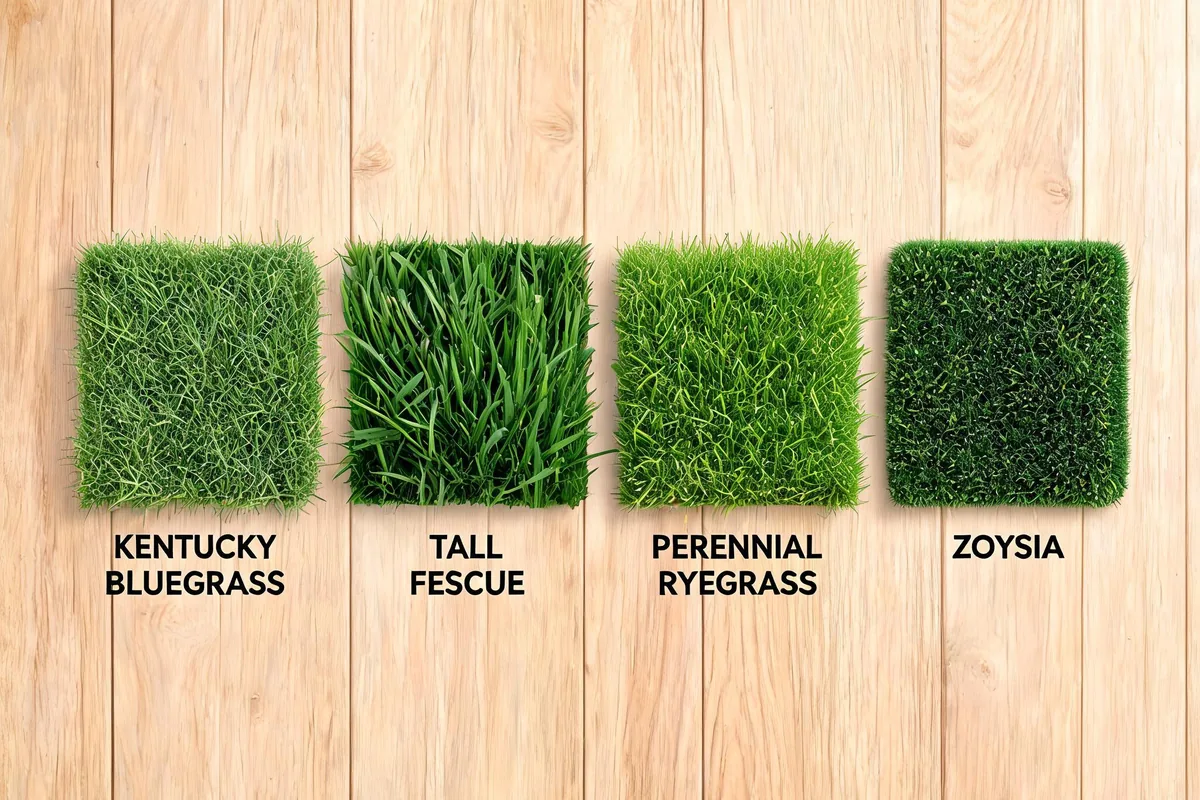
Most lawn care advice starts with "identify your grass type first" and then immediately assumes you already know it. In practice, most homeowners don't know whether their lawn is Kentucky bluegrass or tall fescue, and that distinction changes every key maintenance decision — when to fertilize, when to overseed, what herbicides are safe, and what mowing height to use. This guide gives you the concrete features to make the identification yourself.

Step 1: Cool-season or warm-season?

This distinction controls everything else. It is based on geography and seasonal behavior, not leaf appearance.

Cool-season grasses are actively growing in spring (March—May) and fall (September—November) and may go semi-dormant or grow slowly in hot summers. They typically maintain green color year-round in zones 4—7. In zones 8—9, they may die out in summer heat. Per Penn State Extension, cool-season species include Kentucky bluegrass (Poa pratensis), tall fescue (Festuca arundinacea), fine fescues (Festuca spp.), and perennial ryegrass (Lolium perenne).

Warm-season grasses are dormant and brown from approximately November through March in most of their range. They green up when soil temperatures exceed 55—60°F in spring. Per Texas A&M AgriLife Extension, warm-season species include bermudagrass (Cynodon dactylon), zoysiagrass (Zoysia japonica), St. Augustinegrass (Stenotaphrum secundatum), centipedegrass (Eremochloa ophiuroides), and bahiagrass (Paspalum notatum).

If your lawn goes uniformly brown in winter and then turns green in spring — in the South or Southwest — you have a warm-season species.

Step 2: Key identification features

Leaf blade width

Leaf width is the quickest first filter.

Width categorySpecies
Very fine (hair-like, under 2mm)Fine fescues (chewings, hard, creeping red)
Fine (2—4mm)Kentucky bluegrass, perennial ryegrass
Medium (4—7mm)Tall fescue, zoysiagrass
Coarse (7—10mm)St. Augustinegrass, bahiagrass
Very coarse (10mm+)Tall fescue (some coarse types), bahiagrass

Hold a blade between two fingers and measure at the widest point.

Folding vs. rolling

One of the most reliable identification features: how does the emerging leaf tip appear in the bud? This refers to the new leaf before it unfurls.

Per Penn State Extension:

To check: look at a new emerging shoot in the crown zone of the plant. Pinch the top — a folded bud will feel flat; a rolled bud will feel rounded.

Vernation (leaf arrangement in bud)

This is the same feature as folded vs. rolled, described more precisely. Per NC State Extension TurfFiles, "vernation" refers to how the new leaf is arranged within the sheath before unfurling.

Ligule type

The ligule is a small membrane or fringe of hairs at the junction between the leaf blade and the sheath (where the leaf joins the stem). Examining the ligule requires pulling back a leaf blade and looking at the base.

SpeciesLigule type
Kentucky bluegrassMembranous (translucent membrane, about 1mm)
Tall fescueMembranous (very short, under 1mm)
Perennial ryegrassMembranous (short, 0.5—1mm)
Fine fescuesMembranous (very short) or absent
BermudagrassFringed (ring of hairs)
ZoysiagrassFringed (ring of hairs)
St. AugustinegrassFringed
CentipedegrassAbsent or very small
BahiagrassMembranous

Auricles

Auricles are claw-like appendages that clasp the stem at the base of the leaf blade. Not all species have them.

The presence of auricles on a fine-to-medium bladed grass in the Northeast is a strong indicator of tall fescue or perennial ryegrass.

Boat-shaped leaf tip

Kentucky bluegrass has a distinctive compressed, boat-shaped leaf tip that resembles the prow of a boat. Per Penn State Extension, this feature alone distinguishes Kentucky bluegrass from other common cool-season grasses when combined with its folded bud. Look at the very tip of the leaf blade — if it tapers to two parallel ridges that come to a point (like a ski tip), that's bluegrass.

Growth habit: rhizomes, stolons, or bunch-type

Rhizomes are underground stems that spread laterally below the soil surface. Species with rhizomes spread aggressively and produce a dense, self-repairing sod.

Stolons are aboveground runners (look for stems running laterally along the surface with nodes that produce new shoots).

Bunch-type grasses grow in discrete clumps and spread only by tillering (new shoots from the same crown). They do not self-repair bare spots readily.

SpeciesSpread type
Kentucky bluegrassRhizomes
Perennial ryegrassBunch-type
Tall fescueBunch-type (modern turf-types form dense stands but don't spread)
Fine fescuesCreeping red: rhizomes; chewings/hard: bunch-type
BermudagrassRhizomes and stolons
ZoysiagrassRhizomes and stolons
St. AugustinegrassStolons
CentipedegrassStolons
BahiagrassShort rhizomes

If your lawn looks like it spreads into beds and garden edges via surface runners, you likely have bermudagrass or zoysiagrass (warm-season) or a creeping species.

Species-by-species identification guide

Kentucky bluegrass (Poa pratensis)

Per Penn State Extension: fine-to-medium leaf width (2—4mm), boat-shaped leaf tip, folded in bud, short membranous ligule, no auricles. Spreads by rhizomes, forming a dense sod. Dark blue-green color. Seed heads in spring are a V-shaped panicle. This is the dominant lawn grass across the Northeast, upper Midwest, and Pacific Northwest. It goes semi-dormant (tan) during extended heat and drought in summer.

Tall fescue (Festuca arundinacea)

Medium to coarse leaf (4—8mm), rolled in bud, membranous ligule, blunt auricles. Glossy on the upper surface. Bunch-type growth — bare spots don't fill in naturally. Per NC State Extension, the coarser, non-turf varieties (K-31 and similar) have a distinctly wider leaf than improved turf-type tall fescues. K-31 in a Kentucky bluegrass lawn looks immediately different — coarser, shinier, darker green.

Perennial ryegrass (Lolium perenne)

Fine-to-medium leaf (2—4mm), glossy underside, rolled in bud, small auricles present, membranous ligule. Bunch-type growth. Very fast germination (5—10 days). Per Penn State Extension, ryegrass has "prominent veins on the upper leaf surface" and a distinctive gloss on the lower surface.

Fine fescues (Festuca spp.)

Hair-like to very fine leaves (0.5—2mm). The finest textured cool-season grasses. Chewings fescue and hard fescue are bunch-type; creeping red fescue spreads by short rhizomes. Pale blue-green color. Common in shade mixes and low-maintenance lawns. Often the fine-textured component in a bluegrass-fescue blend.

Bermudagrass (Cynodon dactylon)

Fine leaf (1.5—3mm), gray-green color, fringed ligule, folded in bud. Both rhizomes and stolons — extremely aggressive lateral spread. Per Texas A&M AgriLife Extension, bermudagrass turns brown below 50°F and is the most heat and drought-tolerant warm-season species. Seed heads resemble a 3—5 fingered hand (digitate racemes). In the North, bermudagrass occasionally invades lawns as a weed.

Zoysiagrass (Zoysia japonica and Zoysia matrella)

Medium leaf (3—5mm for Z. japonica, 1—2mm for Z. matrella), stiff and slightly prickly texture, fringed ligule. Spreads by rhizomes and stolons. Very slow to establish but extremely dense once established. Per NC State Extension, zoysia is "the most shade-tolerant of the warm-season grasses" and has good cold tolerance relative to bermudagrass.

St. Augustinegrass (Stenotaphrum secundatum)

Very wide, flat blade (7—12mm), rounded tip (not pointed), rolled in bud, fringed ligule, spreads by thick above-ground stolons. Deep blue-green color. The stolons are flattened and large — unmistakable once you know what to look for. Per Clemson Extension HGIC, St. Augustinegrass is "the most shade-tolerant of the warm-season grasses" and is the dominant lawn grass in Florida and coastal Gulf states.

Centipedegrass (Eremochloa ophiuroides)

Medium leaf (3—5mm), medium green, rolled in bud, short or absent ligule. Distinctive feature: seed heads form a single raceme (one spike), not multiple fingers like bermudagrass. Spreads by stolons. Light apple-green color distinguishes it from bermudagrass in mixed stands. Very slow growth — a low-maintenance warm-season species.

Quick identification key

QuestionAnswerWhat it suggests
Does it go brown in winter?YesWarm-season species
Does it go brown in winter?No (Northeast/Midwest)Cool-season species
Boat-shaped leaf tip?YesKentucky bluegrass
Very wide, flat blade with round tip, large stolons?YesSt. Augustinegrass
Very fine, hair-like blades?YesFine fescue
Coarse blades, auricles present?YesTall fescue
Glossy underside, rolled, auricles?YesPerennial ryegrass
Fine, gray-green, prickly, stiff blades, aggressive spread?YesBermudagrass
Medium blade, very dense, prickly feel, slow spread?YesZoysiagrass
Light green, medium blade, single seedhead spike?YesCentipedegrass

Frequently asked

How do I tell Kentucky bluegrass from tall fescue?

The simplest test: leaf width and leaf tip. Kentucky bluegrass has a narrow blade (2—4mm) with a distinctive boat-shaped compressed tip — two parallel ridges coming to a blunt point. Tall fescue has a medium to wide blade (4—8mm) with a flat, pointed tip and a shiny upper surface. Per Penn State Extension, the auricles on tall fescue are another quick differentiator — pull back a leaf blade at the base and look for two small claw-like appendages clasping the stem. Bluegrass has none.

Is my grass bermudagrass or zoysiagrass?

Both are warm-season, both have rhizomes and stolons, both feel somewhat stiff. The main differences: bermudagrass is finer textured (1.5—3mm), gray-green, and has seed heads that look like 3—5 fingers spread apart. Zoysiagrass is slightly coarser (3—5mm for Z. japonica), a deeper green, and much denser — a well-established zoysia lawn feels like a thick carpet. Per NC State Extension, zoysia also retains a gray-tan dormant color longer into spring than bermudagrass and greens up more slowly.

I have patches of two different grasses. What do I do?

Mixed-species lawns are common, especially in transition zones and older neighborhoods where grass was established over multiple decades. Per Penn State Extension, the best approach is to identify both species, choose the dominant one (or the one better suited to your conditions), and over time use management practices (mowing height, fertilization, selective herbicides) to favor the desired species. K-31 tall fescue in a bluegrass lawn is a common example — it doesn't blend in, and removal requires spot-treating with a non-selective herbicide and reseeding.

Can I send a sample to a lab for grass identification?

Yes. Per Cornell Cooperative Extension, turfgrass samples can be submitted to university extension diagnostic labs for identification. Once you've confirmed your grass type, see mowing height guide for species-specific height recommendations, lawn fertilization schedule for timing, and when to overseed your lawn for the correct overseeding window. Contact your state's cooperative extension service for submission instructions and fees. For most homeowners, the visual key above is sufficient — lab submission is most useful when the grass is unrecognizable or a specific disease or pest is suspected alongside the identification question.

—-

Sources

  1. Penn State Extension &mdash; <a href="https://extension.psu.edu/turfgrass-species-identification">Turfgrass Species Identification</a>.
  2. NC State Extension TurfFiles &mdash; <a href="https://turffiles.ncsu.edu/grass-types/">Grass Types</a>.
  3. Texas A&M AgriLife Extension &mdash; <a href="https://agrilifeextension.tamu.edu/lawn/">Lawn Care</a>.
  4. Clemson Extension HGIC &mdash; <a href="https://hgic.clemson.edu/factsheet/lawn-grass-identification/">Lawn Grass Identification</a>.
  5. Cornell Cooperative Extension Turfgrass &mdash; <a href="https://turf.cals.cornell.edu/">Turfgrass Resources</a>.

Sources