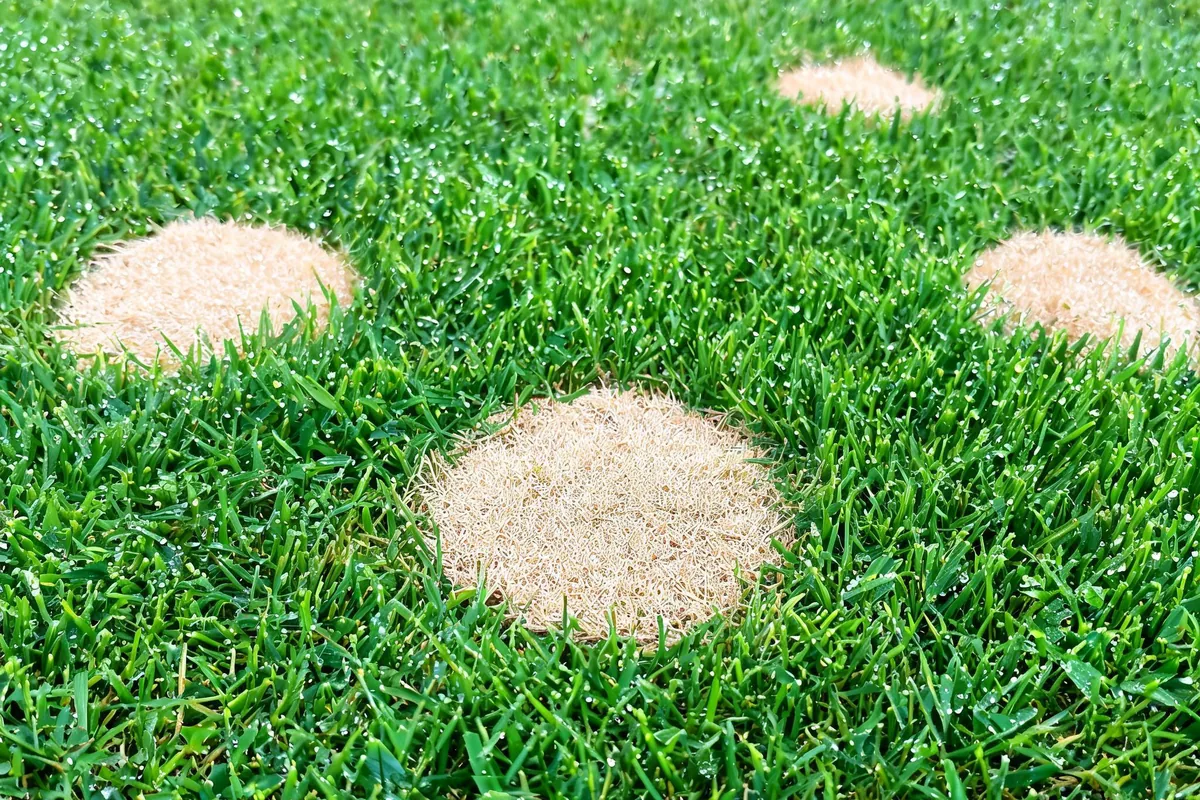
Dollar Spot Disease: Identification and Treatment
Dollar spot is caused by Clarireedia jacksonii (formerly classified as Sclerotinia homoeocarpa) and is one of the most common turfgrass diseases in North America.
—- title: "Dollar Spot Disease: Identification and Treatment" slug: dollar-spot-lawn hub: lawn category: Lawn guide description: "Dollar spot is caused by Clarireedia jacksonii (formerly classified as Sclerotinia homoeocarpa) and is one of the most common turfgrass diseases in North America. The name comes from the symptom." date: 2026-06-10 updated: 2026-06-10 author: "Thomas A." reading_time: 9 —-
Dollar spot is caused by Clarireedia jacksonii (formerly classified as Sclerotinia homoeocarpa) and is one of the most common turfgrass diseases in North America. The name comes from the symptom pattern on closely mowed turf — small, roughly circular tan spots about the size of a silver dollar. On home lawns maintained at 3—4 inches, the spots can be larger, but the characteristic hourglass lesion on individual blades is diagnostic.
Identification
Patch symptoms
Per Penn State Extension's turfgrass disease guide, dollar spot patches on home lawns appear as tan to straw-colored spots ranging from 2 to 6 inches in diameter. Multiple spots may coalesce under heavy disease pressure into larger irregular areas of dead turf.
Unlike brown patch, the patches of dead turf in dollar spot are typically small and numerous — a lawn with heavy dollar spot looks like it's peppered with silver-dollar-sized tan circles. Brown patch produces fewer, much larger patches.
Leaf blade symptoms
The most reliable identification feature is the leaf lesion. Per NC State Extension TurfFiles, dollar spot lesions on individual blades are:
- Bleached or straw-colored in the center
- Bordered by reddish-brown to tan bands at both ends
- Hour-glass shaped when viewed on an intact blade — the lesion narrows across the width of the blade and widens again above and below
- Present throughout the patch, not just at edges
This "hourglass" or "banded" lesion distinguishes dollar spot from brown patch (which causes tip blight with a chocolate brown irregular margin) and from other diseases.
Mycelium in the morning
Per Penn State Extension, dollar spot produces a white, cottony mycelium visible on the grass surface during morning dew — similar to brown patch but finer textured and present throughout the patch area rather than at the advancing edge. The mycelium disappears as the dew evaporates. Look for it early in the morning before 9 a.m.
Susceptible species
Per NC State Extension TurfFiles, dollar spot affects both cool-season and warm-season turfgrasses:
Cool-season:
- Creeping bentgrass (Agrostis stolonifera) — most severely affected at low mowing heights (golf greens); the classic dollar-size symptom comes from bent
- Kentucky bluegrass (Poa pratensis) — moderately susceptible; spots are larger at home-lawn mowing heights
- Tall fescue (Festuca arundinacea) — susceptible but less so than bentgrass or ryegrass
- Perennial ryegrass (Lolium perenne) — highly susceptible
- Fine fescues — highly susceptible, especially in summer
Warm-season:
- Bermudagrass (Cynodon dactylon) — susceptible; dollar spot can be severe in nitrogen-deficient bermuda
- Zoysiagrass — susceptible
- Centipedegrass — susceptible
Disease development conditions
Per Penn State Extension, dollar spot develops when:
- Temperature: 60—90°F, with peak activity at 70—80°F. Active across a wider temperature range than brown patch, which is why dollar spot can appear in spring and persist into fall.
- Leaf wetness: Extended dew periods (8+ hours of wet leaves); drought stress followed by dew or light rain.
- Nitrogen: Low soil nitrogen levels dramatically increase susceptibility. This is the most important cultural factor.
- Low mowing height: Closely cut turf is more susceptible.
Dollar spot is unusual among turf diseases in being most severe when nitrogen is low. Per Cornell Cooperative Extension, "nitrogen-deficient turf is highly susceptible to dollar spot." Most fungal diseases are worsened by excess nitrogen; dollar spot is the opposite.
Cultural management: nitrogen is the first tool
When dollar spot appears on a cool-season lawn in late spring or early summer, the first management step per Penn State Extension is to apply 0.5 to 1 lb of actual nitrogen per 1,000 sq ft. In many cases, this alone suppresses dollar spot within 2—3 weeks as the grass grows through the diseased tissue.
This does not apply in the peak of summer (July—August) for cool-season grasses — summer nitrogen carries its own risks of brown patch and heat stress. The nitrogen strategy for dollar spot is appropriate for late spring (May—June) outbreaks and early fall (September) outbreaks.
Per NC State Extension TurfFiles, the seasonal dollar spot management calendar for cool-season lawns:
| Season | Action |
|---|---|
| Late spring (May—Jun) | Apply 0.5—1 lb N per 1,000 sq ft if disease appears |
| Early summer (Jun—Jul) | Fungicide if disease severe; avoid additional N |
| Peak summer (Jul—Aug) | Fungicide only; no N on cool-season grass |
| Early fall (Sep) | Fungicide; apply moderate N for recovery |
| Late fall (Oct—Nov) | Apply fall N; disease subsides with cooling temps |
Other cultural practices
Per Penn State Extension, the following practices reduce dollar spot pressure:
- Morning irrigation. Water early enough that leaves dry by 10—11 a.m. Avoid evening irrigation. Per NC State Extension, "irrigation timing is the single most manageable environmental factor."
- Proper mowing height. Maintain at 3—4 inches for cool-season grass. See mowing height guide.
- Reduce drought stress. Dollar spot spreads readily into drought-stressed turf. Maintain 1—1.5 inches of water per week during dry periods.
- Core aeration and thatch management. Thick thatch creates the moist microclimate that favors dollar spot. See dethatching lawn and lawn aeration guide.
Fungicide treatment
Per Penn State Extension, fungicide treatment is warranted when:
- Dollar spot covers more than 5—10% of the lawn area
- Cultural practices (nitrogen application, irrigation management) haven't suppressed the disease within 2—3 weeks
- The lawn is a high-maintenance turf where appearance standards require rapid response
Effective fungicides for dollar spot:
| Active ingredient | Mode of action | Consumer trade names | Application interval |
|---|---|---|---|
| Propiconazole | DMI (triazole) | Bonide Infuse, Fertilome Systemic | 14—21 days |
| Myclobutanil | DMI (triazole) | Spectracide Immunox | 14—21 days |
| Azoxystrobin | QoI (strobilurin) | Scotts DiseaseEx, Heritage | 14—28 days |
| Trifloxystrobin | QoI (strobilurin) | Compass | 21—28 days |
| Thiophanate-methyl | MBC (benzimidazole) | Cleary 3336 | 14 days |
| Fludioxonil | PP fungicide | Medallion | 21—28 days |
Per NC State Extension TurfFiles, resistance to DMI fungicides (propiconazole, myclobutanil) and MBC fungicides (thiophanate-methyl) has been documented in dollar spot populations with histories of repeated use. Rotate between QoI and DMI classes to manage resistance risk.
Application notes: Apply in 2—4 gallons of water per 1,000 sq ft. Water in lightly after application (0.1 inch) to move the product into the canopy. For preventive programs on high-value turf, begin applications when conditions are favorable (extended dew periods, temperatures in 60—80°F range) before visible disease appears.
Dollar spot vs. other similar diseases
| Feature | Dollar spot | Brown patch | Fairy ring | Pythium blight |
|---|---|---|---|---|
| Spot size (home lawn) | 2—6 inches | 6 inches to several feet | Ring with green border | Several inches to feet; greasy appearance |
| Leaf lesion | Hourglass with red-brown banding | Tan with chocolate brown edge | Varies | Greasy, dark, shredded |
| Mycelium visible | White cottony, early morning | Dark gray smoke ring at edge | None or underground | White cottony; glistening; appears quickly |
| N-stress increases severity? | Yes — worse with low N | No — worse with high N | No | Worse with high N |
| Temperature peak | 70—80°F | 80—95°F | Any | 85—95°F (very humid nights) |
Common problems table
| Symptom | Cause | Fix |
|---|---|---|
| Silver-dollar-sized tan spots, hourglass lesions on blades | Dollar spot | Apply 0.5 lb N if spring/early fall; apply fungicide if severe |
| Spots appeared despite adequate fertilization | Disease pressure exceeding cultural suppression | Add fungicide; check irrigation timing |
| Fungicide applied but spots keep spreading | Resistance; wrong product; inadequate coverage | Rotate to different mode of action; verify application rate and coverage |
| Disease reappears every year in same areas | Drainage issue; shading; low organic matter | Core aerate; improve drainage; test soil for pH and N |
| White webbing on lawn in early morning | Could be dollar spot mycelium or Pythium web blight | Check temperature: Pythium occurs at higher temps (85°F+) with wet conditions |
Frequently asked
Will dollar spot kill my lawn permanently?
In most cases, no. Per Penn State Extension, dollar spot kills leaf tissue but typically leaves crowns and roots intact in cool-season grasses. As conditions change — temperatures shift, nitrogen is applied, or irrigation management improves — the grass grows back through the diseased area. In severe cases where spots are dense and conditions remain favorable for weeks, crown death can occur in individual plants, leaving bare soil that requires overseeding. See when to overseed your lawn.
Can I use dollar spot fungicide on bermudagrass?
Yes. Per Texas A&M AgriLife Extension, dollar spot is a documented disease of bermudagrass lawns, particularly in low-nitrogen, humid conditions. Propiconazole and azoxystrobin are labeled for use on bermudagrass for dollar spot control. For warm-season grasses in the South, the disease window often runs April through October, during which fungicide applications at 14—28 day intervals may be warranted on high-maintenance bermuda.
Is there a difference between dollar spot and fairy ring?
Yes, though both create unusual patch patterns. Per NC State Extension TurfFiles, fairy ring produces rings or arcs of either dark green stimulated grass or dead grass (depending on the stage), often with mushrooms present. Dollar spot produces small, discrete tan spots scattered throughout the lawn without a ring structure. The presence of mushrooms or a ring outline rules out dollar spot; the presence of hourglass leaf lesions rules out fairy ring.
Should I be concerned about dollar spot resistance to fungicides?
This is primarily a concern on golf courses and highly managed sports turf where fungicides are applied repeatedly throughout the season. Per NC State Extension, resistance to thiophanate-methyl and some DMI fungicides has been documented in dollar spot populations under intensive management. For a typical home lawn receiving 1—3 fungicide applications per year, resistance development is not a significant practical concern. Rotating modes of action is still good practice.
—-
Sources
- Penn State Extension — <a href="https://extension.psu.edu/dollar-spot-of-turfgrasses">Dollar Spot of Turfgrasses</a>.
- NC State Extension TurfFiles — <a href="https://turffiles.ncsu.edu/problems/dollar-spot/">Dollar Spot</a>.
- Cornell Cooperative Extension Turfgrass — <a href="https://turf.cals.cornell.edu/">Turfgrass Resources</a>.
- Texas A&M AgriLife Extension — <a href="https://agrilifeextension.tamu.edu/lawn/">Lawn Care</a>.
- UMass Extension Turfgrass — <a href="https://extension.umass.edu/landscape/factsheets/lawn-care">Lawn Care Factsheets</a>.