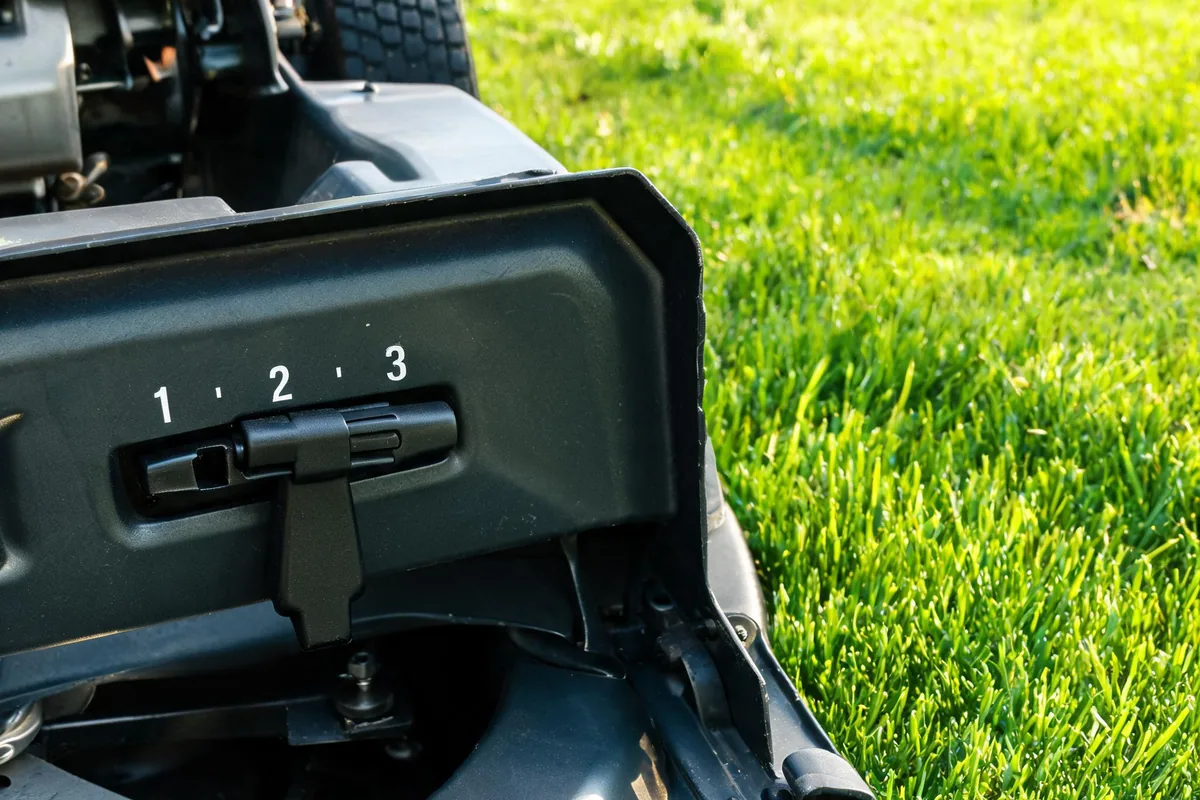
Proper Mowing Height by Grass Type
Mowing height is one of the most powerful and least used tools in lawn management. Most homeowners set the mower at a convenient height and never touch it.
—- title: "Proper Mowing Height by Grass Type" slug: mowing-height-guide hub: lawn category: Lawn guide description: "Mowing height is one of the most powerful and least used tools in lawn management. Most homeowners set the mower at a convenient height and never touch it. That one setting is often too low — a." date: 2026-06-10 updated: 2026-06-10 author: "Thomas A." reading_time: 9 —-
Mowing height is one of the most powerful and least used tools in lawn management. Most homeowners set the mower at a convenient height and never touch it. That one setting is often too low — a practice called scalping — which stresses the grass, opens the lawn to weed invasion, and reduces the root depth that determines drought tolerance.
Why mowing height matters biologically
The relationship between mowing height and root depth is documented in turfgrass research. Per Penn State Extension's turfgrass program, "shoot density and rooting depth are directly related to cutting height — as mowing height increases, rooting depth increases." This means a lawn mowed at 4 inches has significantly deeper roots than the same lawn mowed at 2 inches, translating to more drought tolerance and better access to subsoil nutrients.
The mechanism: grass leaves are the primary photosynthetic surface. When you cut them short, the plant allocates more energy to regrowing leaves (shoot priority) at the expense of root growth. Taller leaves generate more photosynthates, allowing the plant to invest in both shoots and roots.
Per NC State Extension, grass maintained at its recommended height also shades the soil surface more effectively, reducing soil temperatures and suppressing weed seed germination — particularly for annual weeds like crabgrass, which require light at the soil surface.
Mowing heights by grass species
Cool-season species
| Grass species | Recommended range | Notes |
|---|---|---|
| Kentucky bluegrass (Poa pratensis) | 2.5—4 inches | 3—4 inches in summer; can drop to 2.5 in fall |
| Tall fescue (Festuca arundinacea) | 3—4 inches | Higher heat tolerance at 3.5—4 inches; do not mow below 2.5 |
| Perennial ryegrass (Lolium perenne) | 2—3.5 inches | Can tolerate lower heights; 3 inches recommended for home lawns |
| Fine fescues (Festuca spp.) | 2—3.5 inches | Shade lawns at 3.5 inches; full sun at 2—2.5 |
| Creeping bentgrass (Agrostis stolonifera) | 0.125—0.5 inch | Golf course only; requires specialized mowing equipment |
Per Penn State Extension, the recommended height for Kentucky bluegrass on home lawns is 2.5—3.5 inches. Raise this to 3.5—4 inches in summer when heat stress is greatest.
Per Cornell Cooperative Extension, tall fescue should be maintained at 3—4 inches throughout the growing season. Mowing tall fescue below 2.5 inches opens the stand to summer heat damage and weed invasion.
Warm-season species
| Grass species | Recommended range | Notes |
|---|---|---|
| Bermudagrass (Cynodon dactylon) — common | 1—2 inches | Home lawn; lower heights require frequent mowing |
| Bermudagrass — hybrid (Tifway, Celebration) | 0.5—1.5 inches | Sports turf; requires reel mower |
| Zoysiagrass (Zoysia japonica) | 1—2.5 inches | Tolerates taller heights; mow before 3 inches to avoid scalping |
| Zoysiagrass (Zoysia matrella) | 0.5—1 inch | Finer textured; requires more frequent mowing |
| St. Augustinegrass (Stenotaphrum secundatum) | 3—4 inches | Tall maintenance height; shade tolerance declines below 3 inches |
| Centipedegrass (Eremochloa ophiuroides) | 1.5—2 inches | Do not exceed 2.5 inches; taller promotes scalping |
| Bahiagrass (Paspalum notatum) | 3—4 inches | Tolerates tall mowing; seedhead production at any height |
Per Texas A&M AgriLife Extension, St. Augustinegrass in shade should be maintained at the upper end of its range, 3.5—4 inches, because lower heights reduce the leaf area available for photosynthesis under limited light.
Per Clemson Extension HGIC, zoysiagrass mowed too infrequently (above 3 inches) develops a thick canopy layer and then scalps badly when cut down to the recommended height. The solution is more frequent mowing to stay within the recommended range, not less frequent mowing at a taller height.
The one-third rule
Per Penn State Extension, "never remove more than one-third of the leaf blade in any single mowing." This is not a suggestion — it is the most important mowing guideline in turfgrass management.
How it works in practice: If your lawn is maintained at 3 inches, mow when it reaches 4.5 inches (removing 1.5 inches, which is one-third of 4.5). If your lawn is at 2 inches, mow when it reaches 3 inches. If you wait until the lawn is 6 inches tall and then mow it to 3 inches, you are removing 50% of the leaf blade — a scalping event that will temporarily brown the lawn and stress the root system.
During peak spring growth, this may mean mowing twice a week. During summer dormancy for cool-season grasses, or winter dormancy for warm-season grasses, mowing frequency drops sharply.
Seasonal height adjustments
Cool-season lawns: raise in summer
Per Penn State Extension, "during periods of heat and drought stress, increasing the cutting height by 0.5 to 1 inch above the normal growing season height is recommended." This is the single adjustment that does more for a cool-season lawn's summer performance than any other practice.
Practical implementation: In late May, raise the mower deck from the normal 3-inch setting to 3.5—4 inches. Keep it there through August. Lower back to 3 inches after Labor Day as fall growth resumes.
Warm-season lawns: lower in fall, don't scalp
Per NC State Extension, warm-season grasses may be mowed at or near the lower end of their range as they approach dormancy to reduce the visual impact of browning straw. However, scalping — removing more than one-third of the blade at once — going into dormancy leaves roots exposed and vulnerable to winter injury.
The last mowing of the season
For cool-season grasses, per Penn State Extension, the last fall mowing should bring the lawn to 2.5—3 inches. This timing pairs with the fall overseeding window — see when to overseed your lawn and lawn aeration guide. For grass identification questions, see how to identify your grass type. Lawns left too tall going into winter mat down under snow, promoting snow mold (Microdochium nivale and Typhula spp.). Lawns cut too short lose insulating leaf tissue going into winter.
For warm-season grasses, maintain the normal height through the last mowing of the growing season. Do not scalp warm-season grass in fall.
Blade sharpness: the overlooked variable
Per Penn State Extension, a dull mower blade tears rather than cuts grass, leaving ragged brown tips on the leaf tissue. This cosmetic damage also creates entry points for fungal pathogens. Sharp blades produce clean cuts that heal quickly.
The standard recommendation: sharpen mower blades at least twice per season for a 5,000 sq ft lawn. For a 10,000+ sq ft lawn mowed weekly, sharpen every 8—10 hours of mowing time.
Signs of a dull blade: grass tips appear white to tan, lawn looks dull rather than green a day after mowing, ragged tips visible on individual blades.
Mulching vs. bagging clippings
Per Penn State Extension, grass clippings returned to the lawn decompose quickly and can supply up to 1 lb of actual nitrogen per 1,000 sq ft per season — equivalent to one fertilizer application. Mulching clippings does not cause or significantly worsen thatch. Thatch is composed primarily of stems and roots, not leaf blades.
Bag clippings only when:
- The lawn has disease (infected clippings can spread fungal spores)
- Clippings are too thick (clumping from missed mowing) and will smother grass beneath
- You're applying a systemic herbicide (bag treated clippings for 2—3 mowings)
Mowing patterns
Per NC State Extension, alternating mowing direction each time prevents grain (the directional lean of grass toward the last mowing direction) and avoids compaction ruts. For home lawns, three alternating patterns — north-south, east-west, diagonal — prevent soil compaction in wheel tracks.
Common problems table
| Symptom | Cause | Fix |
|---|---|---|
| Brown tips after mowing | Dull blade; or too much removed at once | Sharpen blade; follow one-third rule |
| Lawn thins after mowing | Mowing too low; scalping | Raise mowing height; aerate and overseed if stand is damaged |
| Strips of longer grass between mower passes | Missed strips due to uneven overlap | Slow down; ensure 2—3 inches of overlap between passes |
| Uneven height across lawn | Mower deck unlevel | Adjust deck to equal wheel height on all sides |
| Summer browning persists after rain | Grass mowed too short in heat | Raise deck; reduce mowing frequency in summer |
| Clumps of clippings after mowing | Allowed grass to grow too tall before mowing | Mow more frequently; bag if clumps won't break down within 2 days |
Frequently asked
What's the best mowing height for Kentucky bluegrass?
Per Penn State Extension, 2.5—3.5 inches during the normal growing season, raised to 3.5—4 inches in summer. Kentucky bluegrass is more heat-tolerant at taller heights — the extra leaf surface keeps soil temperatures lower and root systems deeper. The common instinct to mow short for a "tidy" look actively harms bluegrass during summer.
Can I mow bermudagrass with a rotary mower?
Yes, for home lawns maintaining common bermudagrass at 1—2 inches. At those heights, a sharp rotary mower produces acceptable results. Per Texas A&M AgriLife Extension, hybrid bermudagrasses (Tifway 419, Celebration, TifTuf) maintained at 0.5—1 inch require a reel mower — a rotary mower tears the leaf tissue at those heights and produces a rough, scalped appearance.
Should I bag my clippings if the lawn has grubs or fungal disease?
For fungal disease, yes — per Penn State Extension, infected clippings can deposit fungal spores on unaffected areas. Bag and dispose of (not compost) clippings when dollar spot, brown patch, or similar diseases are active. For white grub infestations, clipping management doesn't affect grub populations (they're in the soil); standard mulching is fine.
When should I mow a newly seeded lawn for the first time?
Per Penn State Extension, wait until new seedlings are 3—4 inches tall — typically 3—4 weeks after germination. Set the deck at 3 inches for the first cut. Mowing seedlings too early damages their shallow root systems and can uproot them entirely if the soil is wet.
—-
Sources
- Penn State Extension — <a href="https://extension.psu.edu/mowing">Mowing</a>.
- NC State Extension TurfFiles — <a href="https://turffiles.ncsu.edu/management/mowing/">Mowing Management</a>.
- Cornell Cooperative Extension Turfgrass — <a href="https://turf.cals.cornell.edu/">Turfgrass Resources</a>.
- Texas A&M AgriLife Extension — <a href="https://agrilifeextension.tamu.edu/lawn/">Lawn Care</a>.
- Clemson Extension HGIC — <a href="https://hgic.clemson.edu/factsheet/mowing/">Mowing</a>.