Pollinator Garden Design: Layout, Bloom Succession, Habitat
title: "Pollinator Garden Design: Layout, Bloom Succession, Habitat"
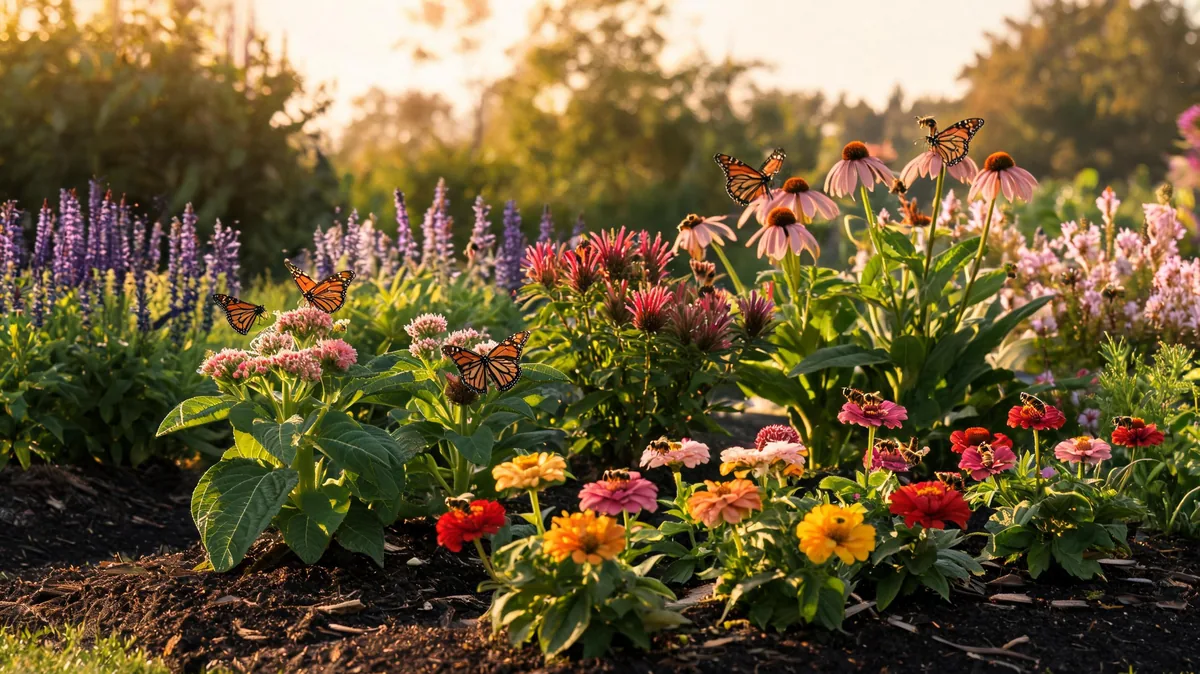
A pollinator garden is not simply a collection of bee-friendly plants. It is a designed system with three functional requirements: food (pollen and nectar from spring through fall), shelter (nesting sites and larval host plants), and protection from pesticides. A garden that provides all three functions year-round for multiple pollinator species requires planning — specifically, planning across time (bloom succession) and space (habitat layering).
This guide covers the design principles behind a functional pollinator garden, based on the framework published by the Xerces Society for Invertebrate Conservation and regional guidance from university Extension programs. The principles apply regardless of garden size — from a 100-square-foot suburban border to a multi-acre restoration.
This article contains affiliate links. As an Amazon Associate, we earn from qualifying purchases - at no extra cost to you. We only recommend products we have personally tested or that are the universal first recommendation from university Extension publications. See our full disclosure.
Design principle 1: bloom succession across the full season
The single most important design decision is ensuring continuous bloom from the earliest spring bee emergence through the latest fall foragers. Most gardens are designed around the summer peak (June—August) and have gaps in April—May and September—October — the two periods when pollinators are most stressed.
The spring gap (March—May)
Per Penn State Extension's pollinator habitat guide, the late-winter through early-spring period is the most critical gap in most landscapes. Native bee queens emerging from overwintering sites in March and April need immediate nectar and pollen. In most suburban landscapes, this need is unmet.
Plants that fill the spring gap:
- Willows (Salix spp.) and maples (Acer spp.): tree-scale pollen sources in March—April that are often the only pollen available to early queens
- Wild columbine (Aquilegia canadensis): April—June, hummingbirds and early bumblebees
- Golden alexanders (Zizia aurea): April—June, black swallowtail host and bee forage
- Prairie smoke (Geum triflorum): April—June, low-growing for front-of-border
- Wild blue lupine (Lupinus perennis): April—June, bumble bee specialist pollen
Keep deer and rabbits out
Liquid Fence uses egg-and-garlic scent. One application lasts 30 days and works on both deer and rabbits. Read our full pick.
The summer peak (June—August)
This is where most gardens have adequate coverage. Coneflowers, bee balm, bergamot, catmint, and the tall composites all perform in summer. The design challenge here is not finding plants but avoiding a monoculture of summer composites that all bloom simultaneously and then leave gaps.
Per UMass Extension's native plant guides, staggering the bloom within the summer season — early (June), mid (July), late (August) — ensures continuous resource across the peak season. This is achieved through species selection rather than spacing.
I grow catmint 'Walker's Low' in my Melville border as the June anchor, then coneflower and black-eyed Susan through July and August, then let the switchgrass and Joe Pye weed (nearby) carry into September. The transition is imperfect but there is never more than a few days without something open.
The fall gap (September—October)
Per the Xerces Society, the fall gap is the second most critical seasonal stress point. Bumblebee queens and solitary females need to build fat reserves for overwintering. Migrating monarchs need concentrated nectar sources. Native bees provisioning fall nests need abundant pollen in September.
Native goldenrod (Solidago spp.) and native asters (Symphyotrichum spp.) solve this problem. Both bloom August—October in most of the eastern U.S., overlap with the monarch migration, and are among the top-ranked bee forage plants per the Xerces Society's plant lists. Together they are the most important late-season additions to any eastern pollinator garden.