Problem

Deer-Resistant Perennials: What Actually Works in Suburban Long Island

No perennial is deer-proof. The most reliably ignored plants in high-pressure areas are aromatic herbs, fuzzy foliage, toxic plants, and the alliums. Hostas, daylilies, and tulips are deer candy.

Deer standing in a flowery field with dense green forest
Photo: Unsplash on Unsplash

—- title: "Deer resistant perennials" slug: deer-resistant-perennials hub: care category: "Plant list" description: "'Deer-resistant' is a marketing term. 'Deer-proof' doesn't exist. The honest framing is one I learned from the Rutgers Landscape Plants Rated by Deer Resistance publication, which has been the." date: 2026-06-10 updated: 2026-06-10 author: "Thomas A." reading_time: 11 zones_min: 3 zones_max: 9 —-

"Deer-resistant" is a marketing term. "Deer-proof" doesn't exist. The honest framing is one I learned from the Rutgers Landscape Plants Rated by Deer Resistance publication, which has been the most-used reference on this question in the mid-Atlantic for over twenty years: plants are rated A through D, where A is rarely damaged and D is frequently severely damaged, and even the As get eaten when deer are hungry enough.

I garden in Melville, on Long Island. Deer pressure here is moderate-to-high — there's an active herd that moves through my neighborhood every winter and early spring, and my front bed has been a long experiment in what they touch and what they don't. This guide is the intersection of what Rutgers and Penn State Extension have documented and what I have actually watched happen in my own yard.

The Rutgers rating system

The Rutgers New Jersey Agricultural Experiment Station's Landscape Plants Rated by Deer Resistance (publication E271) is the most rigorous deer-resistance reference for the mid-Atlantic. It assigns each plant a letter rating:

I'll use these ratings throughout this guide. They reflect data collected at multiple New Jersey sites with varying deer pressure — your local mileage will vary, but the relative rankings are reliable.

Rarely damaged (Rutgers A-rated) perennials

These are the plants deer pass over even in heavy-pressure areas, at least until winter starvation drives them to eat anything green. In my yard, all of these have survived 4+ winters with zero or minimal deer damage.

Aromatic foliage — the biggest category

Deer avoid plants with strong essential-oil aromas. The mechanism is plausibly the volatile compounds that deer find unpalatable, especially when other less-aromatic food is available. Per Penn State Extension's deer and rabbit resistant plant lists, this group includes:

Bulbs and alliums

Toxic plants

Deer learn to avoid plants that have made them sick. These plants are toxic to varying degrees and reliably ignored:

Fuzzy or prickly foliage

Ornamental grasses (most species)

Per the New Jersey deer-resistance work, most ornamental grasses fall in the A–B range. Notable A-rated:

Ferns

Per multiple extension lists, including Penn State Extension, ferns are reliably deer-resistant:

Seldom severely damaged (Rutgers B-rated) perennials

These take occasional browsing but generally come through without significant damage. Worth planting in moderate-pressure areas.

What deer actually eat (Rutgers C and D)

The other half of the equation — what to either fence, repellent-spray, or avoid planting:

Frequently severely damaged (Rutgers D):

Occasionally severely damaged (Rutgers C):

My own Long Island observations

This is anecdotal — local conditions matter enormously — but in my Melville yard with moderate-to-high deer pressure:

This roughly tracks the Rutgers ratings. The two consistent surprises in my yard were how badly tulips got hit (worse than expected for a bulb) and how reliably the aromatic herbs were ignored (better than expected, even by hungry late-winter deer).

What actually works when deer pressure is high

Tier 1 — Reliable:

Tier 2 — Effective with diligent application:

Tier 3 — Unreliable / placebo:

A starter "deer-resistant" border plan

If you're starting fresh and want a low-effort, deer-tolerant perennial bed, the following plant list will give you four-season interest with minimal browsing in most mid-Atlantic suburban yards:

Spring: Daffodils (drifts), ornamental alliums (Globemaster, Purple Sensation), bleeding heart, hellebore.

Early summer: Peony (B-rated, occasional spring browse on shoots), bearded iris (B-rated), catmint 'Walker's Low' (A-rated), lady's mantle.

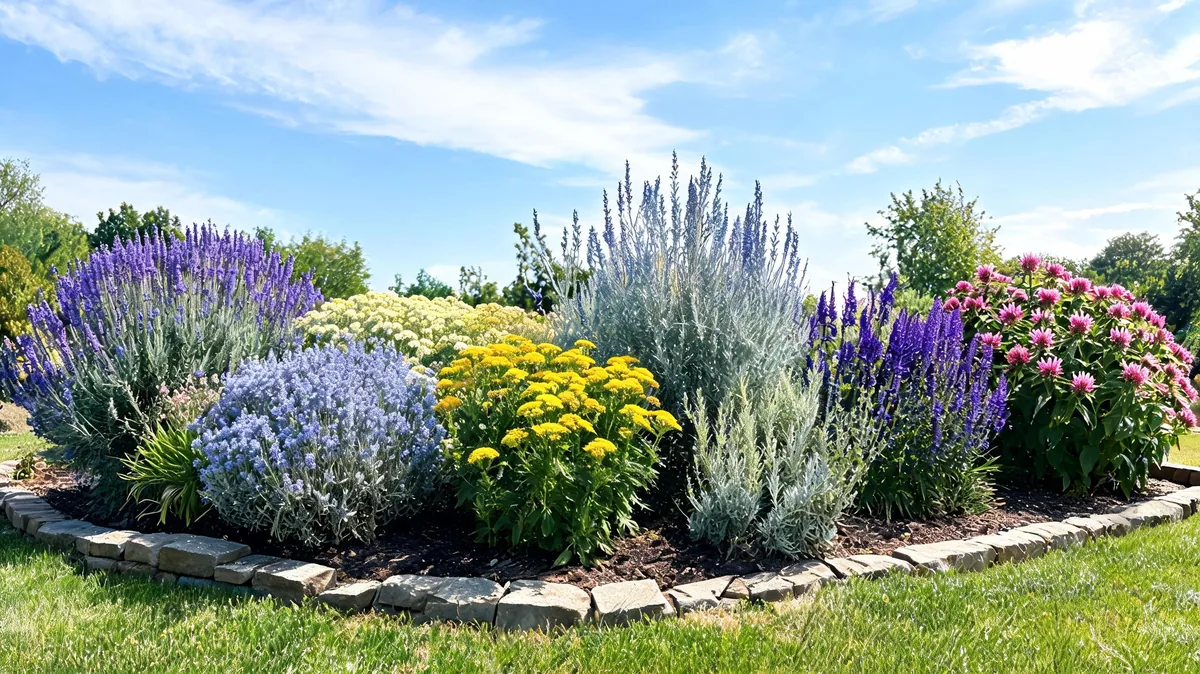
Mid-summer: Russian sage, salvia 'May Night', lavender, yarrow 'Moonshine', coneflower (B), black-eyed Susan (B).

Late summer / fall: Sedum 'Autumn Joy' (Rutgers A), ornamental grasses (switchgrass, little bluestem, miscanthus), goldenrod (B).

Winter structure: Ornamental grasses left standing, hellebore foliage, evergreen ferns (Christmas fern, autumn fern).

Every plant on this list is Rutgers A or B, available at most regional nurseries, and well-documented in the Rutgers and Penn State Extension publications.

A note on regional variation

The Rutgers ratings are based on New Jersey field observations. Deer in central New Jersey are not perfectly identical to deer in Vermont, Texas, or Oregon — local browse preferences vary based on what alternative food is available, what plants deer have grown up eating, and population density.

The relative rankings are robust — lavender will be more deer-resistant than hosta everywhere — but specific A-ratings may not hold up in a deer population that has learned to eat plants outside their normal preference. The Penn State Extension Master Gardener publication on rabbit-resistant plants and the Rutgers deer publication should be your starting points if you garden in the mid-Atlantic; OSU Extension's Central Oregon deer-resistant list is the analog for the West.

Recommended gear: Best deer repellent: Liquid Fence vs Bobbex vs Plantskydd — our buyer's guide covering picks for every budget, ranked by Extension publication consensus and personal use.

Frequently asked

Are there any deer-proof perennials?

No. Per the Rutgers Landscape Plants Rated by Deer Resistance publication, every plant on the "rarely damaged" list is rated A — not "deer-proof" — because in heavy-pressure areas or during winter starvation, deer will eat plants they normally ignore. The most reliable deer-resistant categories are aromatic-foliage herbs (lavender, catmint, Russian sage, salvia, thyme), toxic plants (foxglove, monkshood, hellebore), fuzzy-foliage plants (lamb's ears, mullein), and the alliums (ornamental onions, daffodils). Even within these categories, individual deer learn to eat what they grew up eating, so local conditions matter.

What do deer hate the most?

Strong aromatic herbs and toxic plants are the most reliably ignored. Per Rutgers and Penn State Extension lists, the consistently A-rated perennials are lavender, catmint, Russian sage, ornamental salvia, lamb's ears, yarrow, foxglove, monkshood, hellebore, daffodils, and ornamental alliums. None of these are deer-proof, but in moderate-pressure areas they go years without significant damage. The "smell-test" rule has predictive power — if a plant smells strongly when you brush against it (sage, lavender, catmint), deer usually avoid it.

Do deer eat hostas?

Yes, consistently. Hostas are among the most deer-browsed garden plants in the eastern U.S. Per multiple extension references and the Rutgers deer-resistance work, hostas are rated D — frequently severely damaged. In high deer-pressure suburbs, hostas planted in unprotected beds are eaten to the crown, often overnight. The only reliable protection is fencing or consistent repellent application. If deer pressure in your yard is significant, switching from hostas to Epimedium, ferns, Pulmonaria, or Solomon's seal for shade plantings is realistic — all are A-rated for deer resistance.

Are deer repellents actually effective?

Yes, with caveats, per Rutgers' deer management research. Taste-based repellents (rotten egg, hot pepper, putrescent egg solids) and odor-based repellents (predator urine, garlic, sulfur compounds) both work — but require reapplication every 1–2 weeks and after rain, and rotation between products to prevent deer habituation. The leading commercial products (Liquid Fence deer repellent, Plantskydd deer repellent, Bobbex) all have evidence behind them. Repellents are effective for small gardens and individual plant protection; for large landscapes with high deer pressure, fencing is more cost-effective long-term than repellents applied weekly across the entire property.

Sources

  1. Rutgers New Jersey Agricultural Experiment Station — Landscape Plants Rated by Deer Resistance (publication E271).
  2. Rutgers New Jersey Agricultural Experiment Station — An Overview of White-Tailed Deer Status and Management.
  3. Penn State Extension — Rabbit-Resistant Garden and Landscape Plants (Master Gardener publication, includes deer/rabbit dual-resistance ratings).
  4. Oregon State Extension — Deer-resistant plants for Central Oregon.
  5. University of Minnesota Extension — How to manage deer damage on trees and other plants.
  6. NC State Extension Plant Toolbox — Paeonia — Woody Types (tree peony deer-resistance note).