Thrips on Roses, Vegetables, and Ornamentals
title: "Thrips on Roses, Vegetables, and Outdoor Ornamentals"
—- title: "Thrips on Roses, Vegetables, and Outdoor Ornamentals" slug: thrips-outdoor hub: problems category: Problem description: "Thrips on roses, vegetables, and ornamentals: how to identify the silvery stippling damage, which species are most damaging, and how to treat infestations effectively." date: 2026-06-10 updated: 2026-06-10 author: "Thomas A." reading_time: 7 —-
Thrips are among the smallest and most destructive insect pests in the garden. Adults are barely 1/16 inch long, fringed with feathery wings, and easy to miss on a casual inspection. What they lack in size they compensate for in numbers and feeding intensity.
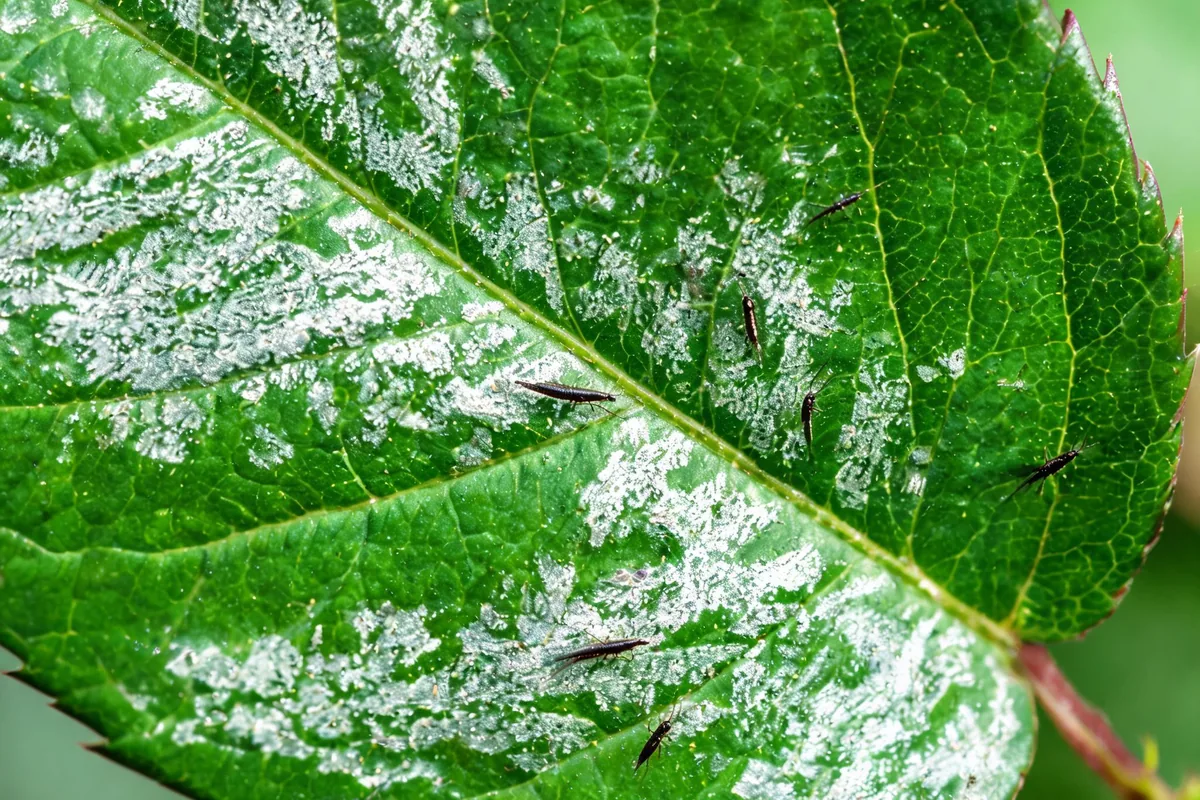
Per UC IPM, thrips feed by puncturing individual plant cells and consuming the contents. This produces the characteristic silver or bronze streaking and stippling on leaves and flowers. Heavy infestations distort growth, damage flowers, and in some cases kill plants. Beyond direct feeding damage, certain thrips species vector serious plant viruses.
Biology
Thrips belong to the order Thysanoptera. Per UC IPM, they have incomplete metamorphosis with egg, two larval stages, prepupa, pupa, and adult. The pupae typically develop in the soil or leaf litter.
Females of most species lay eggs inside plant tissue. Per Missouri Botanical Garden, "thrips have a high reproductive rate." In warm weather, a generation can be completed in as little as 2—3 weeks, allowing populations to build rapidly.
Thrips overwinter in plant debris, bark, and soil as pupae or adults. In the Northeast, thrips populations are typically highest in early summer and again in late summer through fall.
Common species and their hosts
Per UC IPM and Clemson HGIC:
| Species | Primary Hosts | Notes |
|---|---|---|
| Western flower thrips (Frankliniella occidentalis) | Roses, flowers, vegetables, many crops | Most damaging; vectors TSWV; widely distributed |
| Eastern flower thrips (Frankliniella tritici) | Grasses, flowers, fruit blossoms | Important in Northeast; attacks strawberry blossoms |
| Onion thrips (Thrips tabaci) | Onion, leek, garlic, some ornamentals | Can vector tomato spotted wilt virus |
| Rose thrips (Thrips fuscipennis) | Primarily roses | Brown-streaked petals |
| Tobacco thrips (Frankliniella fusca) | Legumes, corn, cotton | More common in Southeast |
Per UC IPM, Frankliniella occidentalis, the western flower thrips, is the most economically damaging thrips species in North America. It feeds on a very wide range of plants and is the primary vector of Tomato Spotted Wilt Virus (TSWV) and Impatiens Necrotic Spot Virus (INSV).
Identification and damage symptoms
Thrips are most reliably detected by tapping flower heads or leaves over a white piece of paper. The tiny insects will fall onto the paper and become visible as they move.
| Damage Type | Description | Common Plants Affected |
|---|---|---|
| Leaf silvering/bronzing | Stippled, silvery patches where cells have been emptied | Many vegetables, ornamentals |
| Flower distortion | Petals with brown streaks, edges curled or scarred | Rose, peony, lisianthus |
| Leaf curl | Young leaves curled and distorted | Many plants |
| Rust-colored spots on petals | Cell feeding damage | Roses, gladiolus, chrysanthemum |
| White or silvery streaks on leaf surface | Leaf feeding | Onion, leek, garlic |
| Virus symptoms (ring patterns, necrosis) | TSWV or INSV vectored by thrips | Tomato, pepper, impatiens, many others |
Per Penn State Extension, on roses, thrips damage manifests as brown streaking on petals, distorted buds that fail to open normally, and silvery stippling on leaves. In early-opening buds where thrips feed before petals open, the damage is only revealed when the flower finally opens — often to distorted, streaked, or browning petals.
Roses and thrips in the Northeast
Roses in Long Island and the Northeast commonly show thrips damage to flowers during June and July, peaking during hot, dry periods when thrips populations are highest. Per UC IPM, thrips are most active in warm, dry conditions. Rainy, cool periods naturally suppress thrips populations.
Symptoms: buds that open to reveal brown-edged, streaked, or distorted petals; flower color appears "off" or washed out; on inspection, tiny, slender insects visible inside the bud near the stamens.
Treatment
Cultural controls
Remove and destroy infested flowers. Per Missouri Botanical Garden, removing infested flowers immediately reduces the thrips population and eliminates sites where eggs are deposited. For roses during high thrips periods, remove spent and distorted flowers promptly.
Reflective mulch. Per UC IPM, silver or aluminum reflective mulch under plants disorients thrips and significantly reduces colonization. This is most practical in vegetable gardens.
Fall cleanup. Per Penn State Extension, removing plant debris in fall destroys thrips overwintering habitat and reduces the spring population.
Avoid excess nitrogen. High nitrogen produces the lush, tender growth that thrips prefer. Balanced fertilization reduces plant susceptibility.
Insecticides
Per UC IPM, insecticide applications for thrips have significant limitations:
- Thrips inside flowers and rolled leaves are protected from contact spray
- Thrips develop resistance to insecticides quickly
- Broad-spectrum insecticides kill natural enemies
Insecticidal soap: Kills thrips on contact; no residual activity; must contact the insect. Per Clemson HGIC, effective for exposed thrips on leaves.
Neem oil: The active compound azadirachtin disrupts thrips development and has feeding deterrent properties. Per Penn State Extension, neem is moderately effective against thrips and is compatible with beneficial insects at low concentrations. Apply early morning or evening to avoid burning foliage in heat.
Spinosad: Derived from soil bacteria; highly effective against thrips; OMRI-listed for organic use. Per UC IPM, spinosad is among the most effective insecticides for thrips and has lower impact on beneficial insects than pyrethroids. It is toxic to bees when wet — apply in the evening when bees are inactive.
Pyrethroids (bifenthrin, permethrin): Rapid knockdown; highly toxic to beneficial insects; avoid on flowering plants; resistance can develop with repeated use.
Biological control
Per UC IPM, natural enemies of thrips include:
- Pirate bugs (Orius spp.) — among the most effective thrips predators; active in most gardens
- Predatory mites (Amblyseius cucumeris, Neoseiulus cucumeris) — commercially available for release; most effective in protected environments
- Lacewing larvae — generalist predators that include thrips
Avoiding broad-spectrum insecticides allows these natural enemies to establish and provide some degree of suppression. Per Missouri Botanical Garden, in unsprayed gardens, natural enemy populations often prevent thrips from reaching damaging levels.
Thrips and tomato spotted wilt virus
Per UC IPM, western flower thrips and a few related species vector TSWV, one of the most economically damaging plant viruses affecting vegetables and ornamentals. Infected plants show:
- Bronze or purple streaking on leaves and stems
- Necrotic ring spots on leaves
- Distorted growing tips
- Stunted growth
There is no cure for TSWV. Thrips management — particularly reducing thrips populations in and near the vegetable garden — is the primary strategy for reducing virus spread. Per Rutgers NJAES, TSWV is present in New Jersey and the surrounding region and affects tomato, pepper, impatiens, and many other hosts.
Common problems table
| Symptom | Cause | Fix |
|---|---|---|
| Rose buds open to distorted, brown-streaked flowers | Western flower thrips inside buds | Tap bud over white paper to confirm; remove infested buds; spinosad |
| Silvery, stippled patches on vegetable leaves | Thrips feeding damage | Inspect undersides for insects; insecticidal soap; spinosad |
| Distorted young growth on many plants | Thrips feeding on growing tip | Prune infested tips; treat with neem or spinosad |
| Bronze/purple streaking plus ring spots on tomato | Possible TSWV (thrips-vectored) | No cure; remove plant; manage thrips to prevent spread |
| Heavy damage despite regular spraying | Thrips in flowers or leaf rolls protected from spray | Physical removal of infested tissue; improve timing; use spinosad |
Frequently asked
How do I check if my roses have thrips?
Per UC IPM, hold an open flower upside down over a white sheet of paper and tap it firmly several times. Tiny, slender insects that fall onto the paper and move are thrips. You can also gently open a distorted bud and look inside near the base of the petals and stamens — thrips congregate in the tight, protected spaces inside flowers.
Is there a systemic insecticide that works on thrips?
Per Penn State Extension, imidacloprid has some systemic activity against thrips in vegetative tissue, but its translocation into flowers makes it a pollinator risk and reduces its utility for thrips in blooms specifically. Acephate (a systemic organophosphate) is also effective but has broad toxicity to beneficial insects.
Can thrips spread from my roses to my vegetable garden?
Yes. Per UC IPM, western flower thrips move freely and feed on a wide range of hosts. Managing thrips on ornamentals near a vegetable garden reduces the potential for thrips to move to vegetables and potentially spread TSWV.
Why are thrips worse during dry spells?
Per Missouri Botanical Garden, hot, dry conditions favor thrips population growth and suppress their natural enemies, particularly predatory mites which require some humidity. Rainy periods physically dislodge thrips from plants and increase mortality from soil-dwelling pathogens. This is why thrips outbreaks in the Northeast typically peak during dry heat waves.
Recommended gear: Best Neem Oil for Gardens: How It Works and When to Use It — our buyer's guide covering picks for every budget, ranked by Extension publication consensus and personal use.
Sources
- UC IPM — <a href="https://ipm.ucanr.edu/PMG/PESTNOTES/pn7429.html">Thrips</a>
- Penn State Extension — <a href="https://extension.psu.edu/thrips">Thrips</a>
- Missouri Botanical Garden — <a href="https://www.missouribotanicalgarden.org/gardens-gardening/your-garden/help-for-the-home-gardener/advice-tips-resources/insects-pests-and-problems/insects/thrips">Thrips</a>
- Clemson HGIC — <a href="https://hgic.clemson.edu/factsheet/thrips/">Thrips</a>
- Rutgers NJAES — <a href="https://njaes.rutgers.edu/plantdisease/">Plant Disease Profiles</a>