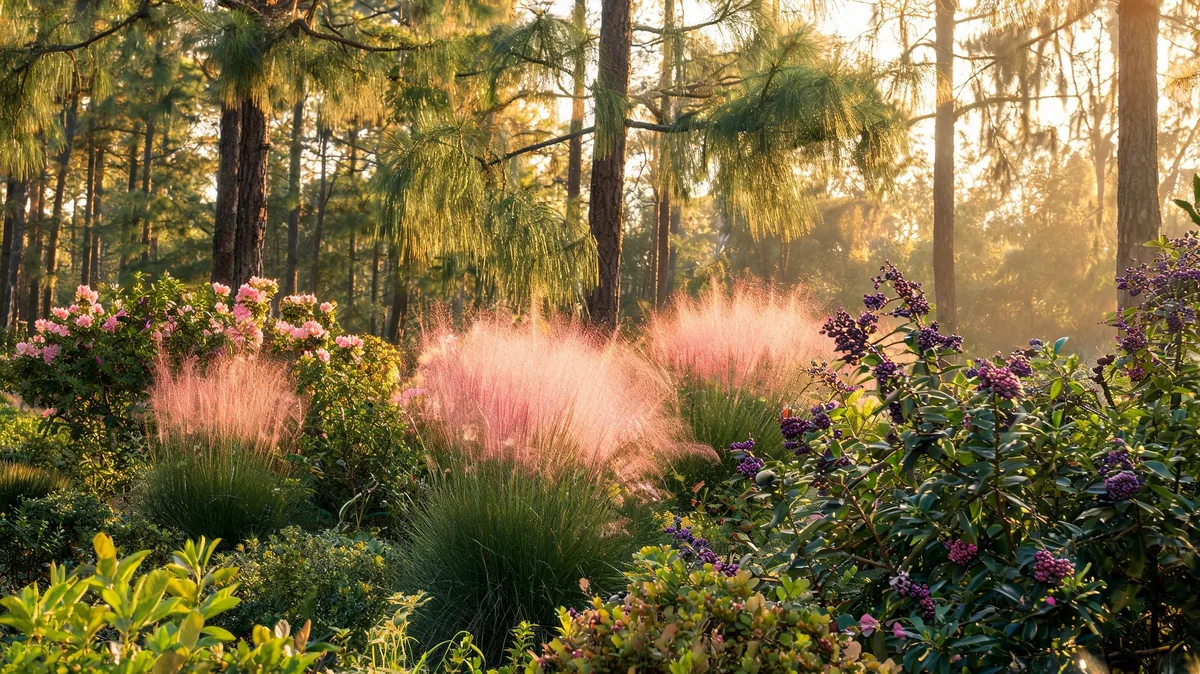
The Southeast United States — encompassing Virginia, North Carolina, South Carolina, Georgia, Florida, Alabama, Mississippi, Louisiana, Arkansas, and Tennessee — is one of the most botanically diverse regions in North America. Per the Lady Bird Johnson Wildflower Center, the Southeast contains several plant diversity hotspots, including the Appalachian highlands (among the highest vascular plant diversity in temperate North America) and the coastal plain's longleaf pine ecosystem, which once covered 90 million acres and now persists on less than 3% of its historical range.
USDA hardiness zones range from zone 5b in the Blue Ridge Mountains to zone 10b in South Florida. Summers are hot and humid. Soils range from the acidic, well-drained sandy loam of the Piedmont to the heavy clay of the coastal plain and the seasonally flooded soils of river bottoms. Any planting advice that ignores this variation — recommending the same plants for Charlotte and Miami — is oversimplifying.
Trees: the ecological foundation
Longleaf pine (Pinus palustris): Zones 7—10. Per the US Fish & Wildlife Service's longleaf pine conservation program, the longleaf pine ecosystem is the most biodiverse forest type east of the Mississippi and is critically endangered. Longleaf is a foundation species — its fire-adapted open canopy allows a rich groundlayer of native grasses, wildflowers, and orchids. For large properties in the Southeast's coastal plain, longleaf restoration is the highest-value ecological action available.
Live oak (Quercus virginiana): Zones 7—11. The quintessential southern evergreen tree. Like all oaks, it supports high caterpillar diversity. Per Clemson HGIC, live oak is extremely long-lived (centuries), salt-tolerant, and among the most hurricane-resistant trees in the coastal Southeast.
American beech (Fagus grandifolia): Zones 3—9. A large forest tree with smooth gray bark and edible nuts. Supports 100+ caterpillar species. Slow-growing but extraordinarily long-lived. Currently under threat from beech leaf disease in parts of its range.
Flowering dogwood (Cornus florida): Zones 5—9. The spring signature tree of eastern North America — white bracts appear before the leaves in April. Per NC State Extension, it provides berries consumed by 36 species of birds and is the larval host for spring azure and summer azure butterflies.
Eastern red cedar (Juniperus virginiana): Zones 2—9. A native evergreen that provides critical winter cover for birds and larval host for the olive hairstreak butterfly. Per Clemson HGIC, it tolerates a wide range of soils including dry and poorly drained, and is one of the most adaptable native trees in the Southeast.
More like this, monthly
Get the seasonal care notes — no upsell, unsubscribe any time.
One email per month from Thomas: what to plant, what to prune, what's about to break. Cited the same way as the guides.
Free. No spam. Same author as the guide you just read.
Got it — check your inbox to confirm. Welcome.
Kill caterpillars, spare everything else
Bacillus thuringiensis (Bt) only affects caterpillars — bees, birds, pets, and beneficials are totally safe. Kills feeding worms in 1-3 days. Read our full pick.