Growing Onions: Day-Length, Spacing & Curing Guide
title: "Growing Onions: Complete Garden Guide"
—- title: "Growing Onions: Complete Garden Guide" slug: growing-onions hub: vegetables category: Vegetable description: "How to grow onions from sets, transplants, or seed: day-length selection, planting depth, spacing, curing, and solving the most common problems." date: 2026-06-10 updated: 2026-06-10 author: "Thomas A." reading_time: 9 —-
I don't grow onions at my Long Island plot — my vegetable beds are committed to tomatoes, peppers, cucumbers, and a few greens. This guide draws from Cornell Cooperative Extension, Penn State Extension, and NC State Extension, along with Johnny's Selected Seeds growing guides, which together represent the most detailed published guidance on home onion production in the mid-Atlantic and Northeast.
Onions trip up gardeners not through complicated care but through one poorly understood concept: day-length. An onion variety that bulbs beautifully in Georgia will produce only scallion-sized results in New York, and vice versa. Getting the day-length match right is the foundational decision.
Day-length: the critical selection factor
Allium cepa cultivars are classified by the day-length required to trigger bulb initiation:
Long-day onions (13—16 hours of daylight to initiate bulbing): Required for USDA zones 6 and north, including all of the Northeast and upper Midwest. Bulbing is triggered by the long days of late spring and early summer at northern latitudes. Varieties: 'Walla Walla Sweet', 'Yellow Sweet Spanish', 'Copra' (excellent storage), 'Cortland', 'Patterson' (long storage).
Short-day onions (10—12 hours): For zones 7 and south, grown as a winter/spring crop where winters are mild. Varieties: 'Granex' (Vidalia parent variety), 'Texas SuperSweet', '1015Y Texas SuperSweet'. Per NC State Extension, these bulb during the short days of late winter and spring in the South; in zone 7a (Long Island), short-day types will bulb prematurely before reaching full size.
Intermediate/day-neutral onions (12—14 hours): Per Cornell Cooperative Extension, intermediate types are suitable for zones 5—7 and provide more flexibility than strict long-day or short-day types. 'Candy' is the best-known intermediate.
For zone 7a Long Island: long-day or intermediate types. 'Copra', 'Patterson', 'Walla Walla Sweet', and 'Candy' are reliable choices per Cornell and Johnny's.
Days to maturity (from transplant): 'Copra' (104 days), 'Patterson' (98 days), 'Walla Walla Sweet' (115 days), 'Candy' (85 days). Per Johnny's Selected Seeds, days-to-maturity figures are from transplant, not from seed.
USDA zones and temperature requirements
Onions are hardy biennials grown as annuals across USDA zones 3—10, with variety selection determining suitability. Per Cornell Cooperative Extension, onions are cold-hardy once established — transplants tolerate temperatures down to 20°F after proper hardening. Seeds germinate best at 65—75°F soil temperature; plants grow best at air temperatures of 55—75°F.
Per Penn State Extension, \"onions thrive in cool weather.\" In zone 7a, plant transplants or sets as soon as the ground can be worked in early spring — typically late March to early April. The goal is maximum vegetative growth before the long days of June trigger bulb initiation.
Starting: seeds, sets, or transplants?
From seed: Started indoors 10—12 weeks before the last frost date. Per Cornell, \"sow seeds in flats indoors 10 to 12 weeks before you plan to transplant them outside.\" Growing from seed allows the widest variety selection and often produces larger, better-quality bulbs than sets. Germination takes 7—10 days at 65—75°F. Per Penn State Extension, use a seedling heat mat to maintain soil temperature and a grow light 2—3 inches above seedlings.
From transplants: Nursery-started transplants are the most reliable method for home gardeners. Per Cornell, transplants should be pencil-diameter thick at the time of planting. Thinner transplants are acceptable but may produce smaller bulbs.
From sets: Small dormant bulbs sold in spring. Sets are convenient but variety selection is limited, typically to 'Yellow' or 'White' generic types. Per Penn State Extension, sets larger than 3/4 inch in diameter are more prone to bolting than smaller sets or transplants. Sets produce results faster than seed but often yield smaller, thinner-skinned bulbs with shorter storage life than transplant-grown onions.
Spacing and planting depth
Per Cornell Cooperative Extension, plant onion transplants or sets 4—6 inches apart in rows 12—18 inches apart. For scallions (green onions harvested before bulbing), 1-inch spacing is appropriate.
Per Penn State Extension, plant sets or transplants no deeper than 1 inch. Planting too deeply delays bulbing and can cause disease issues at the base of the plant. The tip of the set should be just below or at the soil surface.
Soil and fertilizing
Per Cornell Cooperative Extension, onions \"prefer well-drained, fertile, loamy soil with a pH of 6.0 to 7.0.\" Poorly drained soil promotes root disease; onions will not produce good bulbs in wet, compacted soil.
Fertility requirements: Per Cornell, onions are heavy nitrogen feeders. Apply 3—4 pounds of 10-10-10 fertilizer per 100 square feet before planting. Side-dress with nitrogen when plants are 6 inches tall and again when they are 12 inches tall; per Cornell, use 1/3 cup of ammonium nitrate or equivalent per 10-foot row. Espoma Plant-tone 5-3-3 provides a balanced organic alternative.
Stop fertilizing: Per Cornell, stop all nitrogen applications when bulbs begin to swell (when leaves start to fall over). Late nitrogen application delays maturity and reduces storage life. Per NC State Extension, late nitrogen also promotes thick necks that don't cure or store well.
Watering
Per Cornell Cooperative Extension, onions need 1 inch of water per week during active growth. Per Penn State Extension, \"water regularly throughout the growing season.\" Reduce watering significantly in the final 2—3 weeks before harvest to encourage proper curing and tight neck formation. Per NC State Extension, wet conditions at harvest time promote neck rot and reduce storage life.
Soaker hose irrigation is preferred over overhead watering; wet foliage promotes foliar diseases including Botrytis neck rot.
Harvesting and curing
Per Cornell Cooperative Extension, \"when approximately half of the tops have fallen over naturally, the bulbs are ready to harvest.\" Push over any remaining upright tops by hand; this stops neck growth and begins curing. Do not wait for all tops to fall — bulbs may begin to re-root if left too long after the majority have fallen.
Harvest on a dry day. Lift bulbs with a garden fork; do not pull by the tops, as neck damage reduces storage life.
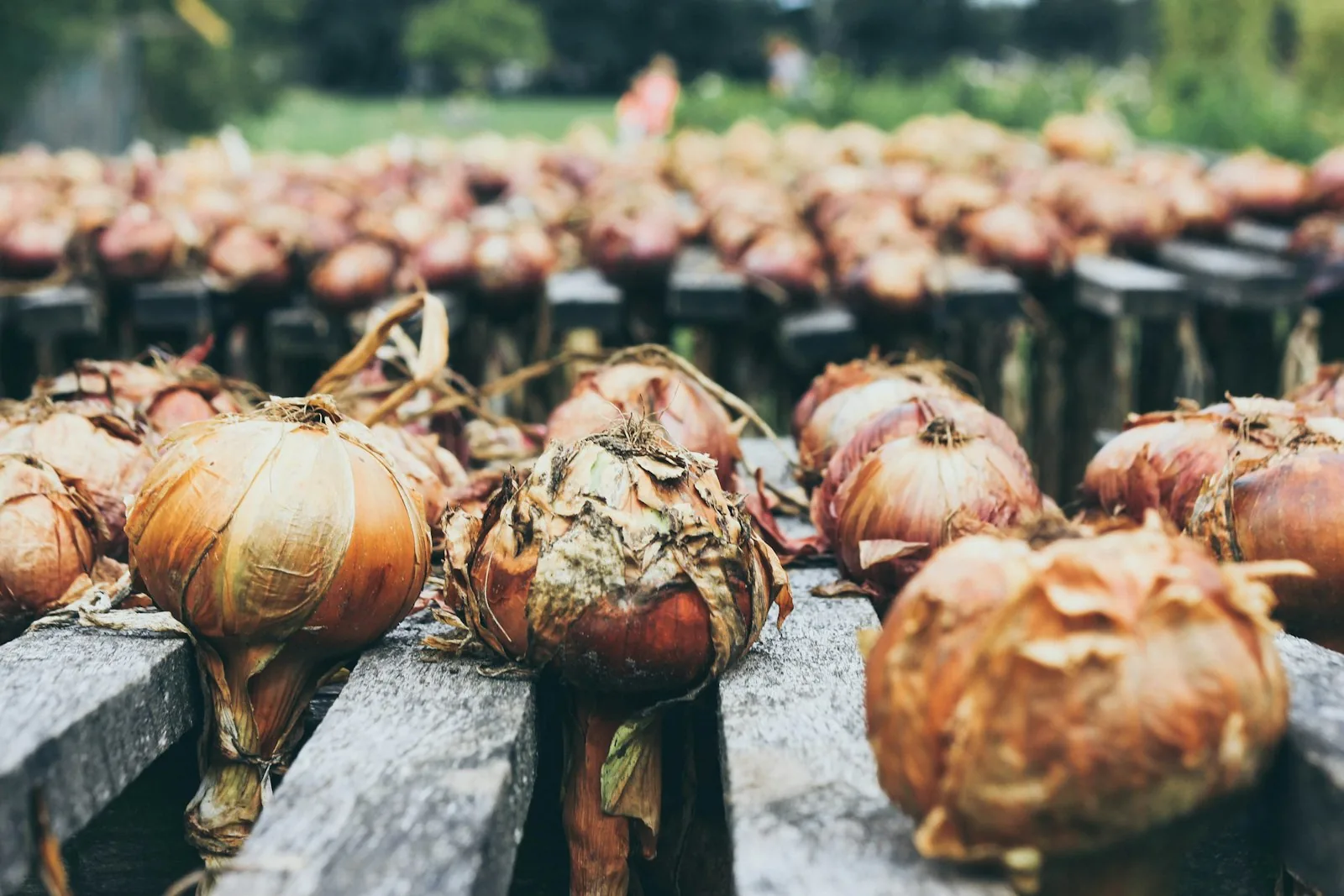
Curing: Per Penn State Extension, cure harvested onions for 3—4 weeks in a warm (75—85°F), dry, well-ventilated location out of direct sunlight. Per NC State Extension, \"curing is essential for long-term storage.\" Onions that are not properly cured develop neck rot during storage. After curing, per Cornell, trim roots and tops to 1 inch and store at 32—40°F with low humidity. 'Copra' and 'Patterson' store 6—10 months under proper conditions; sweet types like 'Walla Walla' store only 2—3 months.
Pests and diseases
Onion thrips (Thrips tabaci): Per Cornell Cooperative Extension, onion thrips are the most significant insect pest of onions in the Northeast. Feeding causes silver streaking on leaves and, in severe infestations, reduces bulb size. Per NC State Extension, control with insecticidal soap sprays when thrips are first detected; Safer insecticidal soap is an OMRI-listed option. floating row cover during early establishment can reduce initial thrips pressure.
Botrytis neck rot (Botrytis allii): The most common storage disease. Per Penn State Extension, neck rot begins at the neck of the bulb after harvest if curing was inadequate. Infection often originates in the field through wet foliage. Control: avoid overhead irrigation, ensure complete curing before storage, improve airflow in storage.
Onion maggot (Delia antiqua): Per Cornell, larvae burrow into the base of onion plants, killing seedlings or causing bulb rot. floating row cover from planting through mid-June (main egg-laying period) is the most effective organic control. Agribon row cover sealed at the edges prevents adult fly access.
Pink root (Pyrenochaeta terrestris): Per NC State Extension, a soilborne disease causing roots to turn pink and die back. Rotate onions to a different bed; avoid planting onions in the same location for 3+ years.
Common problems
| Symptom | Most likely cause | Fix |
|---|---|---|
| No bulb forms or very small bulbs | Wrong day-length variety for latitude; planted too late | Use long-day types in zones 6+; plant in early spring |
| Bolting (flower stalk forms) | Large sets; heat stress | Use smaller sets (<3/4 in); transplants are more reliable |
| Thick necks; poor storage | Late nitrogen application; wet at harvest | Stop fertilizing when bulbs swell; reduce water before harvest |
| Neck rot in storage | Inadequate curing; wet harvesting conditions | Cure fully (3—4 weeks); dry weather harvest |
| Silver streaking on leaves | Onion thrips | insecticidal soap; floating row cover early season |
| Bulb rot at base; maggot visible | Onion maggot | floating row cover from planting; crop rotation |
| Small, soft bulbs despite good plants | Harvested too early; disease | Wait for 50% of tops to fall; check for pink root |
Recommended gear: Best Soaker Hose for Vegetable Gardens (2026) — our buyer's guide covering picks for every budget, ranked by Extension publication consensus and personal use.
Frequently asked
What is the difference between long-day and short-day onions?
Per Cornell Cooperative Extension, bulb initiation in onions is triggered by day length. Long-day varieties require 13—16 hours of daylight to begin forming a bulb — the day lengths that occur in northern latitudes from late May through June. Short-day varieties bulb at 10—12 hours, appropriate for southern winters. In zone 7a (Long Island), planting a short-day variety means the plant bulbs in April before it has grown large enough to produce a useful bulb. Always select long-day or intermediate varieties for zones 6 and north.
Should I grow onions from seed, transplants, or sets?
Per Penn State Extension, transplants grown from seed offer the widest variety selection and typically produce better bulbs with longer storage life than sets. Sets are faster and more convenient but are limited to a few generic varieties and large sets are prone to bolting. For the best results in zone 7a, start long-day varieties from seed indoors in early February, or buy transplants from a reputable source. Sets from a local garden center are an acceptable compromise for gardeners who don't want to start from seed.
When should I stop watering onions before harvest?
Per Cornell, reduce irrigation in the final 2—3 weeks before harvest, once about half the tops have begun to fall over. Wet conditions at this stage produce thick, wet necks that resist curing and rot quickly in storage. Per NC State Extension, onions harvested after a wet period should be cured with extra attention to airflow.
How long do onions store?
Storage life depends on variety. Per Penn State Extension, storage onions like 'Copra' and 'Patterson' keep 6—10 months when properly cured and stored at 32—40°F with low humidity. Sweet onions like 'Walla Walla Sweet' have a much shorter storage life (2—3 months maximum) because their lower sulfur content — what makes them sweet — also makes them less resistant to storage rot. Use sweet types first; store the pungent long-day types for winter.