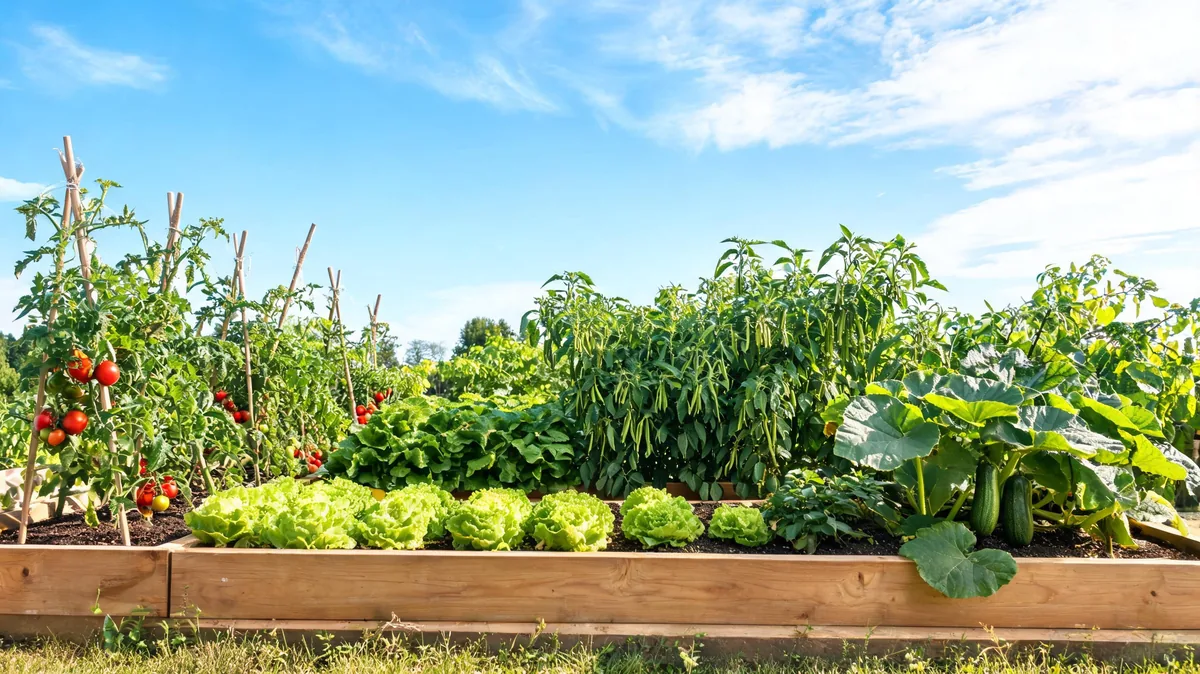
Beginner Vegetable Garden: Layout, Spacing, and What to Plant
The first vegetable garden almost always starts too big. A beginner who sets out a 20x30-foot plot in April is typically overwhelmed by June — too much weeding, too much harvest at once, and too many crops that fail to p
—- title: "Beginner Vegetable Garden Layout and What to Plant" slug: beginner-vegetable-garden hub: vegetables category: Vegetable guide description: "The first vegetable garden almost always starts too big. A beginner who sets out a 20x30-foot plot in April is typically overwhelmed by June — too much weeding, too much harvest at once, and too." date: 2026-06-10 updated: 2026-06-10 author: "Thomas A." reading_time: 9 —-
The first vegetable garden almost always starts too big. A beginner who sets out a 20x30-foot plot in April is typically overwhelmed by June — too much weeding, too much harvest at once, and too many crops that fail to produce. The outcome is often a garden that gets abandoned by July and planted again next year, slightly smaller.
A better starting point: 100-200 square feet, four to six crops with proven track records for a given region, a layout that minimizes weeding and watering work, and a plan that builds skill without requiring perfection. Per Penn State Extension, "starting small is the key to success for beginning vegetable gardeners."
Site Selection
All vegetable production depends on adequate sunlight. Per Cornell Cooperative Extension, most fruiting vegetables (tomatoes, peppers, squash, beans) require "at least 6 to 8 hours of direct sun per day." Leafy greens and root vegetables tolerate 4-6 hours.
Choose the sunniest, most accessible location on your property. Per Penn State Extension, "a spot near the house is easier to monitor and water." Gardens placed far from the water source or in out-of-the-way corners tend to be neglected.
Zone 7a Long Island considerations: The south or southwest side of a structure or fence captures the most sun and also reflects heat, which benefits warm-season crops. Avoid planting under or near large deciduous trees: tree roots compete aggressively for water and nutrients, and the leaf canopy reduces light.
Layout Options for Beginners
4x8-Foot Raised Bed
The standard beginner layout. Per Penn State Extension, a 4x8-foot bed gives all areas "within arm's reach from either side" — no walking on the soil, no compaction, easy weeding. For a single raised bed, a beginner can plant:
- 1 indeterminate tomato (back center, staked to 6 feet)
- 2 pepper plants (back sides)
- 4 bush bean plants (mid-section)
- 4 lettuce transplants (front, partial shade from taller plants acceptable)
- 1 zucchini hill (separate bed recommended — zucchini will take over a 4x8)
Zucchini is a sprawling plant. Per Penn State Extension, "zucchini plants require 3-4 square feet of space per plant." A single plant will occupy most of a 4x8 bed if allowed to sprawl. Grow it in a separate space or train upright on a trellis.
In-Ground Row Garden (100 sq ft)
For beginners with good native soil, a 10x10-foot in-ground plot is a manageable starting size. Per Cornell Cooperative Extension, orient rows "north to south so all plants receive adequate sunlight," with tall crops (tomatoes, corn) on the north end.
A simple 100-square-foot plot plan:
- Row 1 (north): 2 tomato plants, staked at 24-inch spacing
- Row 2: 1 row of beans, 8-10 plants
- Row 3: 3-4 zucchini or cucumber hills
- Row 4: Lettuce and radish mix, succession-sown
What to Plant: Five Reliable Crops for Zone 7a Beginners
1. Bush Beans (Phaseolus vulgaris)
The easiest vegetable in a zone 7a garden. Direct-sow after last frost (mid-May), no transplanting required, no staking, no pruning. Per Penn State Extension, "bush beans are ready to harvest about 50 to 60 days after planting." Per Cornell, space seeds "2 to 4 inches apart in rows 18 to 24 inches apart."
Harvest when pods are 3-5 inches long and snap cleanly without stringiness. Do not let pods mature on the plant — once beans begin to form seeds inside the pod, the plant stops producing new flowers.
Beginner advantage: Beans are nearly impossible to kill in the right temperature window. They fix their own nitrogen and require no supplemental fertilizer if compost is mixed into the bed.
2. Zucchini (Cucurbita pepo)
High yield, fast turnaround. Per Penn State Extension, "the first squash are usually ready 50 to 55 days after planting." The challenge is harvest frequency — a zucchini left unharvested for three days can grow from 6 inches to 12 inches, which is too large. Per Cornell, "harvest summer squash when they are 4 to 8 inches long for best quality."
Beginner advantage: Unmistakable plants, no trellising required, and the harvest signal (oversized fruit) is visible from ten feet away.
3. Lettuce (Lactuca sativa)
Lettuce is the fastest-maturing crop in the spring garden. Per Cornell Cooperative Extension, leaf types mature in "40 to 45 days" from sowing. Sow directly in early April (2-4 weeks before last frost) for a May harvest. In zone 7a, lettuce stops producing quality leaves when temperatures consistently exceed 80°F — target a spring and fall crop, not a summer one.
Beginner advantage: Inexpensive, fast, and immediately satisfying. The first lettuce harvest typically arrives before any other vegetable in the garden.
4. Tomatoes (Solanum lycopersicum)
The most commonly grown home garden vegetable, for good reason. Per Cornell Cooperative Extension, a single indeterminate plant can produce 10-15 pounds of fruit per season under good conditions. For beginners, cherry tomato types (Sungold, Sweet 100) are more forgiving than large-fruited varieties because they tolerate temperature fluctuations and produce faster.
Beginner tomato errors: planting too early into cold soil (per Cornell, wait until nighttime temps are "consistently above 45°F"), not providing adequate support (a 6-foot stake or heavy cage is required for indeterminates), and watering inconsistently (which causes blossom end rot and cracking). Per NC State Extension, "keep the soil consistently watered to avoid blossom end rot and splitting fruit."
5. Radishes (Raphanus sativus)
Mature in 25-30 days, require almost no space, and are direct-sown. Per Cornell, "radishes are among the easiest vegetables to grow." They are an ideal beginner crop because the turnaround is fast enough to teach the cause-and-effect of planting, watering, and harvesting within a single month.
Radishes fail when:
- Left in the ground too long (they turn pithy and hot when they bolt)
- Planted in summer heat (they bolt before sizing up)
- Planted too densely without thinning (roots won't size up without 2-inch spacing per Cornell)
Spacing Reference
| Crop | Spacing Between Plants | Row Spacing |
|---|---|---|
| Tomatoes (indeterminate) | 18-24 inches | 36-48 inches |
| Zucchini | 36-48 inches per hill | 48-60 inches |
| Bush beans | 3-4 inches | 18-24 inches |
| Lettuce (head) | 8-12 inches | 12-18 inches |
| Lettuce (loose-leaf) | 4-6 inches | 12 inches |
| Radishes | 2 inches (thin to this) | 6-12 inches |
| Cucumbers (bush) | 12-18 inches | 48 inches |
| Peppers | 18-24 inches | 24-36 inches |
Spacing data per Cornell Cooperative Extension and Penn State Extension.
Soil Preparation for Beginners
Per Penn State Extension, "most vegetable gardens need 2 to 3 inches of organic matter incorporated into the top 8 to 10 inches of soil." For in-ground planting, this means adding aged compost (not raw manure) and working it in with a fork or tiller before planting.
A soil test from your county extension office costs $10-20 and tells you pH and major nutrient levels. Per Cornell, most vegetables prefer a soil pH of 6.0-6.8. Long Island sandy loam tends to be slightly acidic; if pH is below 6.0, add lime per the test recommendation before planting.
What not to do: Adding too much fertilizer to an unprepared bed, or adding "fresh" (uncomposted) manure, promotes lush growth but can cause nutrient toxicity, salt burn, or pathogen introduction (in fresh manure). Per Penn State Extension, "only aged or composted manure should be used in vegetable gardens to avoid pathogens."
Common Beginner Mistakes
| Mistake | Result | Correction |
|---|---|---|
| Planting too large an area | Overwhelm, abandonment | Start with 100 sq ft or one 4x8 bed |
| Planting tomatoes too early | Cold-stunted plants | Wait until nighttime temps consistently above 45°F |
| Not staking indeterminate tomatoes | Plant sprawl, disease, yield loss | Install 6-foot stake at planting |
| Inconsistent watering | Blossom end rot, cracking, bolting | Mulch + drip irrigation or regular hand watering |
| No succession planting | Glut, then nothing | Stagger lettuce, radish, and bean plantings 2-3 weeks apart |
| Planting zucchini in a small bed | Zucchini takes over | Give each zucchini plant its own 16-square-foot area |
Frequently Asked
What are the easiest vegetables to grow for a beginner in zone 7a?
Bush beans, zucchini, cherry tomatoes, lettuce, and radishes have the highest success rates for zone 7a beginners. Per Penn State Extension, bush beans and zucchini are "among the most productive and easiest vegetables for new gardeners." Cherry tomato types (Sungold, Sweet Million) are more forgiving than large-fruited heirlooms — they tolerate temperature fluctuations and produce faster. Radishes are the best fast-feedback crop: planted, grown, and harvested in 25 days.
How much sun does a vegetable garden need?
Per Cornell Cooperative Extension, fruiting vegetables require 6-8 hours of direct sun daily. Leafy greens (lettuce, spinach, kale) can manage with 4-6 hours. Below 4 hours, production drops significantly for most crops. If your yard does not have a 6-8 hour sun spot, prioritize leafy greens and root vegetables over fruiting crops.
How often should I water a beginner vegetable garden?
Per Cornell Cooperative Extension, most vegetable gardens need "1 inch of water per week from rain or irrigation." In hot, dry weather (typical July-August on Long Island), this may increase to 1.5-2 inches. The most reliable approach for beginners is to check soil moisture 2 inches deep before watering — if it is still moist at that depth, skip the watering. Per NC State Extension, inconsistent watering (long dry spells followed by heavy water) causes more problems than slight underwatering.
Can I grow vegetables in containers?
Yes, with important constraints. Per Penn State Extension, containers must be large enough: tomatoes need at least a 5-gallon container (10-15 gallon is better), peppers 3-5 gallons, and zucchini is impractical in containers due to root volume requirements. Container gardens dry out faster than in-ground or raised bed gardens and need more frequent watering — sometimes daily in summer. Lettuce, radishes, and herbs are the most practical container vegetables.
—-
Recommended gear: Best Raised Garden Bed Kits: Cedar vs. Metal vs. Fabric — our buyer's guide covering picks for every budget, ranked by Extension publication consensus and personal use.
Sources
- Penn State Extension — <a href="https://extension.psu.edu/vegetable-gardening-a-beginners-guide">Vegetable Gardening: A Beginner's Guide</a>.
- Cornell Cooperative Extension — <a href="https://gardening.cals.cornell.edu/lessons/vegetables/vegetable-gardens/">Vegetable Gardens</a>.
- Penn State Extension — <a href="https://extension.psu.edu/raised-bed-gardening">Raised Bed Gardening</a>.
- Penn State Extension — <a href="https://extension.psu.edu/beans-in-the-garden">Beans in the Garden</a>.
- Penn State Extension — <a href="https://extension.psu.edu/summer-squash">Summer Squash</a>.
- NC State Extension Plant Toolbox — <a href="https://plants.ces.ncsu.edu/plants/solanum-lycopersicum/">Solanum lycopersicum (Tomato)</a>.
Sources
- Penn State Extension — Vegetable Gardening: A Beginner's Guide.
- Cornell Cooperative Extension — Vegetable Gardens.
- Penn State Extension — Raised Bed Gardening.
- Penn State Extension — Beans in the Garden.
- Penn State Extension — Summer Squash.
- NC State Extension Plant Toolbox — Solanum lycopersicum (Tomato).