Tomato Hornworm: Identification, Damage, and Control
title: "Tomato Hornworm: Identification, Damage, and Control"
—- title: "Tomato Hornworm: Identification, Damage, and Control" slug: tomato-hornworm hub: problems category: Problem description: "Tomato hornworms can strip a plant in days. Learn to identify them, spot damage early, and control them using Extension-sourced methods including biological controls." date: 2026-06-10 updated: 2026-06-10 author: "Thomas A." reading_time: 8 —-
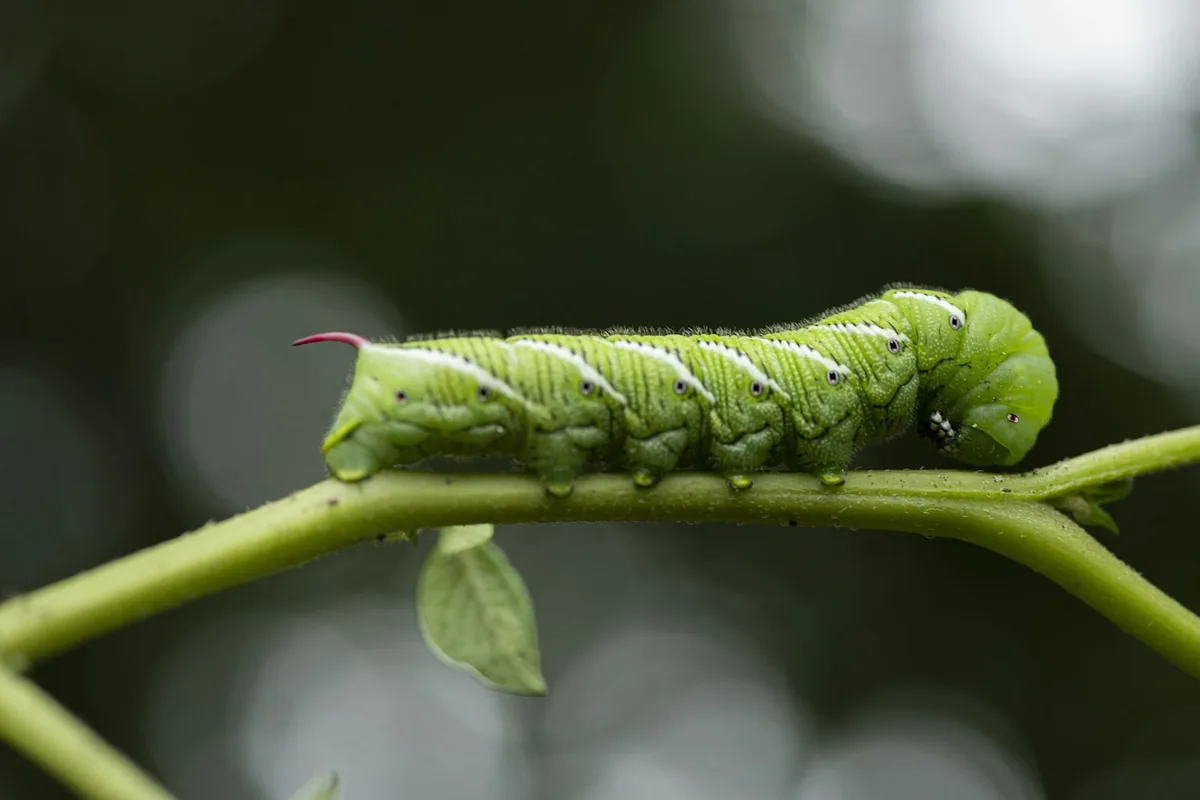
Tomato hornworms are among the most destructive garden caterpillars in North America. A single large larva can strip the foliage from an entire branch in one to two days. They are also remarkably difficult to spot — their green coloration matches tomato stems almost perfectly, and they feed on the upper part of the plant where they are hidden by leaves.
I don't grow tomatoes here in Melville, but the Extension research on hornworm biology and management is thorough, and this guide draws from it.
Table of Contents
- Identification
- Damage Pattern
- Lifecycle
- Finding Hornworms on Your Plants
- Control Methods
- Biological Control: The Braconid Wasp
- Common Situations
- Frequently Asked
Identification
Two species cause "tomato hornworm" damage in North American gardens. Per University of Minnesota Extension's hornworm guide:
**Tomato hornworm (Manduca quinquemaculata):** Green caterpillar up to 4 inches long, with eight V-shaped white markings on each side and a distinctive dark horn at the rear. The adult is a large gray and orange sphinx moth.
**Tobacco hornworm (Manduca sexta):** Nearly identical in size and color, but with seven diagonal white stripes (not V-shapes) on the sides and an orange or red horn. Per University of Minnesota Extension, both species feed on tomatoes and related plants (peppers, eggplant, potatoes) and the damage they cause is indistinguishable in the garden. Management for both is the same.
The horn at the rear looks threatening but is harmless — it cannot sting or bite. First-time gardeners often mistake hornworms for part of the plant stem because the green color is so well-matched.
Damage Pattern
Per Penn State Extension's hornworm page, hornworms cause three types of damage:
- Defoliation: Caterpillars consume entire leaves, leaving only the central midrib or nothing at all. Damage is typically concentrated on the upper portions of the plant, where young growth is most tender.
- Stem damage: Large caterpillars may feed on stems, particularly on younger plants.
- Fruit damage: Hornworms will eat into developing fruit, causing irregular surface scarring or deep cavities. Per Penn State Extension, fruit damage typically occurs later in the season when other food sources are reduced.
Lifecycle
Per University of Minnesota Extension:
- Spring: Overwintering pupae in the soil produce adult sphinx moths.
- Late spring — early summer: Adults are nocturnal and rarely seen. They lay single eggs on the undersides of tomato leaves.
- Summer: Eggs hatch in 6—8 days. Young caterpillars are small (under 1/4 inch) and easy to miss. They grow through five instars over 3—4 weeks.
- Late summer: Full-grown caterpillars (4 inches) drop to the soil and pupate 2—3 inches underground.
- One to two generations per year in most of the United States, per Penn State Extension.
The implication for timing: early detection of small caterpillars is far more effective than dealing with large ones. A 4-inch caterpillar eats many times more than a 1/2-inch caterpillar.
Finding Hornworms on Your Plants
Finding hornworms is harder than treating them. Per Penn State Extension, the most reliable detection method is:
- Look for frass first. Frass — caterpillar droppings — are dark green or black pellets roughly 1/4 inch across for large caterpillars. They accumulate on leaves below the feeding site. If you see frass, a caterpillar is feeding somewhere directly above.
- Follow the defoliation upward. Hornworms feed from the top of stems inward. Bare stems with only midribs remaining indicate active feeding above.
- Check in the early morning or evening. Hornworms are most active at these times. During the heat of midday they tend to grip the stem and remain still.
- Use a UV/blacklight flashlight at night. Per University of Minnesota Extension, hornworms fluoresce bright green under UV light, which makes them easy to spot in the dark. This is genuinely the most effective detection method and is worth doing once a week during peak summer feeding.
Control Methods
Handpicking
For most home gardens, handpicking is the most practical response. Per Penn State Extension, caterpillars can be dropped into soapy water or cut with scissors. The caterpillars cannot bite or sting. Large caterpillars on a small plant can be found and removed in a few minutes using the frass-location method above.
Bacillus thuringiensis (BT spray) var. kurstaki (Bt)
Bt is a naturally occurring soil bacterium that produces proteins toxic to caterpillars when ingested. Per UC IPM's Bt page, Bt kurstaki is effective on hornworms when applied while caterpillars are in early instars (small). Once caterpillars are large — over 2 inches — they are more tolerant and Bt is less reliable.
Per UC IPM, Bt breaks down in sunlight and is harmless to vertebrates, birds, and non-caterpillar insects. Apply in the evening when caterpillars are feeding, and reapply after rain. It is the standard organic-acceptable treatment for hornworms at commercial scale.
Spinosad
Spinosad is another organic-acceptable option. Per UC IPM, spinosad (derived from a soil bacterium) is effective on caterpillars and also has some activity on adult moths, potentially reducing egg-laying. It is more toxic to beneficial insects than Bt, however — per UC IPM, avoid applying when bees are foraging.
Conventional Insecticides
Pyrethroid insecticides (permethrin, bifenthrin) are effective. Per Penn State Extension, carbaryl (Sevin) is also labeled for hornworm control. As with all broad-spectrum insecticides, avoid application when plants are flowering to protect pollinators.
Biological Control: The Braconid Wasp
Hornworms are frequently parasitized by the braconid wasp Cotesia congregata. Per University of Minnesota Extension, the wasp lays its eggs inside the caterpillar. Larvae hatch and feed internally, eventually emerging to form white, rice-grain-sized cocoons on the outside of the caterpillar's body.
A parasitized caterpillar — one covered with white cocoons — is still alive but will die shortly. Per Penn State Extension, the caterpillar stops feeding normally once the wasp larvae emerge. Do not kill or remove a parasitized caterpillar. The emerging wasps will go on to parasitize other hornworms in the garden.
This is a case where doing nothing is the right call. Per University of Minnesota Extension, Cotesia congregata is an important natural regulator of hornworm populations.
Common Situations
| Symptom | Likely cause | Confirming sign | Action |
|---|---|---|---|
| Branches stripped of leaves, stems intact | Large hornworm feeding | Dark frass pellets below; bare midribs | Handpick; apply Bt to remaining plant |
| Small holes in upper leaves, some frass | Young caterpillar, early instar | Tiny caterpillar under 1 inch | Apply Bt immediately while caterpillar is small |
| Cavities in fruit, no leaf damage | Large caterpillar that's moved to fruit | Find caterpillar on or near fruit | Handpick; inspect plant carefully |
| Large green caterpillar with white cocoons on back | Parasitized by braconid wasp | White rice-grain cocoons clearly visible | Leave in place; do not disturb |
| Rapid defoliation at top of plant | Multiple large caterpillars | More than one caterpillar present | Handpick all; apply Bt to protect remaining foliage |
Frequently Asked
How do I find tomato hornworms?
Per Penn State Extension, look for frass (dark green pellets) on leaves below active feeding sites, then look up the plant from there. At night, a UV blacklight flashlight will make hornworms fluoresce bright green against the plant. This is the most reliable detection method. Per University of Minnesota Extension, hornworms are most active in morning and evening, which is the best time to inspect.
Should I kill the hornworm with white eggs on its back?
No. Per University of Minnesota Extension, those white structures are not eggs but the cocoons of braconid wasp larvae that have already completed their internal feeding and emerged. The wasp is Cotesia congregata, an important natural enemy of hornworms. The parasitized caterpillar is already dying and will not feed normally. Leave it in place — the wasps that emerge will seek out additional hornworms in your garden.
When should I apply Bt for hornworms?
Per UC IPM, Bt kurstaki is most effective on young, small caterpillars (early instars). For best results, begin scouting for hornworms as soon as transplants are in the ground and apply Bt at first evidence of egg hatch or small caterpillar feeding. Large caterpillars over 2 inches are significantly harder to kill with Bt. Evening application is preferred because Bt breaks down in UV light and caterpillars are most active after dark.
What plants besides tomatoes do hornworms attack?
Per University of Minnesota Extension, both Manduca quinquemaculata and M. sexta attack all members of the Solanaceae family: tomato, pepper, eggplant, potato, and tomatillo. They will also feed on dill and occasionally other plants. Inspecting all solanaceous crops together is good practice — a hornworm infestation is rarely confined to just the tomatoes.
—-
Recommended gear: Best BT Spray: Bacillus thuringiensis for Caterpillar Control — our buyer's guide covering picks for every budget, ranked by Extension publication consensus and personal use.
Sources
- University of Minnesota Extension — <a href="https://extension.umn.edu/yard-and-garden-insects/hornworms">Hornworms in Yards and Gardens</a>.
- Penn State Extension — <a href="https://extension.psu.edu/tomato-hornworm">Tomato Hornworm</a>.
- UC IPM — <a href="https://ipm.ucanr.edu/PESTNOTES/pn74006.html">Bacillus thuringiensis (Bt)</a>.
- UC IPM — <a href="https://ipm.ucanr.edu/agriculture/tomato/">Tomato Pest Management</a>.
Sources
- University of Minnesota Extension — Hornworms in Yards and Gardens.
- Penn State Extension — Tomato Hornworm.
- UC IPM — Bacillus thuringiensis (Bt).
- UC IPM — Tomato Pest Management.