Japanese beetle damage and control: what actually works
The first Japanese beetle I ever saw was on my neighbor's rose in Melville in June 2017. By the end of July that summer, the beetles were in my yard too — on the basil, on the Virginia creeper, working their way through
—- title: "Japanese beetles" slug: japanese-beetles hub: problems category: Diagnostic guide description: "The first Japanese beetle I ever saw was on my neighbor's rose in Melville in June 2017. By the end of July that summer, the beetles were in my yard too — on the basil, on the Virginia creeper,." date: 2026-06-10 updated: 2026-06-10 author: "Thomas A." reading_time: 9 —-
The first Japanese beetle I ever saw was on my neighbor's rose in Melville in June 2017. By the end of July that summer, the beetles were in my yard too — on the basil, on the Virginia creeper, working their way through the raspberry canes. By August, a dozen roses on the block looked like brown lace. I've managed them in my Long Island garden every summer since.
Japanese beetles are one of the more honest garden problems: the damage is unmistakable, the biology is well-documented, and the extension research on what works and what doesn't is clear enough that there's no excuse for still using pheromone traps.
Identification and damage
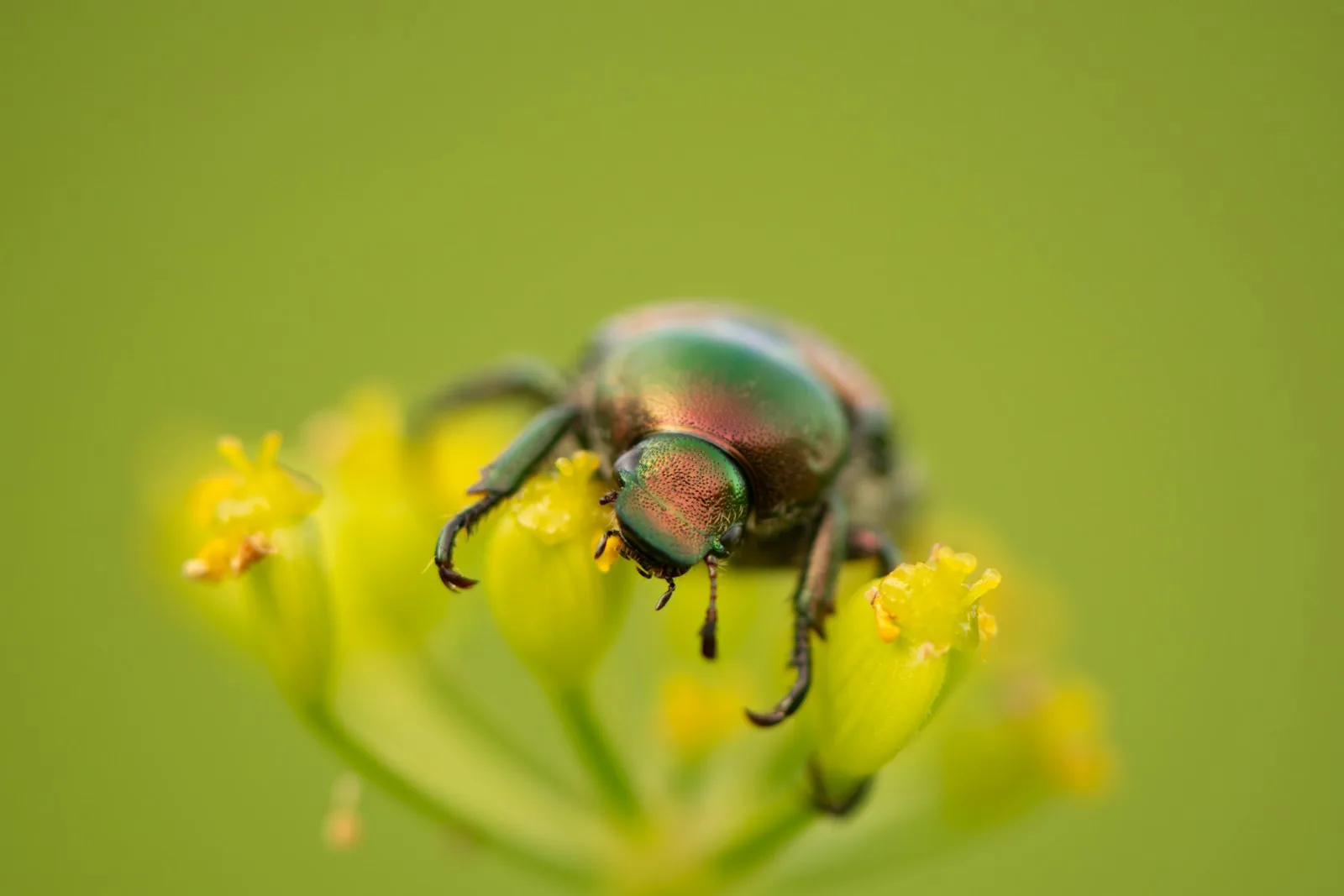
Popillia japonica is a distinctive insect. Adults are about 3/8 inch long with a metallic green head and thorax, copper-brown wing covers (elytra), and white tufts of hair along the sides of the abdomen. The combination of metallic green and copper brown makes them identifiable at a glance once you've seen one.
Adult feeding damage: Adults feed on the upper surface of leaves, consuming tissue between the veins. Per University of Minnesota Extension, this skeletonizing leaves, giving them "a lace-like appearance." Damaged leaves turn brown and may fall. Adults also feed on flowers, which are often more attractive to them than foliage.
Adults feed on more than 300 plant species per University of Minnesota Extension. Preferred plants include rose, grape, linden, apple, crabapple, cherry, plum, birch, elm, raspberry, Virginia creeper, hollyhock, marigold, basil, and corn silks. In my yard, the basil takes the worst of it — a single basil plant in full sun can be stripped to stems in two days during peak emergence.
Per University of Minnesota Extension, healthy, mature trees and shrubs can tolerate significant feeding without long-term injury. Young or unhealthy plants may be stunted or killed.
Grub damage: The larval stage (white grubs) feeds on grass roots in the soil. Per University of Minnesota Extension, "healthy turfgrass can typically tolerate up to 10 grubs per square foot." Above that threshold, dead patches develop that can be peeled back like a carpet. Moles, skunks, and crows digging in the lawn in late summer are a secondary sign of grub infestation.
Lifecycle
Understanding the lifecycle is necessary for timing controls correctly.
Per University of Minnesota Extension:
- Late June — early July: Adult beetles emerge from the soil.
- July — August (peak): Adults feed actively, mate, and lay eggs.
- August: Females tunnel into soil 1—3 inches deep to lay eggs, totaling up to 60 eggs per female over the season.
- August — September: Eggs hatch; young grubs feed on grass roots near the soil surface.
- October: Third-instar (full-size) grubs move deeper into soil for winter.
- Spring: Grubs move back toward the surface, resume feeding briefly, then pupate.
- Late June: New adults emerge and the cycle restarts.
A key behavioral fact from University of Minnesota Extension: "beetle-damaged leaves emit feeding-induced odors that attract other beetles." This aggregation effect is why a single heavily infested rose can pull in waves of new beetles throughout the season — the existing feeding damage is itself an attractant.
What actually works: control by method
Handpicking (most practical for home gardens)
Per Penn State Extension, handpicking is "a simple and effective control method." Walk through the yard in the early morning or evening when beetles are sluggish and temperatures are cool. Knock them into a bowl of soapy water. At cool temperatures, they fall off plants instead of flying away.
Per Penn State Extension, the smell of dead beetles repels living ones — placing containers of trapped or handpicked beetles near desirable plants provides some deterrent effect.
Per Missouri Botanical Garden, a wet/dry vacuum with soapy water works well for larger infestations.
This is the approach I use on my basil — out early with a jar of soapy water, a quick shake of each stem over the jar. On heavy-infestation days in peak July, I can collect 30—50 beetles from a few plants in fifteen minutes.
Physical barriers
Per Missouri Botanical Garden, mesh netting over plants prevents beetle contact. Barriers need to remain in place for approximately a month during peak activity and must be permeable to light and moisture. For pollinators' sake, remove netting during flowering periods.
neem oil
Per Penn State Extension, neem oil is "somewhat effective" on adult beetles. It is not a fast kill — neem's active compound azadirachtin works as a feeding deterrent and disrupts insect development rather than killing on contact. Per Missouri Botanical Garden, pyrethrum or neem applied in two applications 3 to 4 days apart can help control the problem.
Neem requires reapplication after rain and does not provide the immediate knockdown of synthetic pyrethroids.
Conventional insecticides
Per Penn State Extension, pyrethroids (bifenthrin, lambda-cyhalothrin, deltamethrin, zeta-cypermethrin) are effective on adult beetles. Carbaryl and acephate also work.
The warning from Penn State Extension: "these kill all insects, including natural predators." Broad-spectrum insecticides are non-selective. Do not apply when plants are in flower — the products are toxic to pollinators.
Systemic insecticides (imidacloprid) travel through plant tissue into flowers, where they are toxic to pollinators. Per Penn State Extension, "systemic products like imidacloprid are effective on insects but travel throughout the plant into the flowers of clover and other flowers and are toxic to our needed pollinators." Use contact insecticides on non-flowering plants if treatment is necessary; avoid systemics on anything that blooms.
milky spore granular (Paenibacillus popilliae)
milky spore granular is a naturally occurring bacterial disease of Japanese beetle grubs. Per Penn State Extension, it "builds up slowly in the soil and works only on Japanese beetle grubs, not any other species of white grubs."
Per Missouri Botanical Garden, "its efficacy is questionable, and the spore count has to build up for 2—3 years, during which time no insecticides may be used." The mechanism: infected grubs die and release more spores, which infect new grubs. Building an effective soil population takes time and requires that no insecticides be applied to the soil during establishment.
milky spore granular is a legitimate long-term strategy for gardeners committed to a no-insecticide approach to grub management, but it is not a quick fix.
Entomopathogenic nematodes
Heterorhabditis species are more effective against Japanese beetle grubs than Steinernema carpocapsae per Missouri Botanical Garden. Apply when grubs are small (early summer), with irrigation before and after application. Results are variable — nematodes are living organisms and require specific conditions (moisture, soil temperature) to be effective.
The trap problem: why pheromone traps make things worse
Japanese beetle traps are widely sold at garden centers and home improvement stores. The honest assessment from multiple extension sources is that they should not be used for pest management in home gardens.
Per Penn State Extension: "The first popular option, a trap for adults, is not recommended. Japanese beetle traps were created to monitor the beetles' westward expansion. Traps contain a floral scent attractant plus a sex pheromone to bait additional males. They trap only 75 percent of the beetles they attract. That means the plants in your yard feed the rest of the beetles attracted by the trap."
Per University of Minnesota Extension, researchers have found that "regardless of number or placement, the areas around the traps had more beetle feeding damage than if there had been no trap at all." One study found that a trap placed alone led to nearby vegetation having more damage than similar areas with no traps.
The traps work too well as attractants — they draw beetles from the surrounding area that would not have otherwise found your yard. The 25% that don't enter the trap still feed on your plants.
Least-damaged plants: what to grow near high-pressure areas
Per Penn State Extension, consider replacing plants that Japanese beetles severely injure with plants that are "rarely damaged." Japanese beetles show strong preferences and tend to ignore:
- Boxwood (Buxus)
- Holly (Ilex)
- Rhododendron and azalea
- Arborvitae (Thuja)
- Forsythia
- Lilac (Syringa)
- Impatiens
- Begonias
In my yard, the Japanese maples get light feeding but nothing like what the roses and basil take. The hostas — deer food in front, but in the back behind fencing — are completely ignored by the beetles.
Common problems table
| Symptom | Cause | Fix |
|---|---|---|
| Lacy, skeletonized leaves on roses, basil, grapevine | Adult Japanese beetle feeding | Handpick early morning; apply targeted contact insecticide if severe |
| Brown patches in lawn, sod rolls back | Grub feeding on grass roots | Check grub count; treat with nematodes or milky spore granular for long-term; imidacloprid for quick kill (away from flowering plants) |
| Beetles congregating heavily on one plant, light on others | Aggregation pheromone from feeding damage | Prioritize treatment on heavily infested plants; feeding odors attract more beetles |
| Heavy beetle activity near pheromone trap | Trap attracting more beetles than it captures | Remove trap immediately; trap is making the problem worse |
| Beetles feeding in flowers | Normal behavior; flowers are attractive feeding sites | Handpick; protect most valued plants with netting; accept some damage |
Recommended gear: Best Neem Oil for Gardens: How It Works and When to Use It — our buyer's guide covering picks for every budget, ranked by Extension publication consensus and personal use.
Frequently asked
Do Japanese beetle traps help?
No. Per Penn State Extension, the traps only capture 75% of the beetles they attract, and the rest feed on nearby plants. Per University of Minnesota Extension, studies consistently show that areas near traps suffer more plant damage than areas without traps, regardless of trap placement. The traps were designed to monitor beetle spread, not control populations in home gardens. Do not use them.
Does milky spore granular work?
It works, but slowly. Per Penn State Extension, milky spore (Paenibacillus popilliae) is host-specific to Japanese beetle grubs and builds slowly in the soil over 2—3 years. During establishment, no soil insecticides can be used or you will disrupt the bacterial population. It is a legitimate long-term organic strategy for grub management, not a solution for this summer's adult beetles.
When should I treat Japanese beetles?
Adult control is most effective during peak emergence, which per University of Minnesota Extension is primarily July and August. Handpicking is most effective in the early morning and evening when beetles are sluggish. Grub treatment timing is different: per Penn State Extension, imidacloprid applied in June and July before egg-laying has enough residual to kill new grubs; nematodes should be applied when grubs are small with soil moisture before and after application.
Are Japanese beetles found everywhere?
Japanese beetles (Popillia japonica) are native to Japan and were accidentally introduced to the eastern U.S. around 1916. They are now established throughout the eastern United States and have been expanding westward. Per University of Minnesota Extension, adult beetles "can fly up to several miles to feed," which is why neighborhood-level infestations build quickly regardless of what any single yard does.
Sources
- Penn State Extension — Japanese Beetles in the Home Garden.
- University of Minnesota Extension — Japanese beetles in yards and gardens.
- University of Minnesota Extension — Don't fall into the Japanese beetle trapping trap.
- Missouri Botanical Garden — Japanese Beetle.