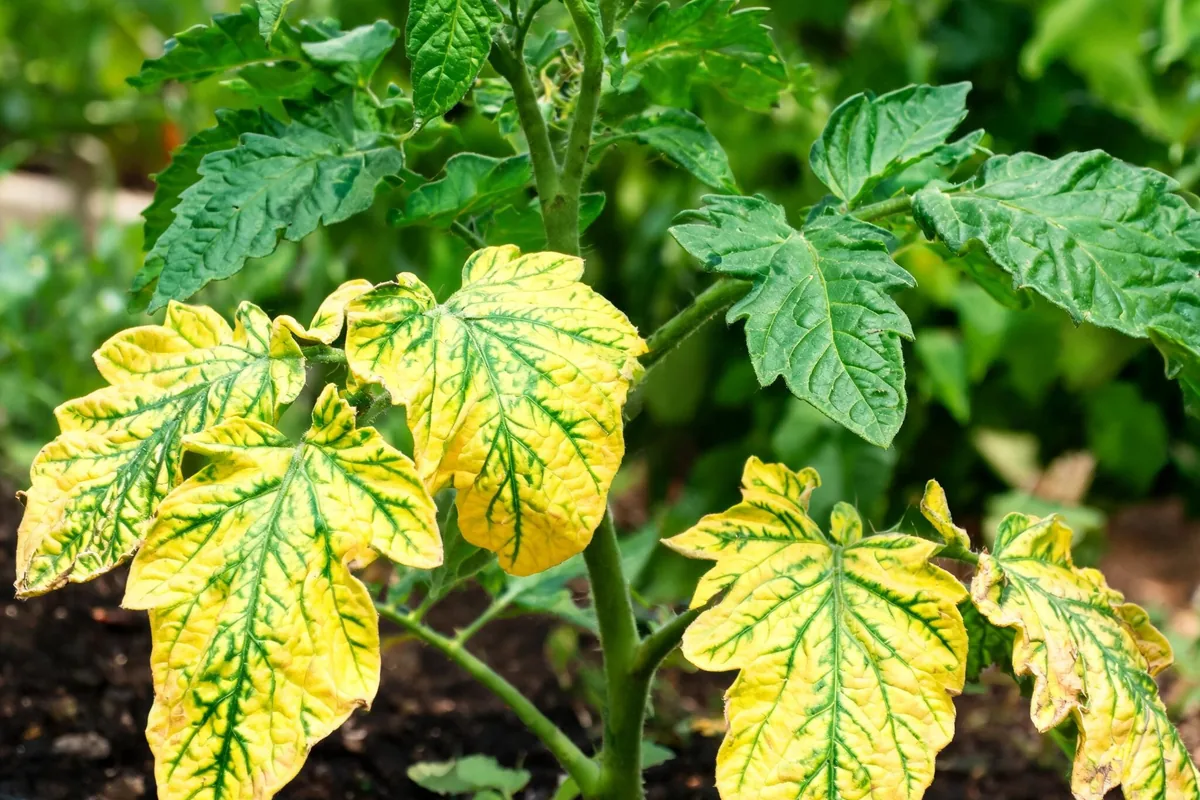
Yellow Leaves on Tomato Plants: Causes and Fixes
title: "Yellow Leaves on Tomato Plants: Causes and Fixes"
—- title: "Yellow Leaves on Tomato Plants: Causes and Fixes" slug: tomato-leaves-yellow hub: problems category: Problem description: "Yellow leaves on tomato plants can mean nitrogen deficiency, fungal disease, or normal aging. This guide identifies every cause with Extension-sourced fixes." date: 2026-06-10 updated: 2026-06-10 author: "Thomas A." reading_time: 9 —-
Yellow leaves on tomato plants are one of the most common distress signals in the summer vegetable garden. The problem is that "yellow leaves" covers a wide diagnostic range — nitrogen deficiency looks nothing like early blight, and normal senescence looks nothing like either. Treating the wrong cause wastes time and can make things worse.
I don't grow tomatoes in my Melville garden — deer pressure here makes it not worth the effort — but this guide draws from the same Extension labs that inform everything else on this site.
Table of Contents
- How to Read the Pattern
- Nutrient Deficiencies
- Fungal and Bacterial Diseases
- Watering Problems
- Other Causes
- Common Situations
- Frequently Asked
How to Read the Pattern
The location and pattern of yellowing narrows the cause significantly. Per Cornell Cooperative Extension's vegetable disease guide, the first step in any tomato disease diagnosis is determining whether symptoms start on lower, older leaves (most nutrient issues, most fungal diseases) or upper, younger leaves (viral, some bacterial, some micronutrient problems).
Ask these questions before reaching for any product:
- Where does yellowing start — lower leaves, upper leaves, or scattered?
- Is there any browning, spotting, or lesion within or around the yellow area?
- Are yellow leaves dropping, or do they stay on the plant?
- Is the yellowing between veins (interveinal) or uniform across the leaf?
- Did it appear suddenly after a weather event, or develop gradually?
Each answer points toward a different cause. The table in the Common Situations section maps these patterns to causes.
Nutrient Deficiencies
Nitrogen Deficiency
The most common nutrient cause of yellow tomato leaves. Per NC State Extension's tomato production guide, nitrogen deficiency appears as a general yellowing of older, lower leaves first. The yellowing is pale and uniform — no spots, no lesions. Newer growth at the top of the plant stays green longer because the plant mobilizes nitrogen from older tissue to support new growth.
Cause: insufficient nitrogen in soil, or soil too cold or too wet to allow root uptake. Heavy rainfall can leach nitrogen from sandy soils rapidly.
Fix: side-dress with a nitrogen source — per Penn State Extension's tomato guide, a light application of calcium nitrate (1 tablespoon per plant, worked into the soil surface, then watered in) at first fruit set is standard practice. Do not over-apply; excess nitrogen produces lush foliage and limited fruit.
Magnesium Deficiency
Interveinal chlorosis — yellow tissue between the veins, with veins staying green — on older lower leaves is the signature symptom. Per Clemson HGIC's tomato troubleshooting page, magnesium deficiency is common on sandy, acid soils and often appears when fruit is sizing up and drawing heavily on the plant's mineral reserves.
Fix: per Clemson HGIC, apply Epsom salts (magnesium sulfate) as a foliar spray — 1 tablespoon per gallon of water — or work 1 tablespoon into the soil around each plant. Results typically appear within 7—10 days.
Iron and Manganese Deficiency
Both produce interveinal chlorosis on younger, newer leaves — the opposite of magnesium. Per UC IPM's tomato nutrient guide, iron chlorosis in tomatoes is most common on alkaline soils (pH above 7.0), where iron is present but chemically unavailable. In zone 7a Long Island gardens with naturally acidic sandy loam, this is less common than in limestone-heavy regions, but it can occur in newly amended beds or near concrete foundations.
Fix: pH adjustment (add sulfur to lower pH) is the long-term solution. Per UC IPM, chelated iron as a foliar spray provides faster correction.
Fungal and Bacterial Diseases
Early Blight (Alternaria solani)
Early blight is the most common foliar disease of tomatoes in the eastern United States. Per Cornell Cooperative Extension, symptoms begin as small, brown or black lesions on lower, older leaves. Lesions have a distinctive concentric ring pattern — often described as a "target" or "bull's-eye" appearance. The tissue surrounding the lesion turns yellow, then the leaf drops.
Disease progresses upward through the canopy over the season. Hot, humid days with cool nights favor spread. Per Cornell, plants under stress — nutrient-deficient, water-stressed, heavily fruited — are more susceptible.
Management:
- Remove and bag affected leaves below the lesion front.
- Apply copper fungicide or chlorothalonil preventively on a 7—10 day schedule beginning when symptoms first appear, per Cornell.
- Mulch the soil surface to reduce splash dispersal of spores from soil to leaves.
- Rotate out of the same bed for 2—3 years; the pathogen overwinters in infected plant debris.
Septoria Leaf Spot (Septoria lycopersici)
Per University of Minnesota Extension, Septoria is identified by small, circular spots with dark brown borders and tan or gray centers, often with tiny black specks (pycnidia — fungal fruiting bodies) visible under magnification at the center. Spots are surrounded by a yellow halo. Like early blight, it starts on lower leaves and moves upward.
Unlike early blight, Septoria spots are smaller and more numerous. The two diseases can appear together. Management is the same: remove affected leaves, apply copper or chlorothalonil, and maintain a clean growing area.
Fusarium Wilt (Fusarium oxysporum f. sp. lycopersici)
Per UC IPM's fusarium wilt factsheet, fusarium wilt causes yellowing that typically begins on one side of the plant or one branch before spreading. Affected leaves yellow, wilt, and die from the bottom up. The internal stem tissue shows a brown discoloration when cut — this is the diagnostic cut: if the vascular tissue is brown, fusarium or verticillium wilt is the likely cause.
There is no effective chemical treatment. Per UC IPM, the only reliable management is planting resistant varieties (labeled "F" in the variety code — e.g., "VFNT" on the plant tag) and crop rotation. Do not plant solanaceous crops (tomato, pepper, eggplant) in the same bed for 3—4 years.
Tomato Spotted Wilt Virus (TSWV)
Per NC State Extension's TSWV factsheet, TSWV causes bronzing, ringspots, and yellowing on young leaves — the opposite pattern from fungal diseases that start low. Transmitted by thrips. Affected plants show stunted growth, distorted leaves, and often a characteristic bronze or purplish cast on young foliage before yellowing appears.
No treatment. Per NC State Extension, managing the thrips vector with reflective mulch early in the season reduces infection rates. Remove and destroy infected plants.
Watering Problems
Overwatering and Waterlogged Soil
Per Penn State Extension, tomatoes need consistently moist but well-drained soil. In waterlogged conditions, roots are deprived of oxygen and begin to die. Dying roots cannot supply nutrients, which produces yellowing that mimics nitrogen deficiency — pale yellow on lower leaves. The diagnostic difference: soggy soil and a wilted, yellowed plant at the same time typically points to root problems, not nutrient shortfall.
Fix: improve drainage. Do not water until the top 1—2 inches of soil are dry. In raised beds with heavy soil, amend with perlite or coarse compost.
Drought Stress
Drought stress can cause leaves to yellow, curl, and drop. Per Penn State Extension, tomatoes need 1—2 inches of water per week from rain or irrigation. In the heat of a Long Island July, this often means watering every 2—3 days in sandy loam. Consistent soil moisture also prevents blossom end rot from developing alongside leaf problems.
Other Causes
Normal Lower-Leaf Senescence
As tomato plants grow and the canopy fills in, lower leaves naturally yellow and drop. Per Clemson HGIC, this is a normal process — leaves shaded out by the canopy above senesce and are dropped. If the plant is otherwise healthy, this is not a problem. Remove yellowed leaves to reduce potential disease inoculum and improve air circulation.
Chemical Drift and Herbicide Injury
Broadleaf herbicide drift — particularly from 2,4-D or dicamba products used on lawns — causes distorted, cupped, strap-like leaves on young growth rather than simple yellowing. Per Penn State Extension, symptoms appear quickly after exposure and look unlike any disease: twisted, narrow leaves with yellowing and distortion together. No treatment; wait for the plant to outgrow the affected tissue if the exposure was minor.
Spider Mites
In hot, dry conditions, two-spotted spider mites (Tetranychus urticae) can cause stippled, pale, and eventually yellow leaves. Per UC IPM, turn the leaf over and look for webbing and tiny moving specks. Miticides or a forceful water spray on the leaf undersides disrupts colonies. Per UC IPM, avoiding broad-spectrum insecticides that kill natural predators is the first preventive step — predatory mites keep spider mite populations in check.
Common Situations
| Pattern | Most likely cause | Confirming sign | Fix |
|---|---|---|---|
| Uniform pale yellow, lower leaves first, no spots | Nitrogen deficiency | No lesions; new growth still green | Side-dress with calcium nitrate |
| Yellow between veins, veins stay green, lower leaves | Magnesium deficiency | Sandy soil; fruit sizing | Epsom salts foliar spray |
| Yellow between veins on new upper leaves | Iron/manganese deficiency | Alkaline soil or near concrete | Lower soil pH; chelated iron |
| Brown target-ring lesions + surrounding yellow, lower first | Early blight | Bull's-eye pattern on lesion | Copper fungicide; remove affected leaves |
| Small tan/gray spots with dark border + yellow halo, lower first | Septoria leaf spot | Tiny black specks in center of spot | Copper fungicide; mulch; rotate |
| Yellow progressing up one side of plant; brown vascular tissue | Fusarium or verticillium wilt | Brown discoloration when stem cut | No treatment; resistant varieties; rotate |
| Yellowing + bronze/distorted new growth | Tomato spotted wilt virus | Thrips on plant; ringspots | Remove plant; manage thrips |
| Pale yellow + soggy soil | Overwatering / root rot | Roots brown and mushy | Improve drainage; reduce watering |
| Lower leaves yellow and drop normally | Normal senescence | Canopy filling in; no disease signs | Remove dropped leaves; no treatment needed |
Frequently Asked
Should I remove yellow leaves from tomato plants?
Per Clemson HGIC, removing yellow lower leaves is generally good practice — it improves air circulation at the base of the plant and removes potential disease inoculum. The exception is if removal would strip a significant portion of the plant's remaining foliage, which would reduce its ability to photosynthesize and fruit. Remove leaves below the lowest fruit cluster as a minimum; further removal depends on how much healthy foliage remains above.
Can tomato yellow leaves recover?
Leaves already yellow or dead will not green up again — those cells are gone. Per Penn State Extension, the goal is to stop the spread by correcting the underlying problem. If the cause is a correctable deficiency (nitrogen, magnesium), new growth will emerge healthy after the issue is addressed. If the cause is a wilt disease, the plant will continue to decline.
Why does early blight keep coming back every year?
Because per Cornell Cooperative Extension, Alternaria solani overwinters in infected plant debris and in soil. It also persists on seed and in infected volunteer seedlings. The primary management levers are crop rotation (moving tomatoes out of the same bed for 2—3 years), cleaning up all plant debris at the end of the season, and applying preventive fungicide once symptoms appear the following year.
How much water do tomatoes need per week?
Per Penn State Extension, tomatoes need 1—2 inches of water per week, with more needed during fruit development and hot weather. Inconsistent watering — wet and dry cycles — is a primary cause of blossom end rot and fruit cracking in addition to stress-induced susceptibility to disease. Drip irrigation at the base of the plant reduces leaf wetness and fungal disease pressure compared to overhead watering.
—-
Recommended gear: Best pepper varieties: sweet, hot, and short-season — our buyer's guide covering picks for every budget, ranked by Extension publication consensus and personal use.
Sources
- Cornell Cooperative Extension — <a href="https://vegetables.cornell.edu/pest-management/disease-factsheets/early-blight-tomato/">Early Blight of Tomato</a>.
- NC State Extension — <a href="https://growingsmallfarms.ces.ncsu.edu/growingsmallfarms-tomato/">Tomato Production Guide</a>.
- NC State Extension — <a href="https://content.ces.ncsu.edu/tomato-spotted-wilt-tswv">Tomato Spotted Wilt Virus</a>.
- Penn State Extension — <a href="https://extension.psu.edu/tomatoes">Tomatoes</a>.
- Penn State Extension — <a href="https://extension.psu.edu/herbicide-drift-and-injury-to-vegetables-and-fruits/">Herbicide Drift and Injury to Vegetables</a>.
- Clemson HGIC — <a href="https://hgic.clemson.edu/factsheet/tomato-problems/">Tomato Problems</a>.
- University of Minnesota Extension — <a href="https://extension.umn.edu/problems/septoria-leaf-spot-tomato">Septoria Leaf Spot of Tomato</a>.
- UC IPM — <a href="https://ipm.ucanr.edu/agriculture/tomato/">Tomato Pest Management</a>.
Sources
- Cornell Cooperative Extension — Early Blight of Tomato.
- NC State Extension — Tomato Production Guide.
- NC State Extension — Tomato Spotted Wilt Virus.
- Penn State Extension — Tomatoes.
- Penn State Extension — Herbicide Drift and Injury to Vegetables.
- Clemson HGIC — Tomato Problems.
- University of Minnesota Extension — Septoria Leaf Spot of Tomato.
- UC IPM — Tomato Pest Management.