Problem

Fusarium Wilt in Tomato: Symptoms and Management

title: "Fusarium Wilt in Tomato: Symptoms, Soil Persistence, and Management"

unripe green tomatoes still on the vine
Photo: Unsplash on Unsplash

—- title: "Fusarium Wilt in Tomato: Symptoms, Soil Persistence, and Management" slug: fusarium-wilt-tomato hub: problems category: Problem description: "Fusarium wilt in tomato: how to identify the one-sided yellowing and vascular browning, why infected soil stays infected for years, and what actually works." date: 2026-06-10 updated: 2026-06-10 author: "Thomas A." reading_time: 8 —-

Fusarium wilt is one of the most discouraging problems in the vegetable garden because it strikes healthy-looking plants during or just before fruit set, and there is nothing you can do to save them. The disease lives in the soil. It can survive there for decades. Once it is present in a bed, it changes how you manage that bed permanently.

Per UC IPM, fusarium wilt of tomato is caused by Fusarium oxysporum f. sp. lycopersici — a soil-borne fungus that specifically infects tomatoes and certain related crops. It does not infect humans or most other plants in the garden.

The disease is widespread in warm-summer regions including Long Island and the rest of the Northeast. Per Rutgers NJAES, fusarium wilt is one of the most common tomato diseases in New Jersey gardens, and the pattern is consistent across zone 7a: healthy transplants, vigorous early growth, then sudden one-sided wilting during the warmest weeks of summer.

What fusarium wilt is

Fusarium oxysporum f. sp. lycopersici is a soil-borne fungal pathogen that enters the plant through roots, colonizes the vascular system (xylem), and blocks water transport. Per Missouri Botanical Garden, "the fungus lives in soil and moves into plants through the roots," where it "produces spores in the water-conducting tissues, blocking water flow and causing the characteristic wilting."

The pathogen is favored by warm soil temperatures — per UC IPM, symptoms are most severe when soil temperatures are between 80°F and 90°F (27°C and 32°C). This is why fusarium wilt on Long Island typically appears in July, when soil temperatures peak.

There are three races of Fusarium oxysporum f. sp. lycopersici affecting tomato. Per NC State Extension, Race 1 is historically most common; Race 2 was identified later and overcome some early resistance; Race 3 is a more recent emergence. Variety labels use "F" for Race 1 resistance, "FF" for Races 1 and 2, and "FFF" for all three races.

Symptoms

Per Missouri Botanical Garden and UC IPM:

Early symptoms:

Progressive symptoms:

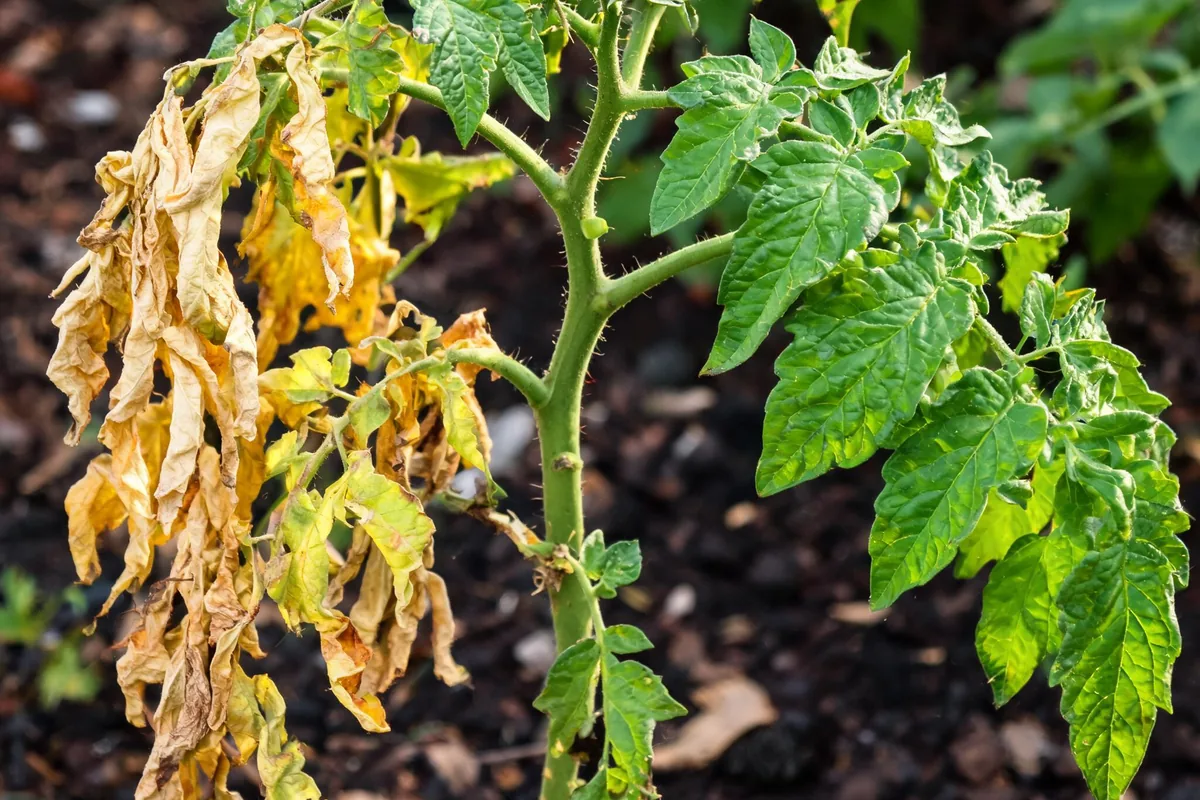
Definitive internal symptom: Per UC IPM, cut the main stem near the base. A brown discoloration in the vascular ring (the ring of tissue just inside the outer bark) is characteristic of fusarium wilt. This cut-stem test distinguishes fusarium wilt from other wilting causes.

SymptomFusarium WiltVerticillium WiltBacterial WiltDrought Stress
Yellowing patternOne-sided, lower leaves firstV-shaped yellowing on leavesUniform, rapid wiltUniform across plant
Internal stem discolorationBrown vascular ring extending up stemLight tan/brown discolorationMay be presentAbsent
Temperature preferenceHot soil (80-90°F)Cool soil (65-75°F)Warm weatherHeat related
Recovery overnightYes, early stageLess typicalNoYes, if watered

Soil persistence

Per Missouri Botanical Garden, Fusarium produces chlamydospores — thick-walled survival structures — that can persist in soil "for many years, even in the absence of a host plant." Research has documented persistence exceeding 10 years in some soils.

This persistence is why chemical soil treatment is largely ineffective for home gardeners: any treatment that kills fungal spores kills beneficial soil organisms too, and the soil will be recontaminated from surviving chlamydospores and from soil movement into the treated area. Per NC State Extension, methyl bromide soil fumigation was once used commercially but is no longer available to home gardeners and is being phased out even in commercial production.

The practical implication: once fusarium wilt is confirmed in a bed, assume that bed is infested permanently unless structural intervention (raised beds with new soil, soil solarization) is made.

Management

Resistant varieties (most effective)

Per UC IPM, "planting resistant varieties is the only practical management tool available to most gardeners." The resistance codes on variety labels are:

Look for these codes on tomato transplant tags or in seed catalog descriptions. Common resistant varieties include 'Celebrity' (VFF), 'Big Beef' (VFF), 'Mountain Pride' (FF), and 'Juliet' (VFF). The resistance is not absolute — it reduces infection but may break down at very high soil temperatures or inoculum levels.

Crop rotation

Per Missouri Botanical Garden, "rotating tomatoes with non-host crops helps reduce the pathogen level in soil." A minimum 3-year rotation away from tomatoes, peppers, and eggplant (all susceptible hosts) in an infected bed is recommended. Note that this does not eliminate the pathogen — it reduces inoculum pressure.

Soil solarization

Per UC IPM, soil solarization — covering moist soil with clear plastic for 4—6 weeks during the hottest part of summer — can kill fusarium propagules in the upper 6 to 8 inches of soil. This requires a 4—6 week period without the bed in production. On Long Island, late July through August is the most effective period. Results are variable and the treatment may not eliminate all propagules in deeper soil.

Remove infected plants promptly

Per Missouri Botanical Garden, remove and dispose of infected plants immediately — do not compost. Leaving infected plant material in the garden increases the spore load in the soil.

Raised beds with clean soil

The most reliable solution for gardens with persistent fusarium problems is growing in raised beds filled with new, uninfested growing medium. Per NC State Extension, use pathogen-free growing media and avoid contaminating the new soil with tools that have worked in infected ground.

Common problems table

SymptomCauseFix
Tomato yellowing on one side, brown vascular ring in stemFusarium wiltRemove plant; do not compost; plant resistant variety next year
Wilting during day, recovery at night (early stage)Possible fusarium wilt — or droughtCut stem to check for vascular browning; confirm diagnosis before discarding
Multiple plants in one bed affected, rest of garden cleanInfected bed soilMark that bed; rotate to resistant varieties; consider soil solarization
Resistant variety still got fusariumRace mismatch or extreme conditionsCheck whether "FF" or "FFF" resistance is available for your region's race
Kept infected plant hoping for recoveryNo cure for vascular colonizationRemove; soil remains infested regardless

Frequently asked

Is there any fungicide that treats fusarium wilt?

No. Per Missouri Botanical Garden, once the fungus is in the plant's vascular system, there is no treatment that will save it. Fungicide applications to the soil or foliage do not reach or eliminate the pathogen once it is inside plant tissue. The focus must be on prevention through resistant varieties and cultural practices.

How do I know if my soil is infested?

Per UC IPM, confirmation requires laboratory testing of a soil sample or an infected plant. However, if susceptible tomato varieties show the characteristic one-sided yellowing with brown vascular tissue in beds where tomatoes have been grown for multiple seasons, fusarium wilt is a reasonable diagnosis. The University Extension lab services in each state (Cornell for New York, Rutgers for New Jersey) can confirm from plant tissue samples.

Can I plant tomatoes in the same bed next year?

Yes, if you use a resistant variety (FF or FFF). Per NC State Extension, resistant varieties can be grown in infested soil with good results. Using susceptible varieties in infested soil will result in disease. The choice is: use resistant varieties, rotate to a different bed, or build new raised beds.

Does fusarium affect other vegetables?

The form that attacks tomatoes (Fusarium oxysporum f. sp. lycopersici) is host-specific to tomato and some related solanaceous crops. Per Missouri Botanical Garden, it will not infect beans, squash, lettuce, or most other vegetable families. However, other forms of Fusarium oxysporum are host-specific to other crops (basil, cucumbers, watermelon), so different beds may have different fusarium strains.

Recommended gear: Best lettuce varieties for heat tolerance and bolt resistance — our buyer's guide covering picks for every budget, ranked by Extension publication consensus and personal use.

Sources

  1. UC IPM &mdash; <a href="https://ipm.ucanr.edu/PMG/PESTNOTES/pn7402.html">Fusarium Wilt of Tomato</a>
  2. Missouri Botanical Garden &mdash; <a href="https://www.missouribotanicalgarden.org/gardens-gardening/your-garden/help-for-the-home-gardener/advice-tips-resources/insects-pests-and-problems/problems/fusarium-wilt-of-tomato">Fusarium Wilt of Tomato</a>
  3. NC State Extension &mdash; <a href="https://content.ces.ncsu.edu/fusarium-wilt-of-tomato">Fusarium Wilt of Tomato</a>
  4. Rutgers NJAES &mdash; <a href="https://njaes.rutgers.edu/plantdisease/">Plant Disease Profiles</a>

Sources