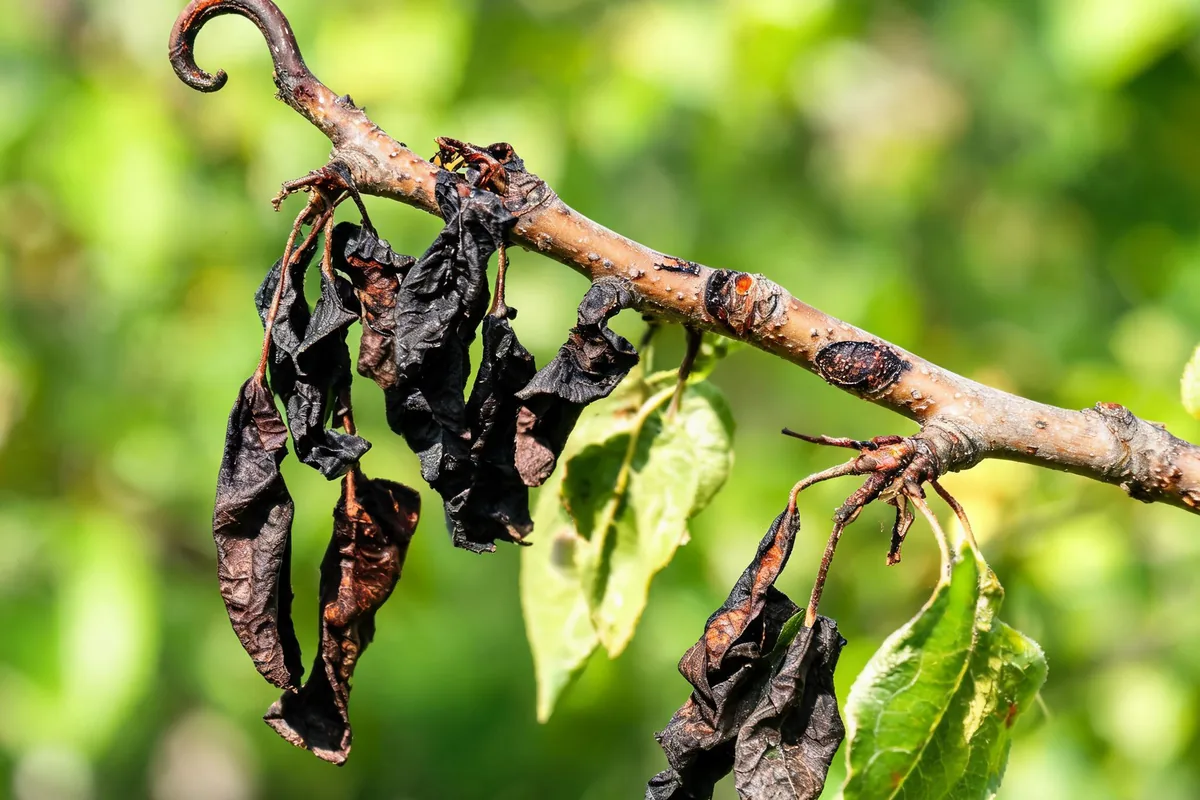
Fire Blight on Pear and Apple: ID and Treatment
title: "Fire Blight: Identification, Treatment, and Prevention on Pear and Apple"
—- title: "Fire Blight: Identification, Treatment, and Prevention on Pear and Apple" slug: fire-blight hub: problems category: Problem description: "Fire blight on pear, apple, and ornamentals: how to identify the shepherd's crook dieback, what causes it, pruning protocols, and copper spray timing." date: 2026-06-10 updated: 2026-06-10 author: "Thomas A." reading_time: 8 —-
No disease in the home orchard produces more visible, dramatic damage in a shorter time than fire blight. A pear tree branch that looks healthy on Monday can appear to have been scorched with a torch by Friday. The name is well chosen.
Fire blight is caused by the bacterium Erwinia amylovora, and per Cornell Cooperative Extension, it is one of the most destructive bacterial diseases of apples and pears in North America. The disease can kill individual branches, entire trees, and in severe outbreaks can devastate commercial orchards.
On Long Island, fire blight is a routine concern for anyone growing pear or apple trees. Wet spring weather during bloom — which is typical from late April through mid-May in zone 7a — creates ideal infection conditions. The disease shows up as blossoms and shoot tips collapse and blacken in late May and early June.
What fire blight is
Erwinia amylovora is a bacterial pathogen native to North America. Per UC IPM, it was first described scientifically in 1780 on pear trees in the Hudson Valley of New York — not far from Long Island.
The bacterium overwinters in cankers on infected wood. Per Missouri Botanical Garden, in spring, bacteria multiply in the margins of these cankers and produce an ooze that insects, rain splash, and wind spread to open blossoms. Once inside the flower, the bacteria spread rapidly into the spur, then the branch, then down toward the trunk.
Per Cornell Cooperative Extension, infection requires warm temperatures (above 65°F, optimal near 80°F) and wetting events — rain, dew, or high humidity — during bloom. The combination of bloom timing, temperature, and moisture is used to calculate fire blight risk in commercial orchards.
Host plants
Per Missouri Botanical Garden, fire blight affects plants in the rose family (Rosaceae):
| Host | Susceptibility |
|---|---|
| Pear (Pyrus communis) | Extremely high; 'Bartlett' and 'Bosc' are highly susceptible |
| Apple (Malus domestica) | High; 'Gala', 'Fuji', 'Rome', 'Jonathan' more susceptible |
| Crabapple (Malus spp.) | Moderate to high depending on cultivar |
| Quince (Cydonia oblonga) | High |
| Hawthorn (Crataegus spp.) | Moderate to high |
| Cotoneaster | High |
| Pyracantha (firethorn) | High |
| Serviceberry (Amelanchier) | Moderate |
| Mountain ash (Sorbus) | Moderate |
| Roses | Low to moderate; mainly in warmer climates |
Identification
Per Penn State Extension, the progression of fire blight symptoms:
Blossom blight: Infected flowers turn brown and die, remaining on the tree. This is the earliest symptom, appearing 1—3 weeks after infection during bloom.
Shoot blight (shepherd's crook): Infected shoot tips wilt and bend into a characteristic shepherd's crook shape. New growth blackens from the tip downward. The hooked tip is one of the most recognizable symptoms.
Cankers: As the bacterium moves into larger branches or the trunk, it creates water-soaked, slightly sunken cankers. In wet weather, infected bark may ooze amber-colored bacterial exudate.
Fire appearance: The overall appearance of heavily infected branches is of scorched, blackened tissue — which is where the disease gets its name.
Per UC IPM, the bacterium may move through the vascular system faster than visible symptoms appear. Pruning to 12 inches below visible infection attempts to remove tissue containing bacteria that has moved ahead of the visible margin.
Treatment: pruning protocol
Pruning is the primary treatment. Per Cornell Cooperative Extension, the protocol:
- Prune 12 inches below any visible infection. Do not guess at where the infection ends — cut well below.
- Disinfect pruning tools between every cut. Per Missouri Botanical Garden, tools should be sterilized in 10% bleach solution (1 part bleach, 9 parts water) or 70% rubbing alcohol between each cut. Failing to do this spreads the bacterium from infected to healthy tissue with each cut. Felco F-2 bypass pruners with stainless blades are easier to disinfect than carbon steel tools.
- Do not compost infected prunings. Burn or bag and dispose of all infected wood.
- Time your pruning correctly. Per Penn State Extension, pruning during dry weather reduces the risk of spreading bacteria from cut surfaces. Avoid pruning in wet weather or when rain is forecast.
- Prune cankers in dormancy. When cankers are visible on larger branches or the trunk, prune them out during winter dormancy — cutting at least 6 to 8 inches below the visible edge of the canker into healthy wood.
Per UC IPM, once fire blight reaches the main trunk (rootstock area), the tree is unlikely to be saved. A tree with trunk blight should be removed.
Chemical control: copper bactericide
Per Cornell Cooperative Extension, copper bactericide applications during bloom are a standard preventive tool in commercial and home orchards. The timing is critical:
- Begin at green tip (just as buds begin to swell and show green)
- Apply every 4—5 days during bloom when temperatures are above 65°F and rain or high humidity is forecast
- Stop after petal fall
Per Missouri Botanical Garden, copper compounds protect blossoms from infection but cannot cure existing infected wood. Repeated copper applications can cause copper phytotoxicity to leaves if applied too heavily or in certain weather conditions. Follow label rates carefully.
Streptomycin is the most effective bactericide for fire blight per research, but its use is restricted in some states due to concerns about antibiotic resistance. Check New York State regulations before applying.
Resistant varieties
For pear, per Cornell Cooperative Extension, varieties with lower susceptibility include 'Harrow Delight', 'Harrow Sweet', 'Kieffer', and 'Moonglow'. For apple, 'Liberty', 'Freedom', 'Enterprise', and 'Pristine' are among the more fire-blight-resistant options developed through Cornell and other breeding programs.
For ornamental crabapple, consult the list maintained by the Morton Arboretum or Cornell's tree-species evaluations — many crabapple cultivars bred after 1990 carry improved fire blight resistance.
Common problems table
| Symptom | Cause | Fix |
|---|---|---|
| Blossoms turn brown and die, stay on tree | Fire blight blossom infection | Prune infected tissue 12 inches below visible infection; disinfect tools |
| Shoot tips blacken and curl into shepherd's crook | Shoot blight from Erwinia amylovora | Same as above; no cure for infected tissue |
| Amber ooze from bark lesion in spring | Bacterial ooze from overwintering canker | Prune out canker in dry weather; 12 inches into healthy wood |
| New infection every bloom season | Annual weather-related infection during bloom | Copper bactericide spray program during bloom; switch to resistant variety |
| Trunk blight — blackened area at base of trunk | Disease reached rootstock | Remove tree; replant with resistant variety |
Frequently asked
Can I save a tree with fire blight?
Depends on where the infection is. Per Penn State Extension, trees with shoot or branch blight that haven't reached the trunk can often be saved with aggressive pruning. Trees with trunk blight, particularly in the rootstock area below the graft union, are rarely saveable. The honest assessment is that a 'Bartlett' pear in an East Coast garden without a copper spray program during bloom will almost certainly get fire blight eventually.
Does bleach disinfection actually matter?
Yes — significantly. Per Cornell Cooperative Extension, research demonstrates that pruning without tool disinfection spreads the pathogen with each cut. Each unsterilized cut through infected wood inoculates the pruner blades, which then deposit bacteria in the next healthy cut. The 10% bleach solution is effective but corrosive to metal — rinse tools and oil them after use.
When is the highest-risk period on Long Island?
Per UC IPM, infection occurs during bloom when temperatures exceed 65°F and moisture is present. On Long Island in zone 7a, pear bloom is typically late April to early May, apple bloom mid-May. Rainy, warm periods during these windows — which are common in the Northeast — are high-risk. Track local forecast and tree phenology, and time copper applications accordingly.
Do ornamental crabapples get fire blight?
Yes. Per Missouri Botanical Garden, older crabapple cultivars like 'Almey', 'Eleyi', and 'Radiant' are highly susceptible. Many newer cultivars bred from the 1980s onward have improved resistance. When selecting a crabapple, fire blight resistance is one of the most important evaluation criteria — check the cultivar rating before buying.
Recommended gear: Best bypass pruners: Felco vs Corona vs ARS tested — our buyer's guide covering picks for every budget, ranked by Extension publication consensus and personal use.
Sources
- Cornell Cooperative Extension — <a href="https://cals.cornell.edu/new-york-state-integrated-pest-management/outreach-education/whats-wrong-my-plant/trees-shrubs/fire-blight">Fire Blight</a>
- Penn State Extension — <a href="https://extension.psu.edu/fire-blight">Fire Blight</a>
- Missouri Botanical Garden — <a href="https://www.missouribotanicalgarden.org/gardens-gardening/your-garden/help-for-the-home-gardener/advice-tips-resources/insects-pests-and-problems/problems/fire-blight">Fire Blight</a>
- UC IPM — <a href="https://ipm.ucanr.edu/PMG/PESTNOTES/pn7414.html">Fire Blight</a>