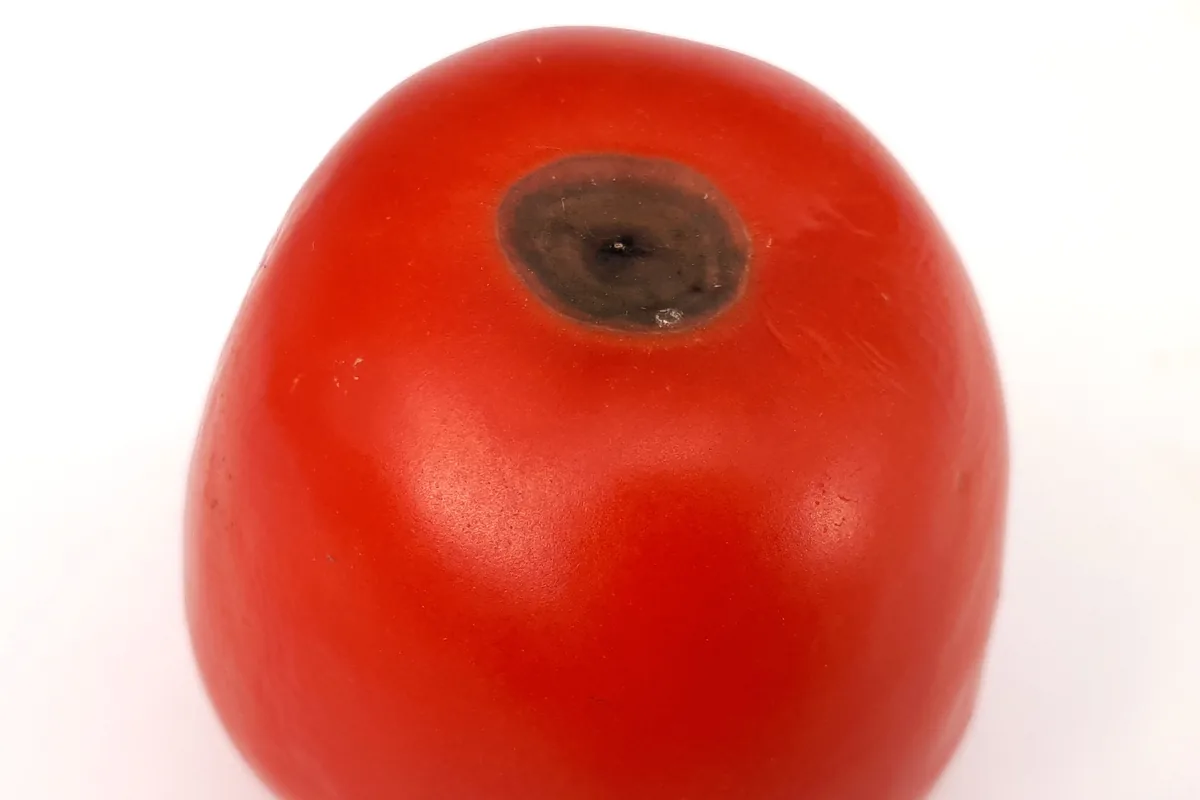
Blossom end rot in tomatoes and peppers: it's not a disease
My neighbor Jim has grown tomatoes in his backyard on Long Island for fifteen years. Every summer, at least a portion of his crop develops that familiar dark, leathery rot on the bottom of the fruit.
—- title: "Blossom end rot" slug: blossom-end-rot hub: problems category: Diagnostic guide description: "My neighbor Jim has grown tomatoes in his backyard on Long Island for fifteen years. Every summer, at least a portion of his crop develops that familiar dark, leathery rot on the bottom of the fruit.." date: 2026-06-10 updated: 2026-06-10 author: "Thomas A." reading_time: 7 —-
My neighbor Jim has grown tomatoes in his backyard on Long Island for fifteen years. Every summer, at least a portion of his crop develops that familiar dark, leathery rot on the bottom of the fruit. He's tried calcium sprays. He's added lime. The rot keeps coming back. The reason it keeps coming back is that he never addressed the actual cause: his tomatoes dry out between waterings.
Blossom end rot looks like a disease. It isn't one. No pathogen is involved. Per Missouri Botanical Garden, blossom end rot is "a physiological disorder" — a disturbance in the normal physiology of the plant. You cannot spray it away.
What blossom end rot actually is
Calcium is a structural component of plant cell walls, and it is immobile in the plant — meaning it cannot move from older tissue to newer tissue once deposited. When a tomato or pepper fruit is developing rapidly, it relies on a constant stream of calcium delivered through the xylem (the plant's water-transport tissue) from the roots.
When calcium supply to the developing fruit tip is interrupted — even briefly — the cells at the blossom end break down. This breakdown manifests as the characteristic dark, sunken, leathery spot at the base of the fruit.
Per Missouri Botanical Garden, the early symptom is "a light tan patch on the blossom end of the green fruit." Over time the area turns dark brown or black and may become sunken or leathery. Sometimes internal black rot develops in the center of the fruit with little or no external symptoms. The fruit is not entirely lost — affected areas can be cut away and the rest eaten.
The cause: irrigation inconsistency, not calcium deficiency in soil
Per Missouri Botanical Garden, "the most common cause is fluctuating soil moisture. Moisture plays an important role in calcium uptake in the plant. When a dry period follows adequate moisture, calcium uptake can be reduced."
An actual deficiency of calcium in the soil is a less frequent cause. Per Missouri Botanical Garden, this "is rarely the case."
What causes calcium uptake to fail even when soil calcium is adequate:
Irregular watering. The classic pattern: a dry stretch, then a heavy rain or deep watering. Roots lose function during the dry period. By the time moisture is restored, the developing fruits have already experienced the calcium deficit.
Root damage. Per Missouri Botanical Garden, root damage due to deep cultivation near the plant or burning from improper fertilization restricts calcium uptake. Hoeing close to tomato roots is a common cause.
Excess nitrogen. Per Missouri Botanical Garden, "excessive applications of fertilizer containing ammonia can result in symptoms." High-nitrogen fertilizers push rapid shoot and leaf growth that competes with developing fruits for calcium. The plant prioritizes vegetative growth; the fruit suffers.
Wrong soil pH. Per Missouri Botanical Garden, "calcium may not be available to plants if the soil pH is too low or high." The correct pH range for tomatoes and peppers is 6.5 to 7.0. Outside this range, calcium becomes chemically unavailable regardless of how much is in the soil.
Container growing. Containers dry out faster than garden soil and are more vulnerable to the moisture swings that trigger blossom end rot. Per Penn State Extension, container growers should maintain consistent soil moisture during periods of high heat.
Which fruits are affected
The first tomatoes of the season are typically most affected. Blossom end rot usually appears on fruit that is one-third to one-half developed. Per Missouri Botanical Garden, as the season continues and root systems become well-established, the problem often resolves on its own — which is why many gardeners see it on their first dozen tomatoes and then it stops.
Plants affected: tomatoes (all types, though paste and Roma types are somewhat more susceptible due to their concentrated fruit development), peppers, squash, cucumbers, and watermelons.
What doesn't work: calcium sprays
Foliar calcium chloride sprays are widely sold as a blossom end rot treatment. The honest assessment: per Missouri Botanical Garden, these are "a last resort" — not a primary treatment. The instruction not to "spray too often or in excessive amounts" is significant. Excess calcium chloride can burn foliage.
More fundamentally: if the problem is that the plant cannot absorb and transport calcium due to moisture stress, putting calcium on the leaves does not fix the plumbing. The calcium still has to move through the xylem to developing fruit. A plant with inconsistent irrigation cannot do that consistently.
Per Penn State Extension, the primary intervention is to "verify that you are applying enough calcium with fertilizers or organic nutrient sources" — and if calcium levels are adequate, "examine your irrigation regime. You may need to supply water more often so the soil is consistently moist."
Prevention: the actual fix
1. Even soil moisture. Water deeply and consistently — every 2 to 3 days in hot weather, or use drip irrigation that maintains steady soil moisture. The goal is preventing the boom-bust wet-dry cycle.
2. Mulch heavily. Per Missouri Botanical Garden, mulch plants with a 3—4 inch layer of organic material to help hold in soil moisture. Shredded leaves, straw, or wood chips all work. Mulch is more effective at preventing blossom end rot than calcium sprays.
3. Don't cultivate deeply near plant roots. Shallow surface cultivation is fine. Deep hoe strokes within 12 inches of the main stem cut feeder roots and disrupt calcium transport.
4. Fertilize correctly. Per Missouri Botanical Garden, use a fertilizer "high in superphosphate and low in nitrogen." When adding nitrogen, use calcium nitrate rather than ammonia or urea forms. Avoid high-nitrogen lawn fertilizer drifting onto or applied near tomato beds.
5. Soil test first. Per Penn State Extension, if blossom end rot persists after irrigation improvement, check the soil test report. Maintain pH at 6.5 to 7.0. If the pH is significantly below 6.0, lime will raise it and increase calcium availability.
6. For containers: Use a tomato-specific fertilizer that contains calcium as a micronutrient. Per Missouri Botanical Garden, standard fertilizers without micronutrients are insufficient for container-grown tomatoes and peppers.
Common problems table
| Symptom | Cause | Fix |
|---|---|---|
| Dark leathery spot on bottom of first tomatoes | Blossom end rot from irregular watering early season | Mulch, consistent irrigation; usually self-corrects as roots establish |
| Blossom end rot despite regular watering | Root damage from cultivation, or soil pH out of range | Avoid deep hoe near roots; soil test for pH |
| Calcium spray applied, problem continues | Root uptake problem — calcium can't reach fruit | Fix irrigation consistency; spray is a last resort, not a cure |
| Rot inside fruit, no external spot | Internal form of blossom end rot | Same cause and treatment as external form |
| Problem only on first fruits, stops later | Normal pattern as root system establishes | Maintain irrigation; later fruits typically fine |
| Problem in containers | Containers dry faster; more vulnerable to moisture swings | Daily watering in heat; use tomato fertilizer with calcium |
Recommended gear: Best Fertilizer for Tomatoes: NPK, Calcium, and Timing from Extension Research — our buyer's guide covering picks for every budget, ranked by Extension publication consensus and personal use.
Frequently asked
Is blossom end rot contagious?
No. Per Missouri Botanical Garden, blossom end rot is a physiological disorder — not caused by any insect or disease organism. You cannot spread it from plant to plant by handling, and it does not spread through soil. Each affected fruit represents a calcium deficit event at the time the blossom end was developing.
Will calcium spray fix blossom end rot?
Per Missouri Botanical Garden, foliar calcium spray is "a last resort" with the caveat not to use it too often or in excess amounts. It does not fix the underlying problem of inconsistent irrigation. Fruit already showing blossom end rot will not recover — the cell damage is done. Calcium spray may prevent new damage on developing fruit only if the root uptake problem is also simultaneously addressed.
Should I remove affected tomatoes from the plant?
Yes. Leaving severely affected fruit on the plant is not beneficial to the plant, and the fruit will not recover the damaged tissue. Cut off or remove fruits with blossom end rot. The undamaged portions of lightly affected fruit are safe to eat — cut away the dark area and use the rest.
Why does blossom end rot stop mid-season?
Per Missouri Botanical Garden, blossom end rot commonly affects fruit that is one-third to one-half developed, and is most common early in the season when root systems are still establishing. As roots develop and the plant's calcium transport becomes more robust, later-season fruit is often unaffected. This is why blossom end rot on the first dozen tomatoes followed by clean fruit on the next fifty is a common pattern.
Sources
- Missouri Botanical Garden — Blossom End Rot of Tomato and Pepper.
- Penn State Extension — Blossom End Rot, Internal Whitening, and Rain Check of Tomatoes.