Daylily Care: Growing Hemerocallis Successfully
title: "Daylily Care: Growing Hemerocallis in Your Garden"
—- title: "Daylily Care: Growing Hemerocallis in Your Garden" slug: daylily-care hub: plants category: Species guide description: "How to grow daylilies (Hemerocallis) in zones 3–9. Deer pressure, division, avoiding scapes being eaten, and cultivar selection for Long Island zone 7a." date: 2026-06-10 updated: 2026-06-10 author: "Thomas A." reading_time: 9 scientific: "Hemerocallis spp." zones_min: 3 zones_max: 9 sun: "full sun" deer_resistant: false native: false pollinator: true bloom: "summer" height_min: 1 height_max: 4 —-
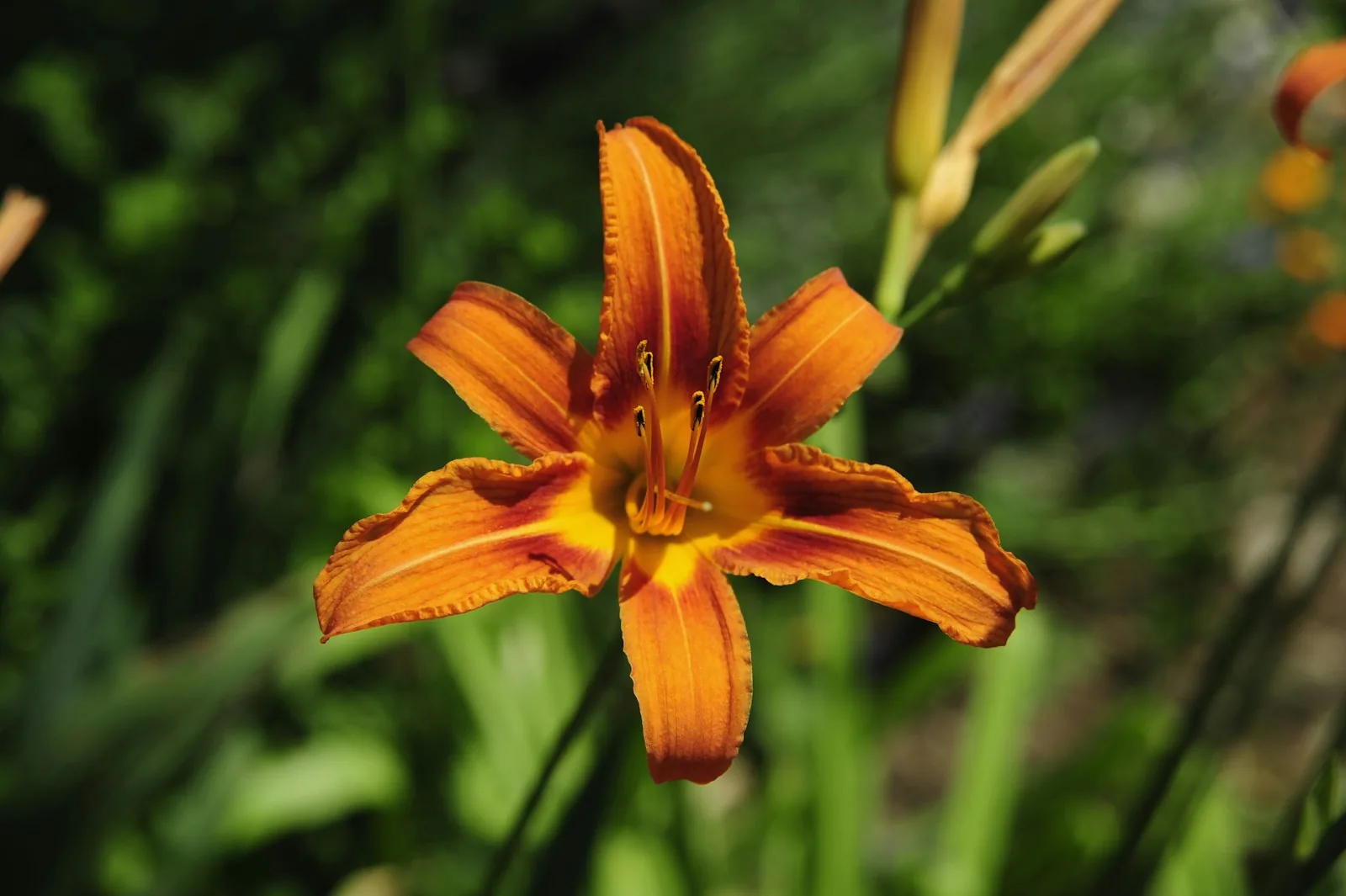
Daylilies are the perennials I'd recommend first to anyone establishing a new garden — Hemerocallis is drought-tolerant, adaptable to a wide range of soils, cold-hardy in zones 3 through 9, and one of the most free-blooming summer perennials available. I grow several cultivars in my Long Island yard, including 'Stella de Oro' (repeat-blooming, yellow, compact), 'Happy Returns' (pale yellow, prolific re-bloomer), and a deep orange unnamed variety that came with the house in 2019 and has spread reliably since. They are the low-maintenance backbone of my sunniest border.
The honest caveat: in high-deer-pressure areas — which includes most of Long Island's suburban landscape — daylilies get eaten. The foliage is palatable; the flower buds even more so. A management strategy for deer is not optional here, it's the first conversation.
Taxonomy and types — orange roadside daylily vs. modern cultivars
A crucial identification point: the daylily commonly seen naturalizing along North American roadsides is Hemerocallis fulva — tawny daylily. Per Missouri Botanical Garden, this is an Asian species naturalized in North America that spreads aggressively by stolons and is considered invasive in some states. It does not produce viable seed in North America but spreads vegetatively.
Modern daylily cultivars (the 80,000+ registered with the American Hemerocallis Society) are primarily derived from H. lilioasphodelus, H. citrina, and other species, and most do not spread aggressively. Per NC State Extension Plant Toolbox, modern cultivars are "clump-forming" without the stoloniferous spreading of H. fulva.
Diploid vs. tetraploid cultivars: Tetraploid daylilies have been bred for larger, more ruffled flowers in more complex colors but often have heavier, coarser foliage. Diploid types have a more graceful, finer texture. Per Penn State Extension, both perform similarly in the garden; the distinction is primarily relevant to collectors.
USDA hardiness zones
Per Missouri Botanical Garden, daylilies are "extremely adaptable" and hardy in zones 3–9 for most cultivars. Some cultivars are evergreen in zones 8–9 (foliage persists through winter); others are semi-evergreen or dormant. Per NC State Extension, in zones 5–7 dormant types are most reliable and have the best cold hardiness.
In zone 7a Long Island, I have never experienced winter damage on any daylily cultivar I've grown, including 'Stella de Oro' and the straight orange H. fulva from the roadside.
Light
Full sun is ideal for maximum bloom. Per Missouri Botanical Garden, daylilies "prefer full sun to light shade" and "tolerate light shade but have reduced bloom." Six or more hours of direct sun produces the densest flowering. In zones 7 and warmer, light afternoon shade extends the lifespan of individual flowers (each lasts one day) and may reduce heat stress on dark-colored cultivars.
In my experience: the daylilies on the south-facing side of my property, full sun all day, bloom weeks longer and more prolifically than a small patch I tried along the east fence that gets afternoon shade. The shaded plants are healthy but bloom sparsely and finish earlier.
Soil
Per Missouri Botanical Garden, daylilies "tolerate a wide range of soils" but "best growth occurs in fertile, well-drained soils with pH 6.0–6.5." In Long Island's sandy loam at approximately pH 6.2, they grow vigorously with no amendment. In heavy clay, improve drainage with compost before planting. They do not perform well in waterlogged soils.
Watering
Established daylilies are significantly drought-tolerant. Per Clemson Extension HGIC, established plants need "about 1 inch of water per week from rain or irrigation during the growing season." During the first year, water weekly to establish roots. After that, the plants in my Long Island yard receive no supplemental irrigation except during July–August droughts lasting over 2 weeks, and they show no distress.
During bloom, adequate moisture improves flower quality and prolongs the season slightly. A deep soak every 1–2 weeks during dry summer stretches is adequate.
Fertilizing
Per Clemson Extension HGIC, daylilies "are not heavy feeders" and respond to a single application of a balanced slow-release fertilizer in early spring as growth emerges. In lean sandy soils, a second light application in early June (before bloom begins) supports flower development. Avoid late-season nitrogen, which encourages vegetative growth at the expense of flower bud initiation for the following year.
I fertilize my daylilies once in early April with Osmocote slow-release fertilizer at the label rate. That's the entire fertilization program.
Deadheading and extending bloom
Individual daylily flowers last one day each. Deadheading the spent flowers — removing the old flower from the scape (flower stalk) — is optional but keeps plants looking neat. Per Missouri Botanical Garden, each scape typically carries 12–15 flower buds that open over 1–2 weeks; removing spent flowers from the scape does not accelerate subsequent openings.
Removing finished scapes: Once all buds on a scape have opened and finished, cut the entire scape to the base. This looks cleaner than leaving dried scapes and redirects energy to the crown.
Reblooming cultivars: Per Clemson Extension HGIC, some daylily cultivars bloom more than once per season. 'Stella de Oro' and 'Happy Returns' (both yellow, compact, 12–18 inches) are the most widely grown re-bloomers. Rebloom is promoted by adequate fertilizer and water and is more reliable in zones 5–7 than in hotter zones where summer heat suppresses reblooming.
Dividing
Per Missouri Botanical Garden, divide daylilies every 3–5 years when bloom quality declines — the crowded clumps produce fewer, smaller flowers than divided plants. Divide in early spring or in early fall (6 weeks before frost).
Dig the entire clump, separate with a hori-hori knife or two garden forks back-to-back, and replant divisions 18–24 inches apart. Each division should have 3–5 fans of foliage and a healthy root system. Water thoroughly after replanting.
Deer pressure
Per Rutgers NJAES, daylilies are rated as "frequently severely damaged" by deer — one of the most palatable perennials for deer. In high-pressure suburban zones like Long Island, daylily foliage and especially flower buds are eaten aggressively.
My management in Melville: I apply Liquid Fence when the foliage reaches about 6 inches in spring and every 4 weeks through bloom season. Without it, the daylilies are eaten. With it, they bloom reliably. Plantskydd powder applied to dormant crowns in fall is a useful supplement that deters early spring browsing.
Companion plants
- Salvia (Salvia nemorosa) — blue-purple spikes contrast with daylily's warm colors; similar sun and drainage requirements.
- Yarrow (Achillea millefolium) — flat-topped yellow or white flowers contrast with daylily's bold blooms.
- Coneflower (Echinacea purpurea) — native companion with pink daisy flowers overlapping daylily bloom.
- Switchgrass (Panicum virgatum) — airy grass form in the background or between daylily clumps.
- Phlox (Phlox paniculata) — white or pink phlox alongside orange or yellow daylilies in a traditional summer border.
Common problems
| Symptom | Most likely cause | Fix |
|---|---|---|
| Foliage and flower buds eaten | Deer | Repellent program; physical fencing |
| Few flowers on established clump | Overcrowding; need division | Divide in spring or early fall |
| Rust spots on leaves | Daylily rust fungus | Apply fungicide if severe; remove infected foliage |
| Leaf streak (yellow-green streaking) | Daylily leaf streak (Aureobasidium) | Remove affected foliage; improve air circulation |
| Orange tawny daylily spreading everywhere | H. fulva stoloniferous spread | This species cannot be stopped easily; remove entirely or contain with edging |
| Slug damage on emerging foliage | Slug pressure in wet springs | iron phosphate slug bait (Sluggo (iron phosphate slug bait)) |
Frequently asked
When do daylilies bloom?
Per Missouri Botanical Garden, most daylilies bloom in June and July in zones 5–7. The exact timing depends on cultivar — early types start in late May, mid-season types bloom in June–July, late types in July–August. By planting early, mid, and late cultivars, total daylily bloom in a garden can span 8–10 weeks. Re-blooming types like 'Stella de Oro' produce a main flush in June–July and then scattered additional scapes through August–September.
Are daylilies toxic to cats?
Per NC State Extension, daylilies (Hemerocallis) are highly toxic to cats — all parts of the plant can cause acute kidney failure. Dogs appear unaffected. True lilies (Lilium spp.) are similarly toxic to cats. This is an important distinction for cat owners: daylilies should not be planted in gardens where cats have access to them.
Why didn't my daylilies rebloom this year?
Per Clemson Extension HGIC, rebloom depends on cultivar, summer temperatures, and available resources. Re-blooming cultivars like 'Stella de Oro' or 'Happy Returns' bloom best in zones 5–7 where summer temperatures moderate in late summer, allowing the plant to initiate new scapes. In zones 8–9, sustained heat can suppress rebloom. Adequate fertilizer, consistent moisture, and timely removal of spent scapes all contribute to rebloom. If a cultivar is not labeled as reblooming, it will not rebloom regardless of conditions.
Recommended gear: Best iron phosphate slug bait: Sluggo vs Slug Magic vs generic — our buyer's guide covering picks for every budget, ranked by Extension publication consensus and personal use.
Sources
- Missouri Botanical Garden — <a href="https://www.missouribotanicalgarden.org/PlantFinder/PlantFinderDetails.aspx?kempercode=c439">Hemerocallis</a>.
- NC State Extension Plant Toolbox — <a href="https://plants.ces.ncsu.edu/plants/hemerocallis/">Hemerocallis</a>.
- Clemson Extension HGIC — <a href="https://hgic.clemson.edu/factsheet/daylilies/">Daylilies</a>.
- Penn State Extension — <a href="https://extension.psu.edu/perennials-in-the-landscape">Perennials in the Landscape</a>.
- Rutgers NJAES — <a href="https://njaes.rutgers.edu/pubs/publication.asp?pid=FS1312">Landscape Plants Rated by Deer Resistance</a>.