This article contains affiliate links. As an Amazon Associate, we earn from qualifying purchases, at no extra cost to you. We recommend products based on university Extension guidance, manufacturer labels and long-term owner reports, never on commission rates. See our full disclosure.
Side by side
| Scotts GrubEx1 | 24 Hour Grub Killer Plus | NemaSeek Hb nematodes | Milky Spore Powder | |
|---|---|---|---|---|
| Active ingredient | Chlorantraniliprole | Trichlorfon | Heterorhabditis bacteriophora | Paenibacillus popilliae |
| Approach | Preventive | Curative | Biological, curative on young grubs | Biological, long-term |
| Best timing | Spring to early summer, before egg hatch | Late summer to early fall, when grubs are found | Late summer, young grubs, soil moist and warm | Once; establishes over years |
| Grub species | All common white grubs | All common white grubs | All common white grubs | Japanese beetle only |
| Speed | Slow, long residual | Fast, short residual | Days to weeks, variable | Years |
| Water in? | Yes, about 0.5 inch | Yes, immediately | Yes, before and after | Per label |
| Bee risk note | Lower-risk option per Extension | Organophosphate; follow label | None from product | None from product |
| Check price | Check price | Check price |
Do you actually need a grub killer?
Most lawns carry a few grubs and never show it. Treating every lawn every year is how homeowners end up spending money on insecticide that was never needed.
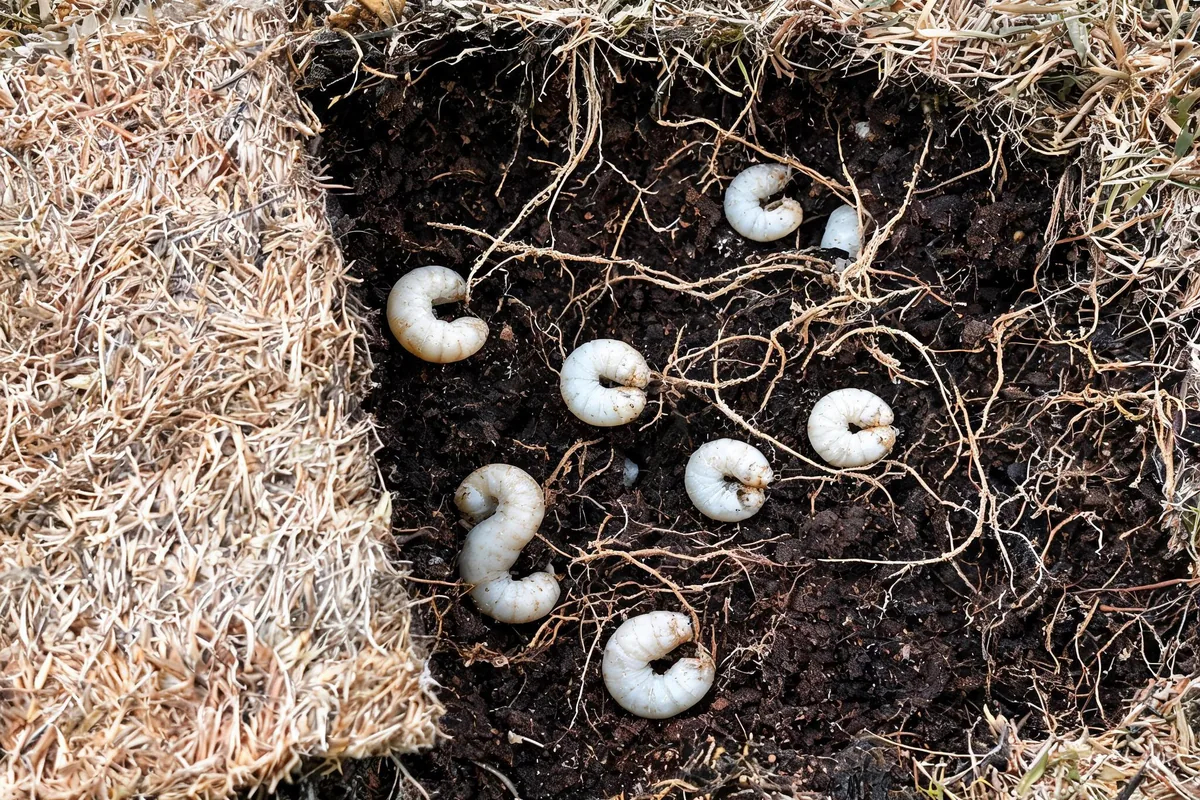
Per Penn State Extension, the way to decide is to count. Cut a square foot of sod about 2 to 3 inches deep at the edge of a suspicious patch, fold it back and count the C-shaped white grubs. Repeat in several spots and average the numbers. Extension thresholds are roughly 10 grubs per square foot for Japanese beetle and similar species, and fewer, around 5, for European chafer, which does more damage per grub. A healthy, watered lawn below those numbers usually outgrows the feeding.
Signs worth checking: irregular brown patches in late summer that peel up like loose carpet, and skunks, raccoons or crows tearing up the turf overnight. Our grub damage guide walks through the count and the lookalikes, including drought and disease.
Preventive vs curative: the decision that matters most
There are two different jobs, and the product follows the job.
- Preventive products go down before eggs hatch and sit in the root zone waiting for tiny first-stage grubs. They are the better tool if you had damage last year or live where grub pressure is reliably high.
- Curative products are for grubs you have already found above threshold. They act quickly but have short residual.
Per Michigan State University Extension, choosing between them comes down to your lawn's history: preventives make sense where damage is expected, curatives where you have confirmed a problem. Using a preventive as insurance on a lawn that has never had grubs is a judgment call, not a requirement.
Most Northeast white grubs, including Japanese beetle, oriental beetle and masked chafer, have a one-year life cycle. Adults lay eggs in midsummer, grubs hatch and feed near the surface from late summer into fall, move deeper for winter, feed briefly in spring, then pupate. That cycle sets every timing window below.
Granules are the normal homeowner format for both types. They go down with a broadcast spreader at the setting on the bag, which also makes the labeled rate easy to hit. Check your spreader setting before you start rather than guessing.
Active ingredients, explained
Chlorantraniliprole (Scotts GrubEx1, Acelepryn) is the newer preventive. It has a long residual, which is why it can go down in spring well ahead of egg hatch. Per the Scotts GrubEx1 label page, it is applied in spring to early summer and protects for up to four months. It is strongest against young grubs, not large ones in fall.
Imidacloprid and other neonicotinoids (thiamethoxam, clothianidin) are also preventives, typically applied in early summer before egg hatch. They work well on young grubs, but they are the products with pollinator concerns; see the bee section below.
Trichlorfon (the active in BioAdvanced 24 Hour Grub Killer Plus, sold professionally as Dylox) is the fast curative. It is an organophosphate with short residual, so it is used when grubs are present and feeding, and it must be watered in right away.
Carbaryl appears on some grub labels as a curative. It is a broad-spectrum insecticide, so if you go this route, read the bee hazard statement on the label carefully and keep it off anything in bloom.
Timing windows that actually work
Timing is where most grub treatments fail. The rough calendar for cool-season lawns in the Northeast:
- April to June: chlorantraniliprole preventive. Its slow movement and long residual let it go down early. Per MSU Extension, chlorantraniliprole products can be applied earlier in the season than neonicotinoids.
- June to mid-July: the window for neonicotinoid preventives such as imidacloprid, before eggs hatch.
- Mid-August to late September: curative window. Grubs are still fairly small and feeding close to the surface, so a curative watered in can reach them.
- October and spring: poor windows. Per Purdue Turfgrass Science, spring grub applications are not your best bet: grubs are large, about to stop feeding, and much harder to kill, and the product is better saved for the right window.
On Long Island and similar coastal areas, adult Japanese beetles typically show up from late June. If you see heavy adult activity on roses or linden in July, that is a reasonable cue to scout the lawn in late August. More on the adults in our Japanese beetle guide.
Water it in, or don't bother
Grubs feed in the root zone, under the thatch. Granules sitting on top of the grass do almost nothing.
- Preventives like chlorantraniliprole and imidacloprid should be followed by about half an inch of irrigation or rain to move the insecticide into the soil, per MSU Extension.
- Trichlorfon curatives need watering in immediately after application; the label is explicit about this, and delay costs efficacy.
- Curatives work poorly in dry soil, because grubs move deeper when the surface dries out. If it has been dry, water the lawn a day or two before treating to bring grubs up.
Keep children and pets off the treated area until it has been watered in and dried, or longer if the label says so.
Which product fits your situation
Matching the product to the situation saves more money than any brand choice.
- You had grub damage last fall. Use a chlorantraniliprole preventive next spring to early summer and water it in. This is the case GrubEx1 is built for.
- You found 10 or more grubs per square foot in late August. Use a trichlorfon curative now, water it in immediately, then reseed in September. Consider a preventive next year.
- You see beetles on your roses but the lawn looks fine. Do nothing to the lawn yet. Adult beetles fly in from a wide area, and a lawn full of beetles in July does not guarantee grubs in your own soil. Scout in late August.
- You want to avoid synthetic insecticides. Try Hb nematodes on young grubs in late summer, and accept that results are less predictable. Keep the lawn thick and well watered so it tolerates some feeding.
- Animals are digging but you cannot find many grubs. Count properly at the edge of the damage before treating. Skunks also dig for other insects, and a low count means insecticide will not stop them.
One product per season is usually enough. Stacking a preventive and a curative on a lawn that never reached threshold only adds cost and exposure.
Bees, clover and neonicotinoids
This is the part most grub product marketing skips. Neonicotinoids such as imidacloprid are systemic, and flowering weeds in a treated lawn, especially white clover and dandelion, can carry residues into nectar and pollen.
Per UMass Extension and MSU Extension's guidance on protecting pollinators during grub control, homeowners can cut the risk in two ways: choose chlorantraniliprole instead of a neonicotinoid, and if you do use a neonicotinoid, mow off flowering weeds before you apply so bees are not foraging on the treated turf. As Purdue Turfgrass Science reminds homeowners every grub season, follow the label directions, including any pollinator precautions printed on it.
That is a big part of why our top pick is a chlorantraniliprole product rather than imidacloprid, even though both prevent grubs.
Biological options: nematodes and milky spore
Beneficial nematodes. Per Cornell's fact sheet on Heterorhabditis bacteriophora, Hb is a cruising nematode that actively hunts hosts in the soil, which suits white grubs. The catch is handling. Nematodes are killed by sunlight and drying, so apply in the evening or on an overcast day, to soil that is already moist, and irrigate afterward. Target young grubs in late summer. Results are much more variable than with insecticides, so treat nematodes as a reasonable option for a low-input lawn, not a guaranteed rescue.
Milky spore. Per University of Missouri Extension, milky spore is a long-term tool with real limits: it infects only Japanese beetle grubs, it takes years to build up in the soil, and it does nothing about adult beetles flying in from the neighbors. If your grubs are masked chafer or European chafer, it will not help at all. Confirm the species first; our white grub guide covers raster patterns.
After treatment: getting the lawn back
Dead patches from grub feeding do not green up after treatment. The roots are gone.
Rake out the dead turf, loosen the top inch or two of soil and reseed. For cool-season lawns in the Northeast, late August through September is the best overseeding window; see when to overseed your lawn. A dense, well-fed lawn tolerates a moderate grub population far better than a thin one, so a sensible fall feeding program matters more than people think. Our lawn fertilizer guide covers the options.
The label is the law. Use the rate on the bag, do not double up, and never apply a grub product to a vegetable garden or other site that is not on its label.
How we choose
These picks are research-based. We did not test these products; we compared them against university Extension guidance on white grub control (Penn State, Michigan State, Purdue, UMass, Cornell and Missouri), current product labels and manufacturer pages, and owner reports on how easy each product is to apply correctly. Picks had to be widely available to homeowners, labeled for white grubs in home lawns, and supported by Extension for the job we recommend them for. The author, Thomas Joseph, gardens in zone 7a on Long Island, where Japanese beetle and oriental beetle grubs are common, but nothing on this page is based on personal trials. We favor lower-risk options for pollinators where efficacy is comparable, and we never recommend off-label use.
Frequently asked
When should I put down grub killer?
For a preventive, spring to early summer for chlorantraniliprole products like GrubEx1, or early summer for imidacloprid, before eggs hatch. For a curative, mid-August to late September after you have counted grubs above threshold.
How many grubs per square foot is too many?
Penn State Extension uses roughly 10 per square foot for Japanese beetle and similar species, and about 5 for European chafer. Below that, a healthy watered lawn usually tolerates the feeding.
Does GrubEx kill existing grubs?
Chlorantraniliprole works best on young grubs. For large grubs already doing damage in late summer or fall, Extension points to a fast curative such as trichlorfon instead.
Is it worth treating grubs in spring?
Usually not. Purdue notes that spring grubs are large and close to pupating, so they are hard to kill and do little more feeding. Save the product for the right window.
Does milky spore work?
Only on Japanese beetle grubs, and slowly. Missouri Extension describes it as a long-term tool with limits; it does nothing for chafer or oriental beetle grubs.
Are grub killers safe for bees?
Chlorantraniliprole is the lower-risk choice per Extension pollinator guidance. If you use a neonicotinoid like imidacloprid, mow off flowering clover and dandelions first and follow the label's pollinator directions.
Sources
- White Grubs in Home Lawns, Penn State Extension
- How to choose and when to apply grub control products for your lawn, Michigan State University Extension
- Spring Grub Control Not Your Best Bet, Purdue University Turfgrass Science
- Grub Control in Lawns, Neonicotinoids and Bees, UMass Amherst Extension
- Protecting pollinators during home lawn grub control, Michigan State University Extension
- Milky spore and Japanese beetles: a long-term tool with limits, University of Missouri Extension
- Heterorhabditis bacteriophora, Beneficial Hb Nematode, Cornell CALS Integrated Pest Management
- Scotts GrubEx1 Season Long Grub Killer, ScottsMiracle-Gro