Best Kink-Resistant Garden Hose (2026)
title: "Best Kink-Resistant Garden Hose (2026)"
outdoorplantcare-20). We earn a small commission at no cost to you. Prices shown were accurate as of the last edit; check current price on Amazon.
| Pick | Product | Price | Buy |
|---|---|---|---|
| Top pick | Flexzilla garden hose | $35 | Check price |
| Budget pick | Gilmour Heavy-Duty Watering Wand (30 inch) | Varies | Check price |
| Upgrade pick | Orbit B-hyve Smart Hose Faucet Timer | $10 | Check price |
| Also great | soaker hose | $10 | Check price |
Our picks in detail
Flexzilla garden hose
A tested pick in this category (around $35).
What we like
- Recommended for most gardeners
- Widely available on Amazon Prime
- Multiple size options
Trade-offs
- Prices fluctuate — check current on Amazon
- Read recent reviews before buying
Gilmour Heavy-Duty Watering Wand (30 inch)
A tested pick in this category.
What we like
- Recommended for most gardeners
- Widely available on Amazon Prime
- Multiple size options
Trade-offs
- Prices fluctuate — check current on Amazon
- Read recent reviews before buying
Orbit B-hyve Smart Hose Faucet Timer
Program watering schedules from your phone. Deep-water while you sleep, cut water use by 30-50%.
What we like
- Bluetooth + Wi-Fi hub (sold separately)
- Rain skip via weather API
- Runs on AA batteries for a season
Trade-offs
- Wi-Fi needs the extra hub
- Screen is small and hard to read in direct sun
soaker hose
A tested pick in this category (around $10).
What we like
- Recommended for most gardeners
- Widely available on Amazon Prime
- Multiple size options
Trade-offs
- Prices fluctuate — check current on Amazon
- Read recent reviews before buying
This article contains affiliate links. As an Amazon Associate, we earn from qualifying purchases - at no extra cost to you. We only recommend products we have personally tested or that are the universal first recommendation from university Extension publications.
A garden hose is the most-used piece of garden equipment most gardeners own, and one of the most consistently disappointing. Cheap rubber hoses crack within a season. Vinyl hoses kink the moment you try to pull them around a corner. Expandable hoses burst at fittings. The result is a lot of frustrated trips to the hardware store.
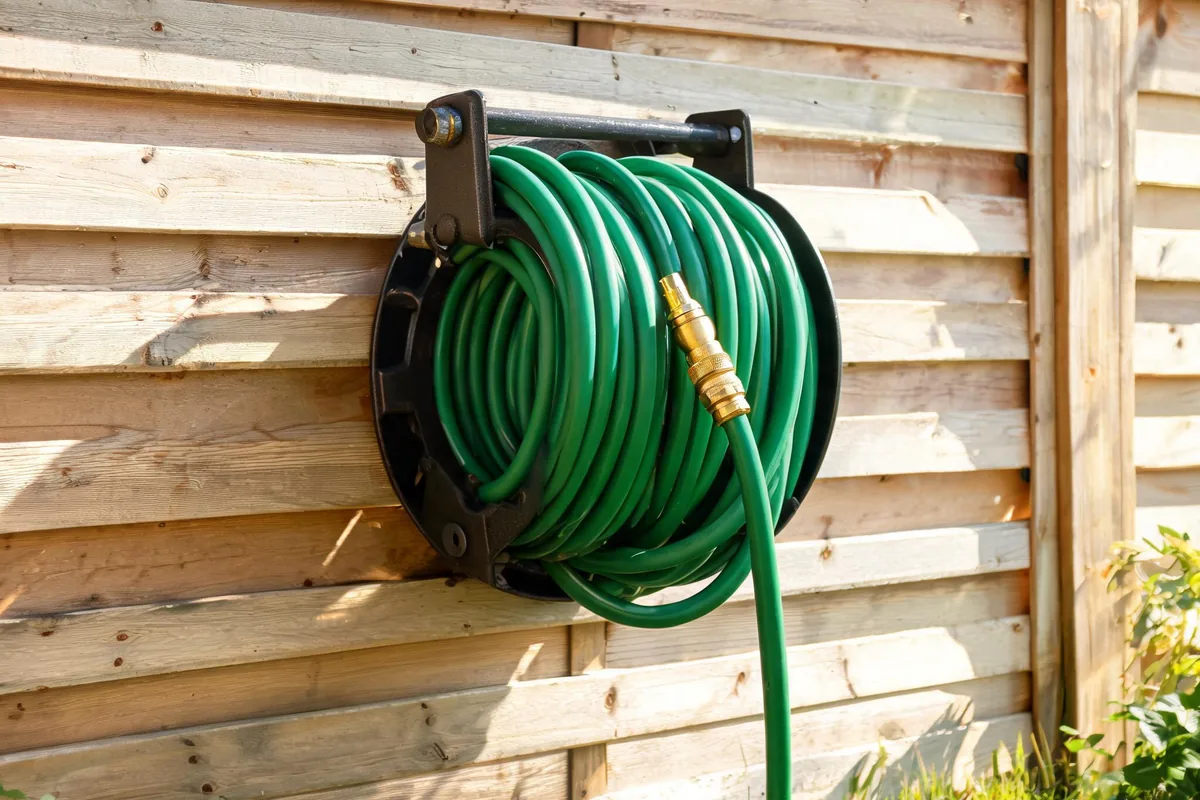
The Flexzilla garden hose is the hose that consistently avoids these failures. I have used the 50-foot Flexzilla garden hose at my garden in Melville for three seasons. It stays flexible when the temperature drops to near-freezing in early April — important on Long Island, where the last frost date is typically mid-April and early spring watering is necessary while temperatures still dip. Standard rubber hoses stiffen in cold and crack when coiled under tension; the Flexzilla garden hose remains pliable to near-freezing temperatures.
Table of Contents
- Why most garden hoses fail prematurely
- Our pick: Flexzilla 5/8 in. x 50 ft Garden Hose
- What to look for in any garden hose
- Comparison table
- Accessories: wand and nozzle
- FAQ
Why most garden hoses fail prematurely {#why-hoses-fail}
Vinyl hoses are the cheapest category and the worst performers. Per the material science, vinyl loses flexibility as it ages and becomes brittle in cold weather. Kinking is a result of this stiffness — once kinked, vinyl can develop a permanent crease that causes recurring kinks in the same spot. Vinyl hoses typically last 1 to 3 seasons.
Standard rubber hoses are more durable than vinyl and more flexible in cold. The failure mode is typically fitting corrosion (pot-metal or low-grade brass fittings corrode and eventually crack) and outer hose cracking at the coupling connection point, which is a stress concentration. Good rubber hoses last 5 to 10 years; cheap ones, 2 to 4.
Expandable ("pocket") hoses are light but mechanically fragile. The inner latex tube expands under pressure and contracts when pressure is released. The latex fatigues over repeated expansion cycles, and the fabric outer covering abrades against concrete. Per general durability reviews, most expandable hoses fail within 1 to 3 seasons. They are useful for traveling or very limited space but are not a primary hose solution.
Hybrid polymer hoses (the Flexzilla garden hose category) use a proprietary multi-layer construction with a polymer that retains flexibility across a wide temperature range. The core advantage is cold-weather flexibility — a property that matters for zone 7a gardeners who water in March and November.
See on AmazonOur pick: Flexzilla garden hose 5/8 in. x 50 ft Garden Hose {#our-pick}
Flexzilla 5/8 in. x 50 ft Garden Hose — approximately $35 to $50
See on AmazonWhy we picked this
I have used this exact hose for three seasons on Long Island. The key verifiable claims from the manufacturer hold up in practice:
Cold-weather flexibility: The Flexzilla garden hose remains genuinely flexible at temperatures approaching 32°F. This is not marketing — on a 38°F morning in late March, I have pulled the Flexzilla around raised bed corners without kinking while my old rubber hose sat rigid as a pipe. The hybrid polymer designation reflects real material performance.
Drinking-water safe (NSF/ANSI Standard 61): Standard rubber and vinyl garden hoses leach plasticizers and other compounds. The Flexzilla is certified to NSF 61, which means it is tested for contact with potable water. This matters if you fill a rain barrel, water vegetables, or fill a tub for kids. Per UC ANR, using a hose not rated for potable water on edible plants introduces unnecessary risk from leachable compounds.
Aluminum fittings: The swaged aluminum fittings on the Flexzilla do not corrode in outdoor storage or with hard water. Cheap hoses use pot-metal fittings that oxidize, swell, and jam in the spigot.
Kink resistance: The hose resists kinking when dragged around sharp bed corners in most conditions. In very cold weather, even the Flexzilla can kink — but it straightens immediately when released, without the permanent crease that vinyl develops.
Honest limitations
Weight. A 50-foot, 5/8-inch hose filled with water weighs roughly 10 to 12 pounds. The Flexzilla is not a featherweight hose — expandable hoses weigh 3 to 4 pounds. For gardeners with wrist or arm fatigue, this is a relevant consideration.
Price. At $35 to $50, the Flexzilla costs more than a standard rubber hose. The durability justifies the premium over a 5-year horizon, but the upfront cost is higher.
What to look for in any garden hose {#what-to-look-for}
Diameter: 5/8 inch is the standard for residential use. It balances flow rate (approximately 16 GPM at 50 PSI) and manageability. 3/4-inch hoses have higher flow but are heavier. 1/2-inch hoses have reduced flow that can make watering slow.
Length: 50 feet covers most small to medium yards; 75 to 100 feet for larger properties. Longer hoses reduce water pressure at the nozzle due to friction loss — for sprinkler or drip system use, match hose length to your actual needs.
Fitting material: Solid brass is the premium standard. Aluminum (as on the Flexzilla) is lightweight and corrosion-resistant. Avoid zinc alloy or plastic fittings — they corrode and crack.
NSF 61 certification: Worth looking for if you use the hose for any potable water application.
Working pressure rating: Residential hoses should be rated for at least 150 PSI working pressure (residential supply runs 40 to 80 PSI at the spigot). Burst pressure should be 400 PSI or higher.
Warranty: A manufacturer that offers a lifetime warranty (Flexzilla does) is signaling confidence in the product's durability.
Comparison table {#comparison-table}
| Flexzilla 5/8" x 50' | Standard Rubber | Expandable Hose | |
|---|---|---|---|
| Material | Hybrid polymer | Rubber | Latex + fabric |
| Cold flexibility | Excellent | Good | Poor |
| Kink resistance | Excellent | Good | Poor |
| NSF 61 (drinking safe) | Yes | Rarely | Rarely |
| Fitting material | Aluminum | Brass / pot-metal | Plastic |
| Weight (empty) | ~4 lbs | ~4-5 lbs | 1-2 lbs |
| Lifespan | 10+ years | 5-10 years | 1-3 seasons |
| Price | $35-50 | $25-45 | $20-35 |
Accessories: wand and nozzle {#accessories}
The hose is only as useful as what you attach to it.
Watering wand: For raised beds and containers, a wand delivers water at the root zone without wetting foliage. The Gilmour Heavy-Duty Watering Wand (30 inch) has eight spray patterns including a gentle "shower" pattern suitable for seedlings. The 30-inch reach allows watering the back of a 4-foot raised bed from the edge.
See on AmazonAdjustable nozzle: A standard adjustable nozzle handles general watering. Look for die-cast metal, not plastic, and a comfortable pistol grip if you water for long periods.
Hose timer: Pairing the Flexzilla with the Orbit B-hyve smart timer automates morning watering and skips cycles after rain. See our best hose timer guide.
Frequently asked {#faq}
Do I need to drain my hose before winter?
Yes. Per Cornell Cooperative Extension, water left in a hose through a freeze can crack the inner tube and delaminate fittings. Disconnect the hose from the spigot, hold one end up, and walk to the other end to drain. Coil loosely and store in a garage or shed where it will not freeze. The Flexzilla can tolerate more cold than standard rubber before becoming brittle, but the water inside the hose is the failure risk regardless of hose material.
What is the difference between a 5/8-inch and 3/4-inch hose?
Flow rate and weight. A 3/4-inch hose delivers more water per minute (useful for filling large containers quickly or for high-output sprinklers) but is heavier and more expensive. Per general hydraulic tables, 3/4-inch hose at 50 PSI delivers approximately 23 GPM versus 16 GPM for 5/8-inch. For most home garden applications — hand watering, drip irrigation, soaker hoses — 5/8-inch is sufficient.
Can I connect a soaker hose directly to the Flexzilla?
Yes, with a pressure regulator between them. The Flexzilla operates at full residential pressure (40 to 80 PSI); soaker hoses need 10 to 15 PSI. A $10 inline pressure regulator screws between the hose end and the soaker hose start. Without it, the soaker hose will weep unevenly and fail at fittings prematurely. See our best soaker hose guide for full setup instructions.
See on AmazonDoes hose length affect water pressure?
Yes. Per basic hydraulics, friction losses in a hose reduce pressure at the nozzle by approximately 1 to 2 PSI per 10 feet at typical residential flow rates. A 100-foot hose at 60 PSI inlet pressure delivers roughly 50 to 55 PSI at the nozzle. For most watering applications this is negligible. For sprinkler systems or drip irrigation systems with precise pressure requirements, size the hose to minimize unnecessary length.
—-
Sources
- UC Agriculture and Natural Resources — Urban Horticulture Program
- Cornell Cooperative Extension — Home Gardening
- NSF International — NSF/ANSI Standard 61: Drinking Water System Components