Native Plants for the Western US: Prairie, Mountain, Pacific
title: "Native Plants for the Western US: Prairie, Mountain, and Pacific"
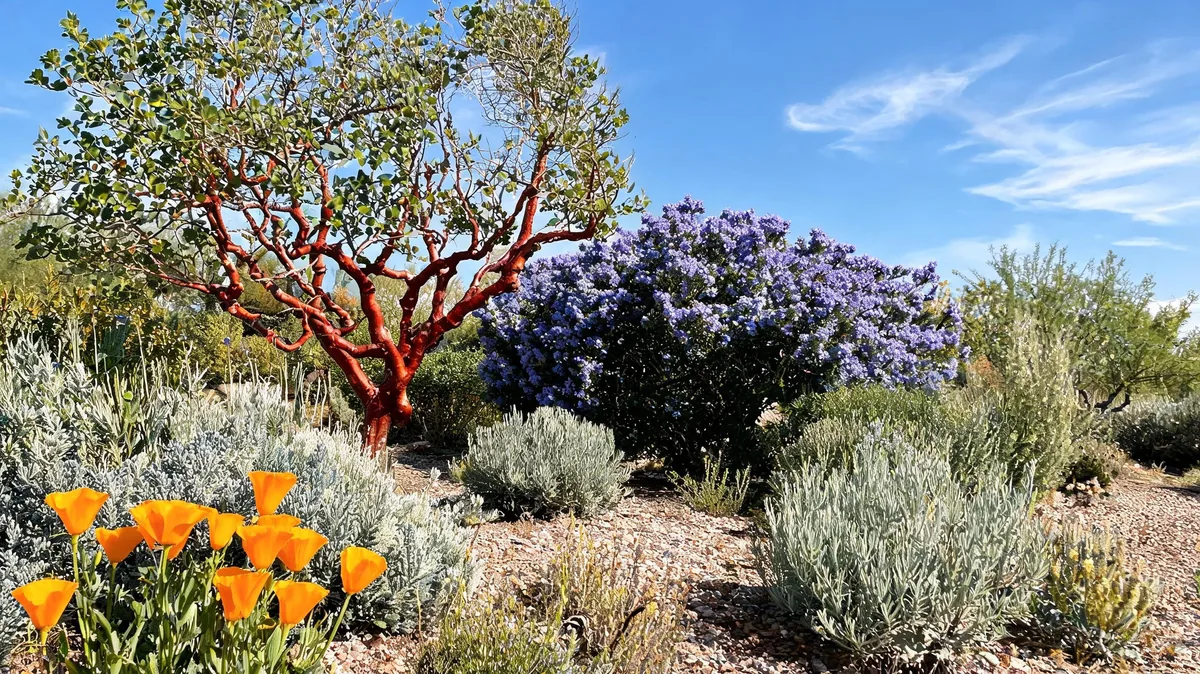
The western United States is not one region — it is several overlapping regions with dramatically different climates, soils, and native plant communities. The Great Basin desert, the California chaparral, the Pacific rainforest of the Coast Range, the Great Plains short-grass prairie, and the Rocky Mountain subalpine all have distinct native plant communities, and a recommendation appropriate for Portland is wrong for Phoenix and wrong for Denver. This guide addresses the three major landscape contexts: the Great Plains and interior mountain West, the Pacific Coast (California, Oregon, Washington), and notes the desert Southwest where it differs substantially.
USDA hardiness zones range from zone 3 in the Rocky Mountain high country and northern Great Plains to zone 11 in the low desert of California and Arizona. Summer drought is the defining challenge in most western landscapes — most precipitation falls October through April, and plants must survive a long dry summer. This is the fundamental difference between eastern and western native gardening.
The Great Plains and Interior Mountain West
The short-grass and mixed-grass prairies of the Great Plains, and the mountain meadows of the Rockies, share a community of drought-tolerant perennials that are among the most pollinator-rich in North America.
Trees and shrubs
Gambel oak (Quercus gambelii): Zones 4—8. The dominant oak of the Rocky Mountain foothills and Colorado Plateau. Per Colorado State University Extension, it is a thicket-forming shrub to small tree, deeply drought-tolerant, fire-adapted, and supports high caterpillar diversity. Wildlife value is very high.
Chokecherry (Prunus virginiana): Zones 2—9. Among the most widely distributed native shrubs/small trees in the West, from the plains to mountain foothills. White flower racemes in May are significant early-season bee forage; dark red-black fruits in late summer feed birds heavily. Per Colorado State University Extension, it tolerates a wide range of soils and exposures.
Rabbitbrush (Ericameria nauseosa): Zones 3—9. The late-season shrub of the Great Basin. Yellow flowers in August—October are the primary nectar source for native bees and migrating monarchs in arid interior landscapes. Per USDA PLANTS database, it tolerates extreme drought, alkaline soils, and disturbed sites. Among the most ecologically important shrubs in the Great Basin pollinator calendar.
Rubber rabbitbrush is the standard name, but the genus was recently split; both Ericameria nauseosa and Chrysothamnus viscidiflorus (green rabbitbrush) perform the same ecological function with overlapping ranges.
Wild plum (Prunus americana): Zones 3—8. See Midwest section — it extends through the Great Plains into the mountain West.
Perennials
Prairie coneflower (Ratibida columnifera): Zones 3—9. A drought-tolerant native of the short-grass prairie with distinctive drooping petals and a prominent central column. Blooms June—October with minimal water. Per Colorado State University Extension, it is one of the most reliable native perennials for western dry conditions.
Blanket flower (Gaillardia aristata): Zones 3—9. Orange-red composite flowers on the native prairie — not to be confused with the heavily hybridized cultivars sold commercially. The straight species grows 1—2 feet in dry, well-drained soils. Per CSU Extension, it is one of the longest-blooming native perennials in the mountain West.
Showy milkweed (Asclepias speciosa): Zones 3—9. The primary western monarch host plant. See monarch waystation article for detail.
Rocky Mountain penstemon (Penstemon strictus): Zones 3—9. A blue-purple flowered native for well-drained, rocky soils. Blooms May—July. The penstemon genus is the most diverse hummingbird genus in the western U.S. Per CSU Extension, it is among the most drought-tolerant native perennials available for Colorado gardens.
Blue wild indigo (Baptisia australis): Zones 3—9. A long-lived perennial of eastern prairies that extends into the central and mountain West. Indigo-blue flowers May—June. Very deep root system (reportedly to 12 feet in some plants) — drought-tolerant once established but slow to establish. Per University of Minnesota Extension, it is one of the longest-lived native perennials in cultivation.