Native Plants for the Midwest: A Regional Guide
title: "Native Plants for the Midwest: A Regional Guide"
—- title: "Native Plants for the Midwest: A Regional Guide" slug: native-plants-midwest hub: care category: Pollinator description: "Native plants for the Midwest US: prairie perennials, trees, shrubs, and grasses for zones 3–6, backed by University of Minnesota, U of Illinois, and UW Extension data." date: 2026-06-10 updated: 2026-06-10 author: "Thomas A." reading_time: 10 —-
The Midwest — broadly defined here as Minnesota, Wisconsin, Michigan, Illinois, Indiana, Ohio, Iowa, Missouri, Kansas, Nebraska, and the Dakotas — is defined ecologically by the tallgrass prairie that once covered most of its area. Per the Xerces Society, the tallgrass prairie is one of the most endangered ecosystems in North America: an estimated 96—99% of the original prairie has been converted to agriculture. What remains supports some of the highest native bee diversity in the country, and the native plants that sustained that ecosystem are the foundation of any meaningful Midwest restoration planting.
USDA hardiness zones range from zone 3 in the Dakotas and northern Minnesota to zone 6b in southern Missouri and southern Illinois. Summers are hot; winters range from cold to very cold. The soils are some of the most fertile on earth — the deep prairie soils that drew settlement are the same that support extraordinary native plant diversity.
The prairie legacy: why this region is different
The original tallgrass prairie extended from Indiana to eastern Nebraska, from southern Manitoba to Texas. Per University of Illinois Extension, the prairie ecosystem supported over 200 species of vascular plants per acre in intact remnants, with root systems extending 10—15 feet deep in some species. Those deep roots built the topsoil that now makes the Midwest the breadbasket of North America.
This history means that the region's native plants are unusually tough. They evolved under periodic fire (which set back woody species and maintained the open prairie), cycles of extreme drought, and extremely cold winters. Prairie natives in the garden rarely need irrigation once established, rarely need fertilizer (prairie soils are nitrogen-rich from centuries of root decomposition), and rarely succumb to pests. The tradeoff is establishment time — a prairie plant spending its first year building root mass shows very little above ground.
Trees and shrubs: the woodland edge
Prairie plants dominate the Midwest narrative, but the region's oak savannas and river-bottom forests contribute critical species too.
Bur oak (Quercus macrocarpa): The most fire-tolerant oak in North America, able to resprout from its deeply insulated root crown after prairie fires. Zones 3—8. Per University of Minnesota Extension, it is one of the most drought-tolerant and cold-hardy native oaks, and its furrowed bark made it the iconic savanna tree of the upper Midwest. Acorns are the largest of any native oak and critical wildlife food.
Serviceberry (Amelanchier spp.): Multi-season shrub/small tree — early white bloom, early summer fruit, fall color. Zones 3—9. Extremely cold-hardy. Per University of Wisconsin Extension, downy serviceberry (A. arborea) and shadbush (A. canadensis) are the primary species for the upper Midwest.
Wild plum (Prunus americana): Zones 3—8. A thicket-forming native shrub/small tree that provides early spring bloom, yellow-red plums, and cover. Per University of Minnesota Extension, it is one of the most valuable native fruiting shrubs for wildlife in the northern Midwest.
Elderberry (Sambucus canadensis): Zones 3—9. White flat-topped flower clusters (June—August) are significant bee forage; black berries in August—September feed birds heavily. Per University of Illinois Extension, it tolerates moist to wet soils and part shade, filling a niche that few other fruiting shrubs occupy.
Nannyberry (Viburnum lentago): Zones 2—8. The most cold-hardy native viburnum, performing into zone 2 in the upper Midwest. White flower clusters in May, blue-black berries in fall. Per University of Minnesota Extension, it is one of the best native shrubs for wildlife in cold-climate Midwest gardens.
Prairie perennials: the core of Midwest native gardening
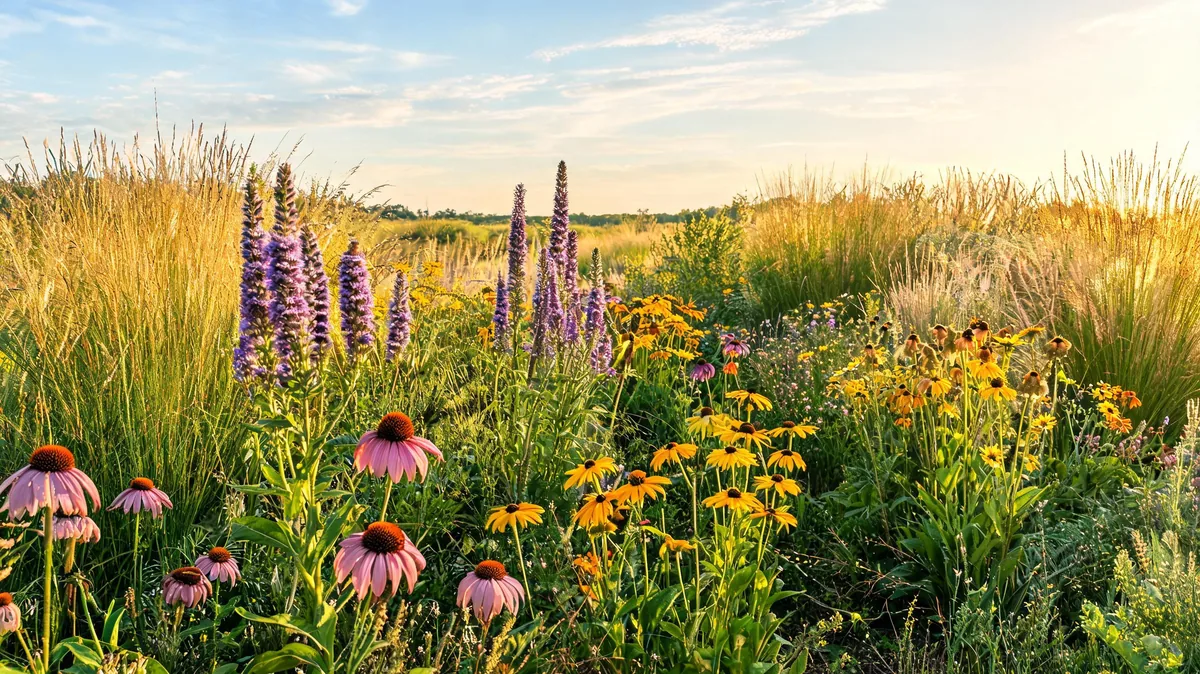
Purple coneflower (Echinacea purpurea): The defining Midwest prairie wildflower. Zones 3—9. July—September bloom. Native throughout the eastern prairie and forest margin. Very high bee and butterfly value.
Black-eyed Susan (Rudbeckia hirta): Zones 3—9. June—October. Tolerates a wide range of soils. Prolific self-seeder in the Midwest — once established in a garden it maintains itself.
Wild bergamot (Monarda fistulosa): Zones 3—9. July—September. Among the most bee-attractive prairie forbs. Per University of Wisconsin Extension, it is one of the top three native plants for attracting bees in prairie garden settings.
Prairie blazing star (Liatris pycnostachya): Zones 3—9. July—September. Tall purple flower spikes — 3—5 feet — that bloom from the top down. Significant nectar source for monarchs and swallowtails. Per University of Minnesota Extension, it prefers full sun and well-drained prairie soils.
Prairie dropseed (Sporobolus heterolepis): Zones 3—8. A native bunchgrass with a distinctive sweet fragrance when in bloom (August—September). One of the most ornamental native grasses, forming neat mounds of fine-textured foliage. Per University of Illinois Extension, it is one of the most sought-after native grasses among Midwest native plant gardeners.
Rattlesnake master (Eryngium yuccifolium): Zones 3—8. July—September. A structural plant — yucca-like basal leaves with globular white flowers on 3—5 foot stems. Visually dramatic and genuinely uncommon in cultivation despite being native to the Midwest prairie. Per the Lady Bird Johnson Wildflower Center, it is a significant late-summer native bee plant.
Prairie smoke (Geum triflorum): Zones 3—6. April—June. A short, early-blooming perennial with distinctive pink feathery seed heads. One of the earliest prairie forbs to flower. Per University of Minnesota Extension, it is a dry-soil specialist suited to the thinner, well-drained prairie soils of the upper Midwest.
Wild lupine (Lupinus perennis): Zones 3—8. April—June. Early spring bloom, significant bumble bee pollen source. Larval host for the Karner blue butterfly (Lycaeides melissa samuelis), a federally endangered species whose remaining habitat is concentrated in the upper Midwest and Northeast.
Common milkweed (Asclepias syriaca): Zones 3—9. June—August. The primary monarch butterfly host plant in the Midwest, and the most important plant addition for monarch conservation in the region per Monarch Watch.
Native grasses: structure and succession
Big bluestem (Andropogon gerardii): Zones 3—9. The dominant grass of the tallgrass prairie, historically constituting 80%+ of biomass in Midwest prairies. Grows 4—8 feet, tolerates drought and clay. Per University of Illinois Extension, it is the benchmark for Midwest prairie grass establishment.
Little bluestem (Schizachyrium scoparium): Zones 3—9. Shorter (2—4 feet) and more widely used in garden settings. Blue-green summer foliage, brilliant copper-red fall color. Tolerates dry sandy soils.
Switchgrass (Panicum virgatum): Zones 3—9. Adaptable to a wide range of soil moisture levels. Per University of Wisconsin Extension, named cultivars including 'Shenandoah' (red fall color), 'Heavy Metal' (strongly upright), and 'Northwind' (blue-green, tall) are widely used in Midwest native plantings.
Prairie dropseed (Sporobolus heterolepis): See perennials section above.
Plant table
| Common Name | Scientific Name | USDA Zones | Bloom Time | Height | Primary Value |
|---|---|---|---|---|---|
| Bur oak | Quercus macrocarpa | 3–8 | Apr–May | 50–80 ft | Fire-resistant; mast; caterpillars |
| Serviceberry | Amelanchier arborea | 3–9 | Apr | 15–25 ft | Early nectar; bird fruit |
| Wild plum | Prunus americana | 3–8 | Apr–May | 10–25 ft | Early pollen; wildlife fruit |
| Elderberry | Sambucus canadensis | 3–9 | Jun–Aug | 5–12 ft | Bee forage; bird fruit |
| Nannyberry | Viburnum lentago | 2–8 | May | 12–18 ft | Cold-hardy; bird fruit |
| Wild lupine | Lupinus perennis | 3–8 | Apr–Jun | 1–2 ft | Bumble bee; Karner blue host |
| Prairie smoke | Geum triflorum | 3–6 | Apr–Jun | 6–12 in | Early pollen; prairie accent |
| Wild bergamot | Monarda fistulosa | 3–9 | Jul–Sep | 2–4 ft | Very high bee value |
| Purple coneflower | Echinacea purpurea | 3–9 | Jul–Sep | 2–4 ft | Bee, butterfly, bird seed |
| Black-eyed Susan | Rudbeckia hirta | 3–9 | Jun–Oct | 1–3 ft | High generalist pollinator |
| Prairie blazing star | Liatris pycnostachya | 3–9 | Jul–Sep | 3–5 ft | Monarch; swallowtail nectar |
| Common milkweed | Asclepias syriaca | 3–9 | Jun–Aug | 3–5 ft | Monarch host (critical Midwest) |
| Rattlesnake master | Eryngium yuccifolium | 3–8 | Jul–Sep | 3–5 ft | Native bees; dramatic form |
| Prairie goldenrod | Solidago speciosa | 3–8 | Aug–Oct | 2–4 ft | Late nectar; 100+ bee spp. |
| New England aster | Symphyotrichum novae-angliae | 4–8 | Aug–Oct | 3–6 ft | Monarch migration nectar |
| Big bluestem | Andropogon gerardii | 3–9 | Aug–Oct | 4–8 ft | Prairie dominant; cover |
| Little bluestem | Schizachyrium scoparium | 3–9 | Aug–Oct | 2–4 ft | Drought-tolerant; fall color |
| Switchgrass | Panicum virgatum | 3–9 | Aug–Sep | 3–6 ft | Structure; nesting cover |
| Prairie dropseed | Sporobolus heterolepis | 3–8 | Aug–Sep | 1–2 ft | Ornamental; aromatic bloom |
| Prairie sedge | Carex bicknellii | 3–7 | May–Jun | 2–3 ft | Dry prairie sedge; groundlayer |
Establishment: the slow year-one reality
Per University of Minnesota Extension's prairie establishment guide, prairie plants invest their first growing season in root development. A big bluestem planted in spring may show only a few leaves above ground by fall, while its root system has extended 12+ inches. This is normal and not a sign of plant failure.
Weed competition is the primary threat to prairie establishment. Per University of Wisconsin Extension, the most common cause of failed prairie plantings is aggressive non-native grasses and broadleaf weeds outcompeting young native seedlings. Site preparation — including killing existing vegetation before planting, using a kill-and-sow approach, or planting large plugs rather than seed — significantly improves establishment success.
Frequently asked
Do I need to burn my prairie garden?
Fire management is optimal for large-scale prairie restoration, but small residential plantings can be maintained by cutting to 4—6 inches in late winter instead. Per University of Wisconsin Extension, late-winter cutting before spring emergence removes accumulated thatch and mimics the effect of fire for small plantings. Prescribed burns are appropriate for larger restorations (0.5+ acres) where fire can be managed safely; consult local fire codes and burn cooperatives for guidance.
Which Midwest natives are best for clay soil?
Per University of Illinois Extension, prairie plants adapted to the heavy clay soils of the central Midwest include big bluestem, switchgrass, wild bergamot, prairie blazing star, ironweed (Vernonia fasciculata), Joe Pye weed, and New England aster. Butterflyweed (Asclepias tuberosa) requires well-drained soil and does not perform in heavy clay; swamp milkweed (A. incarnata) is the clay-tolerant milkweed alternative.
How do I attract monarch butterflies to a Midwest garden?
Per Monarch Watch, the Midwest is at the heart of the eastern monarch breeding range. Plant at least 10 native milkweed plants (common milkweed, swamp milkweed, or prairie milkweed) and at least 3 late-blooming nectar species (goldenrod, native asters, blazing star). Avoid neonicotinoid-treated plants and systemic pesticides on milkweed throughout the breeding season.
Are ornamental cultivars of native plants as valuable as straight species?
Variable. Per Xerces Society guidance on nativar research, some cultivars of native plants have been selectively bred for double flowers (which reduce or eliminate pollen and nectar), altered color that changes bee attraction, or reduced leaf chemistry that affects specialist caterpillars. Cultivars with altered flower structure (double flowers) should be avoided in pollinator gardens. Straight species or cultivars that retain normal flower architecture are preferred; examples include 'Magnus' coneflower, which retains full pollinator value, vs. double-flowered coneflower cultivars.
Recommended gear: Best [coneflower cultivars beyond purple](https://outdoorplantcare.com/plants/best-coneflower-cultivars/) — our buyer's guide covering picks for every budget, ranked by Extension publication consensus and personal use.
Sources
- University of Minnesota Extension. Native plants and prairie establishment. extension.umn.edu
- University of Illinois Extension. Prairie plants and native landscaping. extension.illinois.edu
- University of Wisconsin Extension. Native plant and prairie guides. mastergardener.extension.wisc.edu
- Xerces Society. Tallgrass prairie natives. xerces.org
- Monarch Watch, University of Kansas. Midwest planting guidance. monarchwatch.org
- Lady Bird Johnson Wildflower Center. Midwest plant database. wildflower.org
- USDA PLANTS Database. plants.usda.gov
- Pollinator Partnership. Midwest ecoregional planting guides. pollinator.org