Winter Burn on Boxwood, Holly & Rhododendron
title: "Winter Burn on Evergreens: Boxwood, Holly, and Rhododendron"
—- title: "Winter Burn on Evergreens: Boxwood, Holly, and Rhododendron" slug: winter-burn-evergreens hub: problems category: Problem description: "Winter burn on boxwood, holly, and rhododendron: what causes the brown foliage, how to assess damage, when to prune, and how to prevent it next season." date: 2026-06-10 updated: 2026-06-10 author: "Thomas A." reading_time: 7 —-
Each spring on Long Island, the browning of evergreen foliage after a hard winter produces a wave of concern — and, often, premature action. Gardeners cut back still-living boxwood, rip out rhododendrons that would have recovered, and assume the damage is permanent before the plant has had a chance to show whether the buds are alive.
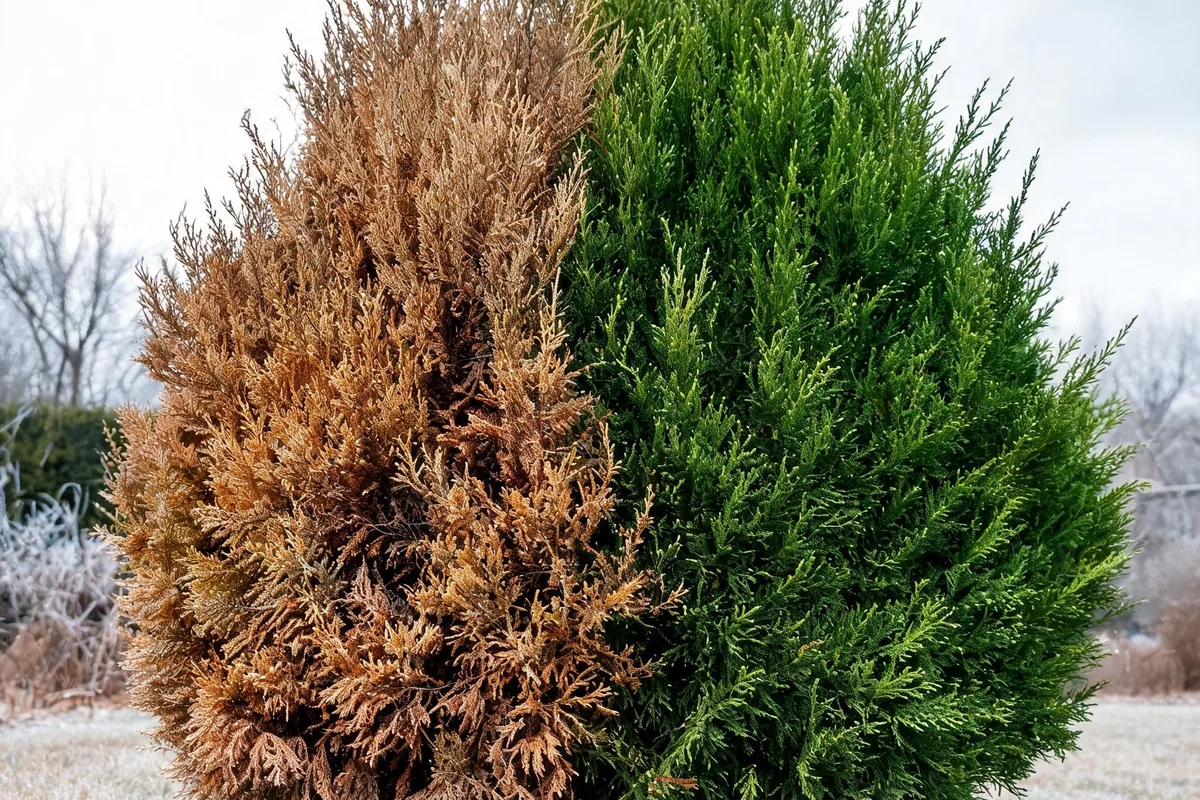
Winter burn is a physiological injury, not a disease. No pathogen is involved. Understanding what causes it tells you both why prevention works and why patience is the right response in spring.
What causes winter burn
Winter burn results from an imbalance between water loss and water uptake. Evergreen leaves (and needles) continue to lose water through their stomata during winter, especially on warm, sunny, or windy days. When the soil is frozen, roots cannot absorb water to replace what's lost.
Per University of Minnesota Extension, winter burn "is most likely to occur during sunny winter days when temperatures are below 25°F, soils are frozen, and there is little or no snow cover." Wind accelerates water loss significantly.
Per Rutgers NJAES, on Long Island and in the broader Northeast, late February and early March are the highest-risk period — the sun is higher and stronger, temperatures fluctuate, foliage begins to transpire on warm days, and roots remain frozen. Snow cover can actually protect foliage by insulating it from radiation and wind.
Secondary winter injury includes:
Frost cracks — longitudinal splits in bark on the south or southwest side of thin-barked trees, caused by rapid temperature fluctuations.
Crown lift injury — soil heaving during freeze-thaw cycles displaces shallow-rooted plants.
Bark dessication — similar mechanism to foliage burn, affects young smooth-barked trees.
Which evergreens are most vulnerable
Per Clemson HGIC, the plants most susceptible to winter burn on Long Island and the Northeast:
Broadleaf evergreens:
- Boxwood (Buxus spp.) — particularly Buxus sempervirens and newer cultivars exposed on the south or west side
- Rhododendron and azalea (Rhododendron spp.) — large-leafed species most vulnerable; flower buds killed more easily than leaf buds
- Holly (Ilex spp.) — American holly and hybrid hollies; Ilex crenata is susceptible; Ilex glabra (inkberry) more tolerant
- Mountain laurel (Kalmia latifolia)
- Leucothoe
Narrow-leaved evergreens:
- Arborvitae (Thuja occidentalis) — brown interior and outer foliage common
- Yew (Taxus spp.) — reddish-bronze discoloration, usually recovers
- False cypress (Chamaecyparis spp.)
Less susceptible:
- Spruce (Picea spp.) — more cold-hardy and drought-tolerant in winter
- White pine (Pinus strobus) — inner needle drop is normal in fall and not winter burn
Identifying winter burn vs. other problems
| Symptom | Winter Burn? | Other Explanation |
|---|---|---|
| Brown foliage on south or west side of plant, interior green | Yes, classic winter burn | — |
| Brown foliage on windward side of plant | Yes | — |
| Uniform browning of entire plant | Possibly severe winter burn | Also check for soil drainage issues, root rot |
| Brown foliage plus dieback at branch tips | Possibly | Check for boxwood blight, phytophthora |
| Brown foliage that emerged in June | No | Late frost, herbicide drift, other cause |
| Buds swollen and green under scale when scratched | Live bud; plant will recover | — |
| Buds dry, shriveled, brittle | Bud death | Reassess whether plant is worth saving |
Per Penn State Extension, scratch a branch lightly with a fingernail. Green or cream-white tissue indicates the branch is alive; brown or dry tissue indicates it is dead. This test — performed in March and April before leafing out — tells you whether to wait or prune.
What to do in spring
Wait before pruning. Per Cornell Cooperative Extension, do not remove apparently dead branches until new growth confirms what has survived. On Long Island, this typically means waiting until late April through May. Cutting living tissue in early spring wastes viable growth.
Scratch-test branches. The scratch test (see table above) is more reliable than foliage color alone. Brown leaves on a live branch will be replaced by new growth from live buds.
Prune dead tissue. Once new growth clearly defines what is alive and dead — typically by late May — prune back to living wood. Cut just above a live bud.
Water thoroughly in spring. Per Rutgers NJAES, once soils thaw, deep watering helps plants rehydrate and push new growth. Apply 1 to 2 inches of water weekly if spring is dry.
Do not fertilize immediately. Per Penn State Extension, wait until plants show new growth before fertilizing. Applying nitrogen to stressed, potentially dead-crown plants wastes fertilizer and may worsen stress.
Prevention
Site selection. Per University of Minnesota Extension, placing vulnerable evergreens on the north or east side of buildings provides protection from the most damaging winter sun and wind exposure. Avoid planting boxwood, rhododendron, or broadleaf holly on south or west exposures in zone 7a.
Mulch in fall. A 3-inch layer of wood chip mulch applied in late fall extends the period before soil freezes, keeps soil temperature more stable, and moderates spring freeze-thaw cycles. Per Clemson HGIC, mulch that insulates roots is one of the most effective preventive measures available to home gardeners.
Water deeply before freeze-up. Per Cornell Cooperative Extension, plants entering winter with adequate soil moisture are significantly less susceptible to winter burn than drought-stressed plants. Water deeply in October and November until the ground freezes.
Burlap windscreens. For especially vulnerable plants (newly planted boxwood, exposed rhododendron), burlap screens on the windward and south sides reduce desiccation. Per Rutgers NJAES, burlap should be attached to stakes a few inches away from the plant rather than wrapped directly on the foliage. Wrapping traps moisture and can encourage disease.
Antidesiccant sprays. Products like Wilt-Pruf are widely recommended but have inconsistent results in research. Per University of Minnesota Extension, antidesiccants "may help, but results are variable." They must be applied when temperatures are above 40°F (typically late November or early December in zone 7a) and may need a second application in late February. They are a supplemental measure, not a primary one.
Choose hardier cultivars. For boxwood, per Rutgers NJAES, Buxus 'Green Velvet', 'Green Mountain', and Buxus microphylla 'Winter Gem' show better cold tolerance than standard Buxus sempervirens. For rhododendron, native species and hybrids with Rhododendron catawbiense heritage are more cold-tolerant than hybrids based on Rhododendron ponticum.
Common problems table
| Symptom | Cause | Fix |
|---|---|---|
| Boxwood brown on south/west side, green inside | Classic winter burn | Wait; scratch-test; prune dead wood in May |
| Rhododendron foliage bronze, flower buds brown | Winter burn plus possible bud death | Scratch-test buds; prune dead buds; water in spring |
| Arborvitae uniformly brown one side | Wind desiccation | Screen from wind next winter; mulch root zone |
| Holly leaves brown-edged, dropping | Winter burn, sometimes root stress too | Check drainage; mulch; water deeply before next winter |
| Plant still brown in late May after winter | Crown or root death likely | Scratch main stem; if dead, remove and replant with hardier variety |
| Same damage year after year on same plants | Site problem — exposure, poor drainage | Move or screen; choose more cold-tolerant species |
Frequently asked
How do I know if my rhododendron will recover?
Scratch a branch — green or white tissue below the bark means it's alive. Per Penn State Extension, the scratch test is far more reliable than foliage color. Brown leaves on a live branch will be replaced by new growth from live buds. Wait until late April or May before concluding the plant is dead.
Do antidesiccant sprays actually work?
Inconsistently. Per University of Minnesota Extension, research results are mixed. They may help in mild winters and on plants with moderate exposure. For plants in harsh exposures on the south or west side, siting and mulching provide more reliable protection than any spray product.
Why is only one side of my plant burned?
Per Cornell Cooperative Extension, one-sided damage is a reliable indicator of winter burn from sun or wind exposure. The burned side is almost always the south, southwest, or windward side — the side exposed to the most solar radiation and the prevailing winter wind. Pathogen damage is typically more random.
When should I give up and replace a plant?
Per Clemson HGIC, if by late May the plant shows no new growth and the scratch test reveals dead tissue all the way to the ground, the plant should be removed. Before replanting the same species in the same location, address the exposure problem — either by choosing a more cold-tolerant cultivar or by adding a windscreen or structural protection.
Recommended gear: Best evergreen and deciduous azaleas by zone — our buyer's guide covering picks for every budget, ranked by Extension publication consensus and personal use.
Sources
- Cornell Cooperative Extension — <a href="https://cals.cornell.edu/new-york-state-integrated-pest-management/outreach-education/whats-wrong-my-plant/trees-shrubs/winter-injury">Winter Injury to Trees and Shrubs</a>
- Penn State Extension — <a href="https://extension.psu.edu/winter-injury-to-plants">Winter Injury to Plants</a>
- University of Minnesota Extension — <a href="https://extension.umn.edu/plant-diseases/winter-burn">Winter Burn</a>
- Rutgers NJAES — <a href="https://njaes.rutgers.edu/fs676/">Winter Injury to Landscape Plants</a>
- Clemson HGIC — <a href="https://hgic.clemson.edu/factsheet/winter-injury-to-landscape-plants/">Winter Injury to Landscape Plants</a>
