Root Rot in Outdoor Plants: Symptoms, Causes, and Recovery
title: "Root Rot in Outdoor Plants: Symptoms, Causes, and Recovery"
—- title: "Root Rot in Outdoor Plants: Symptoms, Causes, and Recovery" slug: root-rot-outdoor hub: problems category: Problem description: "Root rot in outdoor plants is caused by poor drainage and overwatering. Learn to diagnose it, save affected plants, and prevent it with soil and drainage improvements." date: 2026-06-10 updated: 2026-06-10 author: "Thomas A." reading_time: 9 —-
Root rot is one of the most misdiagnosed problems in outdoor gardens. The visible symptoms — wilting, yellowing, and general decline — look like drought stress, so gardeners water more. More water makes root rot worse. The cycle accelerates until the plant dies.
Root rot in outdoor settings is primarily caused by waterlogged soil — saturated conditions that deprive roots of oxygen and allow anaerobic pathogens (Phytophthora, Pythium, Fusarium) to colonize root tissue. The pathogen is secondary; the real problem is drainage.
Table of Contents
- How to Recognize Root Rot
- Causes and Risk Factors
- Common Pathogens
- Diagnosing vs. Drought Stress
- Saving an Affected Plant
- Prevention and Soil Management
- Common Situations Table
- Frequently Asked
How to Recognize Root Rot
Root rot rarely produces symptoms that point directly to the roots without investigation. The aboveground symptoms are:
Wilting that doesn't recover after watering. Per Clemson HGIC's root rot guide, this is the characteristic sign — the plant looks drought-stressed, but watering doesn't help. In drought, a wilted plant perks up within hours of watering. Root-rotted plants do not.
Yellowing of lower leaves, progressing upward. As root function declines, the plant cannot absorb water and nutrients, producing symptoms that mimic nutrient deficiency.
Pale, stunted new growth. New shoots are small, pale, and grow slowly even in active growing season.
Premature defoliation. The plant drops leaves when healthy plants in the same conditions retain them.
Dieback from the tips. Stem tips die back before lower growth, though this varies by pathogen.
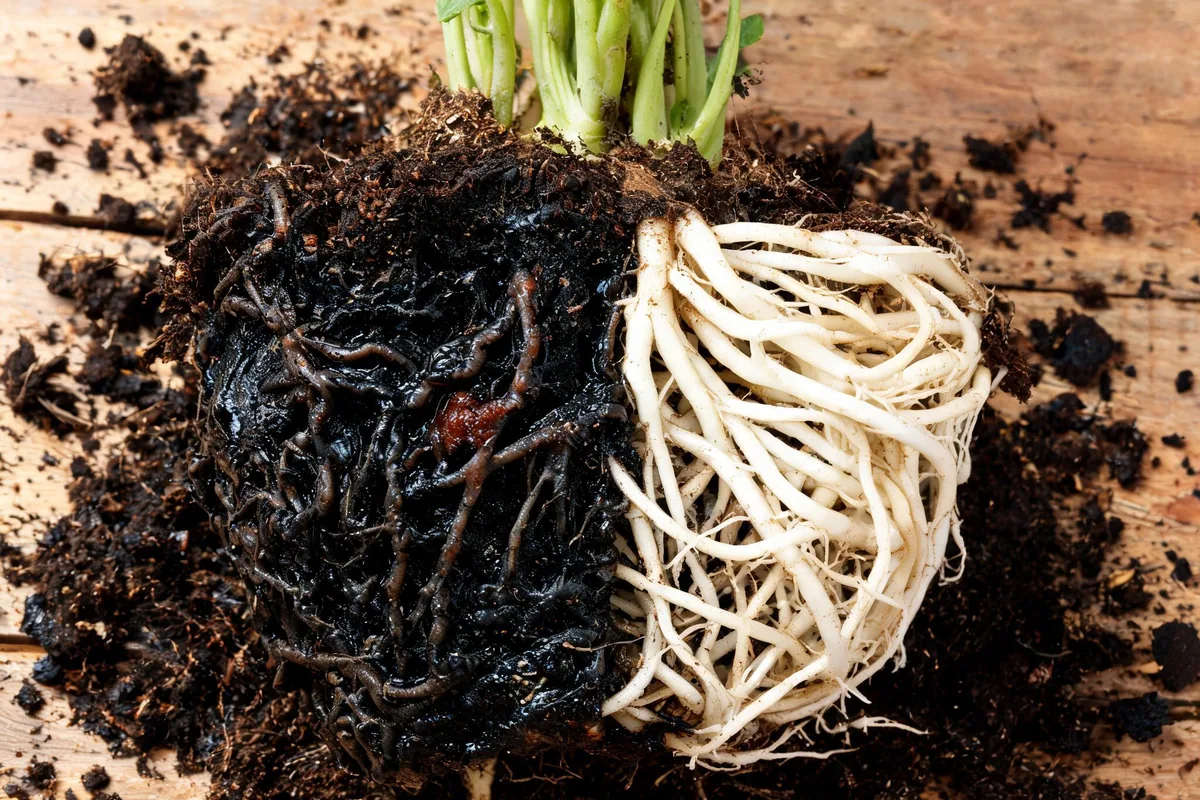
The diagnostic step — examine the roots. Per Missouri Botanical Garden's root rot guide, healthy roots are white to tan and firm. Rotted roots are brown to black, soft, mushy, and may have a foul odor. They often crumble or slide off the root when touched. The transition from healthy to rotted root tissue is often visible as a clear line along a root.
Causes and Risk Factors
Soil Drainage Failure
The primary cause. Per Missouri Botanical Garden, root rot occurs when soil remains saturated with water for extended periods. In saturated soil, oxygen is displaced from pore spaces; plant roots require oxygen for cellular respiration and die in anaerobic conditions, even before pathogen involvement.
Risk factors:
- Heavy clay soil that compacts and drains slowly
- Hardpan layer below the planting zone that traps water above it
- Low-lying areas where water collects after rain
- Overwatering that keeps soil perpetually moist
- Planting too deep — roots near the crown are more susceptible when crowns sit low
Pathogen Involvement
Per UC IPM's Phytophthora root rot guide, Phytophthora species are the most common and destructive root rot pathogens in outdoor settings. Unlike true fungi, Phytophthora is an oomycete (water mold) that produces swimming spores (zoospores) that move through water-saturated soil to infect roots. This is why Phytophthora root rot is often described as "water-spread" — it requires saturated conditions to spread.
Pythium species cause root rot in similar conditions, particularly on young plants and seedlings. Fusarium crown and root rot is a concern on specific crops (tomatoes, strawberries) and has a soil-borne phase.
Specific High-Risk Plants
Per Missouri Botanical Garden, plants with inherently low tolerance for saturated soil:
- Lavender, rosemary, and most Mediterranean herbs
- Boxwood (Buxus)
- Rhododendron and azalea (Phytophthora is the major cause of "rhododendron dieback")
- Rose (crown rot)
- Many annual vegetables in heavy, waterlogged soil
- Iris (particularly soft rot combined with drainage problems)
In my Melville garden, lavender 'Munstead' is the plant I've lost most often to root conditions — not to diseases, but to clay pockets in otherwise sandy loam where water sits. Lavender tolerates drought readily but dies in wet feet.
Common Pathogens
| Pathogen | Plants most affected | Key requirement | Notes |
|---|---|---|---|
| Phytophthora spp. | Rhododendron, azalea, avocado, many others | Saturated soil; requires water for spore dispersal | Most destructive outdoor root rot organism; no effective cure on established plants |
| Pythium spp. | Seedlings; annuals; many vegetables | Saturated soil; high humidity | Often called "damping off" on seedlings |
| Fusarium spp. | Tomato, strawberry, pansy, carnation | Soil; can persist for years without host | Some crop-specific races; crop rotation required |
| Armillaria (honey fungus) | Trees and shrubs; established woody plants | Infected wood in soil | Very difficult to eradicate; recognized by white mycelial mats under bark |
Per UC IPM, the common thread among these pathogens is that they require compromised root systems or specific soil conditions (typically wet) to infect. A well-drained soil with healthy roots resists infection.
Diagnosing vs. Drought Stress
The most important differential diagnosis in plant troubleshooting:
| Feature | Drought stress | Root rot |
|---|---|---|
| Soil moisture | Dry 2+ inches below surface | Wet or waterlogged |
| Response to watering | Plant recovers within hours | Plant does not recover; may worsen |
| Lower leaf yellowing | Yes, but with dry conditions | Yes, but with wet conditions |
| Root condition | White, firm, healthy | Brown/black, mushy, foul odor |
| Stem base condition | Normal | May be soft, discolored |
| Rate of decline | Gradual if not addressed | Progressive; can be rapid |
Per Clemson HGIC, the most reliable diagnostic step is to check soil moisture first and then examine roots if moisture is not the simple answer.
Saving an Affected Plant
Recovery depends on how much functional root system remains. Per Missouri Botanical Garden:
Step 1: Improve drainage immediately. This is the primary intervention. Stop all irrigation. Improve drainage around the plant by digging drainage channels, raising the plant in a berm, or in containers, repotting into fresh, well-drained mix.
Step 2: Prune rotted roots. For plants that can be lifted — shrubs, perennials, container plants — remove all rotted (brown, mushy) root tissue with clean, sterilized pruners. Cut back to white, healthy root tissue. Disinfect pruners between cuts with 70% isopropyl alcohol.
Step 3: Reduce the canopy proportionally. Per Missouri Botanical Garden, because the reduced root system cannot support the original canopy, remove 30—50% of aboveground growth to reduce the water demand on the remaining roots.
Step 4: Replant in well-drained soil. Add coarse compost, perlite, or coarse grit to improve drainage if the original soil was heavy.
Fungicide use: Per UC IPM, fungicide drenches (fosetyl-al or mefenoxam for Phytophthora) may help protect remaining healthy root tissue if applied early, but they do not regenerate already-dead roots. Soil fungicides are a supplement to drainage correction, not a substitute.
Prognosis: Per Missouri Botanical Garden, if more than 50% of the root system is rotted, recovery is unlikely regardless of treatment. Be realistic about whether intervention is worthwhile on a severely affected plant.
Prevention and Soil Management
Soil Amendment Before Planting
Per Missouri Botanical Garden, the most reliable prevention is improving drainage before planting. For heavy clay soils, incorporate 3—4 inches of coarse compost or expanded shale into the planting bed. For individual plant holes, add coarse compost to the backfill.
Per Clemson HGIC, the most common mistake is adding sand to clay soil without sufficient organic matter — this can create a hardpan-like structure. Coarse compost, expanded shale, or bark chips are more reliable clay amendments than sand alone.
Raised Beds
For plants inherently susceptible to root rot (lavender, Mediterranean herbs, many perennials), raised beds with sharp drainage provide conditions where root rot is unlikely to develop even in wet climates. Per Clemson HGIC, elevating the root zone above the existing soil level is one of the most reliable structural interventions.
Correct Planting Depth
Do not plant crown of plants below the surrounding soil grade. Per Missouri Botanical Garden, planting too deep creates conditions where the crown sits in a water-collecting pocket, directly facilitating crown and root rot. Plant at the same depth the plant was growing in the nursery container.
Common Situations Table
| Symptom | Confirming signs | Action |
|---|---|---|
| Wilting that doesn't recover; wet soil | Soggy rootzone; rotted roots on inspection | Stop irrigation; improve drainage; prune rotted roots |
| Lower leaves yellowing; soggy soil after rain | Soil stays wet 2+ days after rain | Improve drainage; add raised bed or berm |
| Lavender dying in wet summer | Natural root rot susceptibility of species | Replant in raised bed; add coarse grit; ensure south or west facing sun |
| Rhododendron wilting and dieback | Phytophthora likely | Remove severely affected plants; improve drainage; phosphonate fungicide for borderline cases |
| Annual vegetables wilting in heavy clay | Pythium damping off | Improve soil drainage for next season; reduce irrigation |
Frequently Asked
Can root rot spread to other plants?
Per UC IPM, Phytophthora spreads through water movement in the soil and through contaminated tools, soil, and plant material. Remove and dispose of infected plants and their immediate root zone soil. Disinfect tools. Do not move potentially contaminated soil to other parts of the garden. Improve drainage across the affected area to eliminate the conditions that allow the pathogen to spread.
Does hydrogen peroxide treat root rot?
There is no extension-validated evidence that hydrogen peroxide effectively treats root rot in outdoor plants. Some indoor plant guides recommend dilute hydrogen peroxide on container roots, but for outdoor soil-borne Phytophthora and Pythium, it would not penetrate to the level needed and would not address the drainage problem that allows the pathogen to persist. Drainage correction is the essential step.
How do I know if my soil drains well enough?
Per Clemson HGIC, perform a percolation test: dig a hole 12 inches deep and 12 inches wide, fill it with water, and let it drain completely. Refill it and measure how long it takes to drain a second time. Well-drained soil drains at 1—3 inches per hour. Soil that takes more than 6 hours to drain 1 inch is poorly drained and a root rot risk for most ornamental plants.
Is Phytophthora root rot the same as other root rots?
Phytophthora is an oomycete — sometimes called a "water mold" — not a true fungus, though it behaves similarly to fungal pathogens and is managed similarly. Per UC IPM, Phytophthora produces swimming spores that require water to disperse, which is why Phytophthora root rot is particularly associated with waterlogged soil and overhead irrigation that splashes water at root zones. Standard fungicides that work on true fungi may not be effective; phosphonate-based fungicides (fosetyl-al) are specifically registered for Phytophthora management.
—-
Recommended gear: Best Raised Garden Bed Kits: Cedar vs. Metal vs. Fabric — our buyer's guide covering picks for every budget, ranked by Extension publication consensus and personal use.
Sources
- Clemson HGIC — <a href="https://hgic.clemson.edu/factsheet/root-rots-of-houseplants/">Root Rots of Plants</a>.
- Missouri Botanical Garden — <a href="https://www.missouribotanicalgarden.org/gardens-gardening/your-garden/help-for-the-home-gardener/advice-tips-resources/insects-pests-and-problems/problems/root-rots.aspx">Root Rots</a>.
- UC IPM — <a href="https://ipm.ucanr.edu/agriculture/">Agricultural Pest Management</a>.
- Clemson HGIC — <a href="https://hgic.clemson.edu/factsheet/soils/">Soils</a>.
Sources
- Clemson HGIC — Root Rots of Plants.
- Missouri Botanical Garden — Root Rots.
- UC IPM — Agricultural Pest Management.
- Clemson HGIC — Soils.