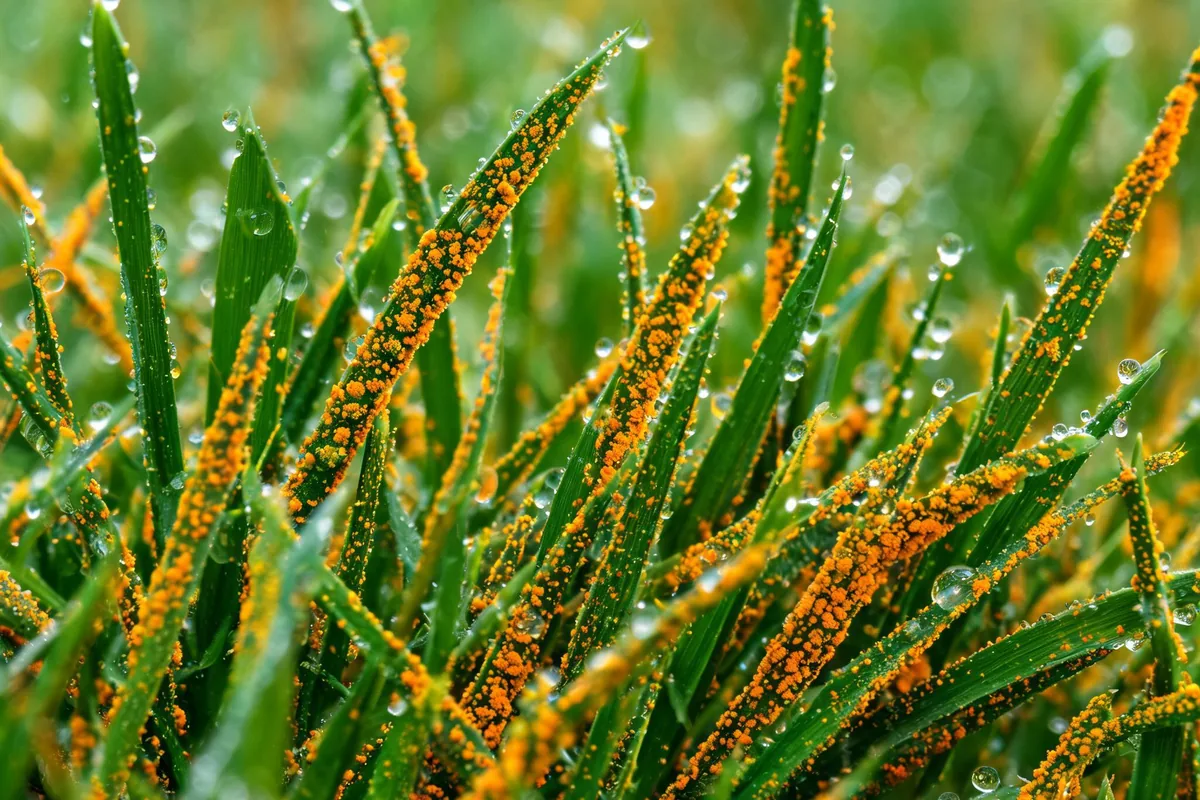
Lawn Rust Disease: Orange Powder on Grass Blades
title: "Lawn Rust Disease: Orange and Yellow Powder on Grass Blades"
—- title: "Lawn Rust Disease: Orange and Yellow Powder on Grass Blades" slug: lawn-rust hub: problems category: Problem description: "Lawn rust turns grass blades orange-yellow with powdery spores. Learn which fungi cause it, why it peaks in late summer, and how to manage it through fertilization and mowing." date: 2026-06-10 updated: 2026-06-10 author: "Thomas A." reading_time: 7 —-
A lawn turning orange in late summer, with grass blades coated in powdery orange-yellow dust that rubs off on shoes and clothing, is a familiar sight on Long Island in August and September. The cause is lawn rust — a group of fungal diseases that attack cool-season turfgrasses during the warm, humid stretch at the end of summer.
Lawn rust is rarely a serious threat to an established lawn. Per Rutgers NJAES, it is "most common on slow-growing turf" — the disease thrives when grass is growing slowly due to heat, drought, low nitrogen, or shade. A lawn that is actively growing fast enough is largely able to outgrow the infection.
What causes lawn rust
Lawn rust is caused by several species of fungi in the genus Puccinia and related genera. Per Penn State Extension, the most common species in the Northeast:
| Pathogen | Primary Hosts | Notes |
|---|---|---|
| Puccinia coronata (crown rust) | Perennial ryegrass, annual bluegrass | Most common rust on ryegrass in Northeast |
| Puccinia graminis (stem rust) | Kentucky bluegrass, ryegrass, wheat | Less common on lawns; more significant in wheat |
| Puccinia striiformis (stripe rust) | Kentucky bluegrass, ryegrass | Yellow-orange stripes along blades |
| Uromyces dactylidis | Perennial ryegrass | Causes orange pustules similar to crown rust |
Per Rutgers NJAES, perennial ryegrass and Kentucky bluegrass are the most susceptible turf species to rust. Fine fescues show moderate susceptibility. Turf-type tall fescue is relatively resistant.
Conditions that favor lawn rust
Per Penn State Extension, lawn rust is most severe when:
- Grass growth is slow. Heat, drought, or low fertility slows grass growth enough that the fungus can keep up with or outpace new leaf tissue production.
- Leaf wetness occurs for 6—8 hours. Dew, light rain, or irrigation at night create infection periods.
- Temperatures are 68–86°F. This range covers late summer in the Northeast, when rust is typically most visible.
- Shaded or poorly ventilated areas. Shade slows grass growth and maintains leaf wetness longer.
On Long Island and across the Northeast, lawn rust typically peaks in August and early September — when summer heat slows cool-season grass growth, dew is heavy on warm nights, and conditions favor spore production and germination.
Identification
Lawn rust is visually distinctive:
- Orange, yellow-orange, or rust-colored pustules (uredinia) on individual grass blades
- The powder rubs off easily on hands, shoes, or clothing — turning them orange
- Individual blades may appear yellowed; infected blades may die prematurely
- Heavily infected lawns appear orange or bronze from a distance
- Pustules are visible on both surfaces of the blade
Per University of Minnesota Extension, the rubbing test is diagnostic: rub your hand across the grass surface. An orange or yellow stain on your hand or clothing confirms rust. Other lawn problems (drought, disease) do not produce this staining.
Differentiating from other lawn problems:
| Appearance | Rust | Drought stress | Grub damage |
|---|---|---|---|
| Orange powder rubs off on hand | Yes | No | No |
| Patches or uniform? | Often more uniform | Patches in sunny/dry areas | Irregular patches |
| Sod stays attached to ground | Yes | Yes | No — peels back |
| Visible pustules on blades | Yes | No | No |
Management
Nitrogen fertilization
This is the primary and most effective management tool. Per University of Minnesota Extension, applying 0.5 to 1 pound of quick-release nitrogen per 1,000 square feet encourages active grass growth that dilutes and outpaces the infection. Apply in late August or early September in the Northeast.
Per Rutgers NJAES, "maintaining adequate fertility" is the single most important cultural practice for preventing rust. A well-fed lawn growing 1 to 2 inches per week in season rarely shows significant rust.
Caution on timing: Do not apply heavy nitrogen in September in the Northeast in a way that forces late-season growth that won't harden off before winter. Apply early enough in fall (before Labor Day) to promote recovery without pushing excessive late growth. Per Penn State Extension, slow-release nitrogen sources are safer than quick-release urea applied late in the season.
Milorganite (5-2-0 slow-release organic nitrogen) is a practical choice: it greens up and thickens the lawn without the surge growth risk of quick-release urea.
Mowing
Per Penn State Extension, mowing at the correct height (2.5 to 3.5 inches for most cool-season lawns) and removing clippings when rust is severe reduces spore load. Mowing infected grass in dry conditions (midday) and bagging clippings during peak rust prevents spreading spores to less-infected areas.
Do not mow wet infected grass and blow clippings across the lawn.
Watering timing
Per University of Minnesota Extension, water in the morning so the grass surface dries during the day. Evening watering extends leaf wetness into the night, when rust infection periods are most favorable. Morning irrigation does not eliminate rust but reduces the duration of infection periods.
Overseed with resistant varieties
Per Rutgers NJAES, turf-type tall fescue shows good rust resistance and is widely recommended for Northeast lawns. Perennial ryegrass varieties vary significantly in rust susceptibility — when overseeding, look for varieties rated as resistant or tolerant to crown rust in NTEP (National Turfgrass Evaluation Program) trials.
Fungicide (rarely warranted)
Per Penn State Extension, fungicide is generally not recommended for home lawns with rust. The disease is cosmetic, natural recovery occurs when temperatures cool, and the cost of a fungicide program typically outweighs the benefit on home turf. For athletic fields, sod production, or golf fairways where appearance is critical, propiconazole (Banner Maxx), myclobutanil, or trifloxystrobin are effective at suppressing rust.
Common problems table
| Symptom | Cause | Fix |
|---|---|---|
| Orange powder rubs off on shoes in August | Lawn rust (likely Puccinia coronata) | Apply 0.5—1 lb quick-release nitrogen per 1,000 sq ft; mow and bag clippings |
| Lawn looks bronze/orange from across yard | Heavy rust, typically on slow-growing ryegrass | Fertilize; mow correctly; overseed with resistant varieties |
| Rust concentrated in shaded area | Shade slows growth and increases leaf wetness | Fertilize; prune to improve light; consider shade-tolerant grass species |
| Rust appears every year in same lawn area | Susceptible variety in ideal rust conditions | Overseed with rust-resistant tall fescue blend |
| Orange staining on clothing but no other issues | Normal rust; plant otherwise healthy | Fertilize; accept natural recovery in fall |
Frequently asked
Is lawn rust dangerous to pets or people?
No. Per University of Minnesota Extension, lawn rust spores do not cause harm to people or animals. The orange staining on clothing and skin washes off easily with water.
Will lawn rust go away on its own?
Yes. Per Penn State Extension, as temperatures cool in fall and cool-season grasses resume active growth, rust typically disappears without treatment. Fertilizing to speed growth is more effective than waiting, but the disease is self-limiting in the Northeast climate.
What fertilizer should I use to control lawn rust?
Any nitrogen source applied at 0.5—1 lb of actual nitrogen per 1,000 square feet will help. Per University of Minnesota Extension, quick-release nitrogen (urea, ammonium nitrate) shows results faster; slow-release options like Milorganite work over a longer period. For a late-season application in the Northeast, a moderate quick-release application early in the lawn rust season (late August) is appropriate.
Which grass types resist lawn rust best?
Per Rutgers NJAES, turf-type tall fescue has the best overall rust resistance of the common Northeast lawn grasses. Among perennial ryegrasses, NTEP trial ratings identify specific cultivars with improved resistance — look for current NTEP ratings when selecting seed, as resistance ratings change as new varieties are released.
Sources
- Penn State Extension — <a href="https://extension.psu.edu/rust-diseases-of-turfgrasses">Rust Diseases of Turfgrasses</a>
- University of Minnesota Extension — <a href="https://extension.umn.edu/lawn-care/lawn-rust">Lawn Rust</a>
- Rutgers NJAES — <a href="https://njaes.rutgers.edu/fs716/">Rust Diseases of Turfgrass</a>