Species guide

Hydrangea Arborescens Care: Annabelle and Smooth Hydrangea

Smooth hydrangea (Hydrangea arborescens) is the only native hydrangea with a zone 3 range, new-wood blooming, and the enormous round white flowers of 'Annabelle' — but flopping stems and bare winter appearance are the tradeoffs.
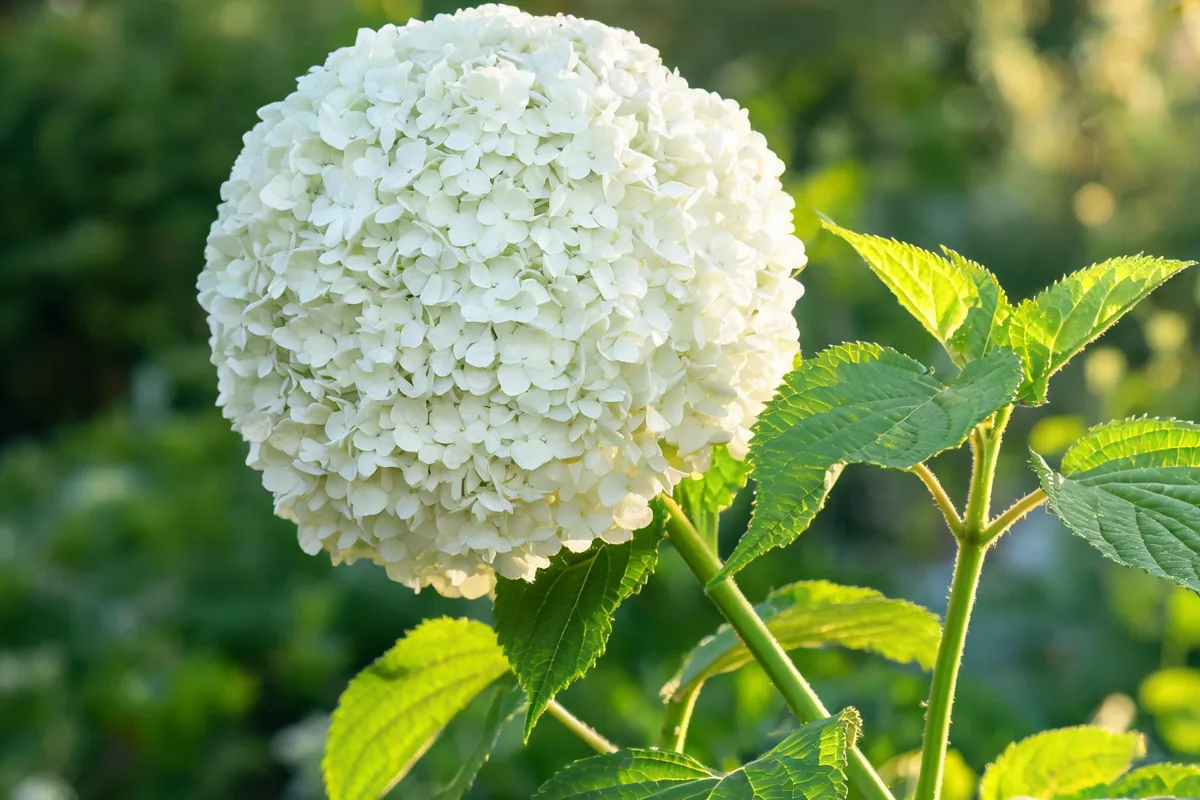
Annabelle hydrangea arborescens with massive white globes drooping on green stems in summer
Photo: Unsplash

This article focuses specifically on Hydrangea arborescens. For a comparison of all five hydrangea species including pruning differences, sun tolerance, and cold hardiness, see the main hydrangea care guide.

Identification and native range

Hydrangea arborescens is native to the eastern United States — per Penn State Extension, "wild populations grow naturally in moist, rocky woodland slopes and along stream banks from New York south to Florida and west to Iowa." This native habitat explains much about the plant's cultural requirements: it evolved with consistent moisture, filtered light, and humus-rich soil.

The identification is straightforward: heart-shaped, serrated leaves on a rounded shrub reaching 3–5 feet. Flowers are round, white, and appear in July–August. Unlike H. macrophylla, the flower heads are not made up of showy sterile bracts alone — 'Annabelle' blooms consist almost entirely of sterile florets, while the straight species has a combination of fertile and sterile florets in a smaller, more delicate head.

Key cultivars

Per Penn State Extension, the cultivar landscape for smooth hydrangea has expanded significantly beyond 'Annabelle.'

USDA hardiness and where it grows

Per University of Minnesota Extension, H. arborescens is hardy in USDA zones 3–9 — the widest cold-hardiness range of all landscape hydrangeas. Zone 3 performance is reliable even without winter protection. The root system survives even when tops are fully winter-killed, and the plant regrows to bloom-sized shrubs each summer.

This wide zone range reflects the plant's North American native origins. While bigleaf hydrangea is from Asia and limited to zones 6–9, smooth hydrangea evolved in the northeastern and mid-Atlantic forests that experience the same winters its gardeners deal with. Per Penn State Extension, "smooth hydrangea is one of the most reliable flowering shrubs for zone 3–5 gardens precisely because it doesn't carry the flower bud vulnerability of Asian species."

Light

Smooth hydrangea performs best in partial shade — a reflection of its native woodland edge habitat. Per Penn State Extension, "smooth hydrangea grows well in partial shade to full sun; in zones 6 and warmer, afternoon shade prevents wilting and leaf scorch." In zones 3–5, full sun is generally well-tolerated and produces more compact, sturdier growth with slightly smaller flower heads than shade-grown plants. In full deep shade, flower production drops significantly.

Compared to H. paniculata, smooth hydrangea tolerates more shade. This makes it a better choice for gardens where afternoon shade from trees or buildings is unavoidable.

Watering

Smooth hydrangea needs consistent moisture. Its native habitat — stream banks and moist slopes — explains why drought stress shows up quickly in summer as wilted leaves and reduced flower size. Per University of Minnesota Extension, "smooth hydrangea needs about 1 inch of water per week from rain or supplemental irrigation during active growth." A 2–3 inch mulch layer is the single most effective tool for moisture retention. Water at the base of the plant to avoid the wet foliage that promotes fungal disease.

Soil and pH

Per Penn State Extension, smooth hydrangea prefers "moist, well-drained, humus-rich soil at a slightly acidic to neutral pH of 5.5–7.0." The organic matter content matters more than pH precision — the moisture-retaining properties of organic-rich soil are key to the consistent moisture this species requires. Average garden loam amended with compost is the practical equivalent of the forest floor soil it evolved in.

Per Penn State Extension, "smooth hydrangea does not change flower color based on soil pH — it is not pH-sensitive the way H. macrophylla is." There is no reason to acidify soil specifically for smooth hydrangea. White stays white and pink stays pink regardless of soil chemistry.

Planting

Plant container-grown smooth hydrangea in spring or fall. Per UMN Extension, fall planting in zones 3–6 is preferred because cool-season root establishment results in better performance in the first summer. Space 'Annabelle' and 'Incrediball' at 4–5 feet apart to allow for mature spread. Compact forms like 'Wee White' can be spaced at 2–3 feet.

At planting, set the crown at soil grade — not below. A mulch ring from the trunk outward to the drip line (keeping 2 inches clear at the trunk) retains moisture and suppresses competition. Smooth hydrangea planted in the right conditions establishes quickly and typically blooms well in its first or second season.

Fertilizing

Per Penn State Extension, a single spring application of a balanced slow-release fertilizer is sufficient for established plants. Avoid high-nitrogen formulations, which produce the lush, heavy stems that increase flopping — already the main structural complaint about smooth hydrangea. Plants in soils annually top-dressed with compost may need no additional fertilization.

Pruning

Smooth hydrangea blooms on new wood — the current season's growth. Per Penn State Extension, "smooth hydrangea blooms on new wood, which means it blooms on the current season's growth." This is the same as panicle hydrangea and the opposite of bigleaf and oakleaf hydrangeas. The implication: you can prune at any time without losing flowers.

The most common approach is a hard cut in late winter or early spring, taking stems to 6–12 inches above the ground. Per University of Minnesota Extension, "cutting smooth hydrangea back hard — to 18 inches or less — each year produces more uniform, compact growth with sturdier stems." This is particularly important for 'Annabelle,' where unpruned mature stems accumulate old wood that is not as vigorous as young growth.

Alternatively, plants can be cut to the ground — they will regrow from the root crown and bloom that summer. This is a viable approach for plants that have become overgrown, old, or disease-affected.

Common problems

Flopping stems

The most common complaint with 'Annabelle.' The enormous flower heads are too heavy for the current season's stems, especially after rain. Management strategies per UMN Extension: hard annual pruning (see above), planting in full sun rather than shade (sun exposure hardens stems), reducing nitrogen fertilization, or switching to 'Incrediball' which was specifically bred with stiffer stems. Staking with peony hoops is also effective.

Leaf spots

Several fungi cause brown leaf spots on smooth hydrangea in humid weather. Per Penn State Extension, these are "primarily cosmetic on mature plants — remove affected leaves and avoid overhead irrigation." In severely affected plantings, a fungicide application early in the season can reduce severity.

Powdery mildew

Less severe on smooth hydrangea than on bigleaf hydrangea. Per UMN Extension, "adequate spacing for air circulation is the primary preventive." Cosmetic rather than life-threatening on established plants.

Deer browse

Per Rutgers NJAES's deer resistance ratings, smooth hydrangea is "occasionally severely damaged" — not resistant. In high-deer-pressure areas (suburban northeastern U.S.), fencing or repellent programs are necessary to protect smooth hydrangea, especially through winter and early spring when deer browse on the dormant crown and emerging shoots.

Frequently asked

Can I cut smooth hydrangea to the ground?

Yes — per Penn State Extension, cutting to the ground "does not harm the plant and can be done intentionally to rejuvenate an old, overgrown clump or to reduce flopping." The plant will regrow from the root crown and bloom in the same summer. This is one of the most forgiving attributes of the species.

Why is my smooth hydrangea not blooming?

The two most common causes are too much shade and root disturbance. Per UMN Extension, "smooth hydrangea in deep shade produces very few flowers." Unlike H. macrophylla, wrong pruning timing is almost never the cause — since it blooms on new wood, timing doesn't matter. New transplants may not bloom the first season while establishing roots.

What is the difference between Annabelle and Incrediball?

Both are cultivars of H. arborescens with large white flower heads. The key difference per Penn State Extension: 'Incrediball' has "significantly stronger, more upright stems that resist flopping better than 'Annabelle'" and can produce flower heads as large as or larger than 'Annabelle.' For most landscape applications, 'Incrediball' is the better choice unless you specifically prefer the historic 'Annabelle' selection.

Do smooth hydrangeas spread?

Yes, slowly, by root suckers. Established clumps expand outward over years. Per Missouri Botanical Garden, "smooth hydrangea spreads by root suckers and can form colonies over time — remove suckers at the soil line to control spread." This is generally considered a desirable filling-in habit rather than an invasive problem in garden settings.

Compare with other hydrangea species

Looking for a different hydrangea? Each species has a distinct care profile:

Sources