Lawn

Lawn Aeration: When, Why, and How

Soil compaction is a slow, invisible problem. The lawn looks fine from a distance while, underneath, the root zone is steadily suffocating — water runs off instead of infiltrating, roots stay shallow, and the grass thins

rainbow forms in sprinkler water on green lawn
Photo: Unsplash on Unsplash

—- title: "Lawn Aeration: When, Why, and How" slug: lawn-aeration-guide hub: lawn category: Lawn guide description: "Soil compaction is a slow, invisible problem. The lawn looks fine from a distance while, underneath, the root zone is steadily suffocating — water runs off instead of infiltrating, roots stay." date: 2026-06-10 updated: 2026-06-10 author: "Thomas A." reading_time: 9 —-

Soil compaction is a slow, invisible problem. The lawn looks fine from a distance while, underneath, the root zone is steadily suffocating — water runs off instead of infiltrating, roots stay shallow, and the grass thins year by year. Core aeration is the most effective remedy, and one of the few lawn practices that consistently shows measurable results in long-term university trials.

What core aeration does

Per Penn State Extension's turfgrass program, core aeration achieves four documented functions:

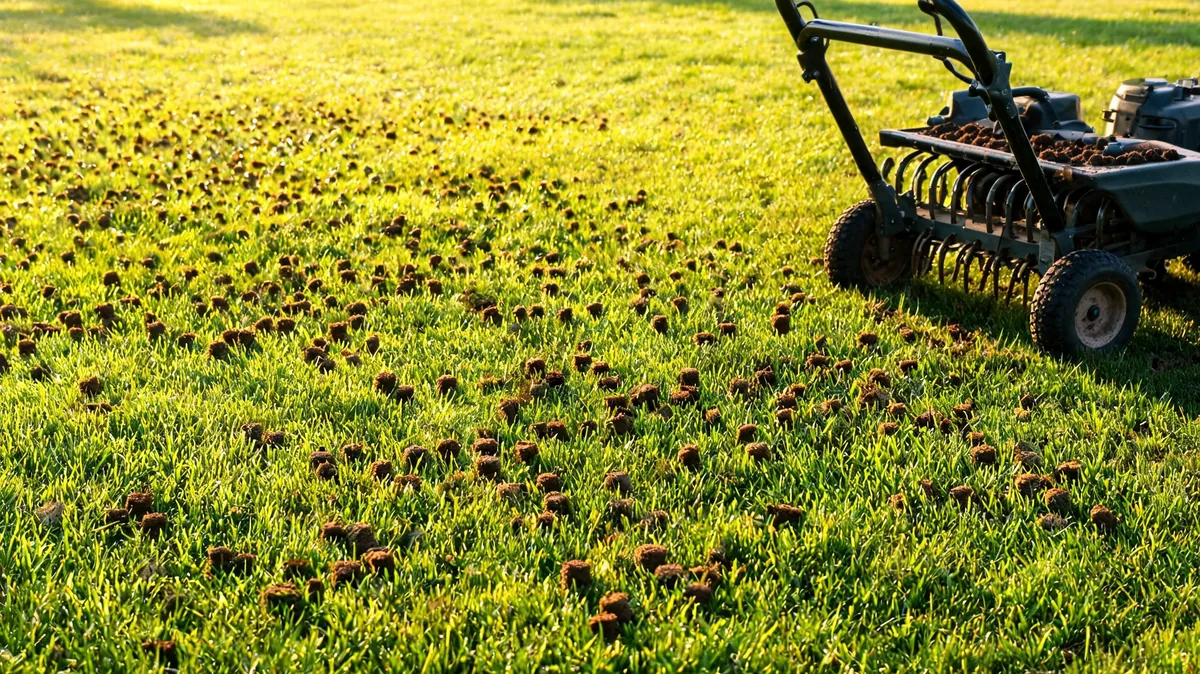
  1. Relieves soil compaction. Foot traffic, vehicle traffic, and repeated irrigation compress soil particles together, reducing the large pore spaces that roots need for oxygen and water movement. A core aerator removes 2—3 inch plugs of compacted soil, creating channels that roots can exploit.
  1. Improves water infiltration. Compacted soil sheds water — up to 75% of irrigation or rainfall on severely compacted surfaces runs off rather than infiltrating. Per Penn State Extension, aeration "dramatically improves the infiltration rate of water into the soil."
  1. Manages thatch. The soil cores deposited on the surface during aeration contain soil microbes that colonize the thatch layer and accelerate decomposition. Per Penn State Extension, "regular core aeration is the most practical means of thatch management on established lawns."
  1. Creates seedbed for overseeding. The holes created by core aeration provide direct seed-to-soil contact, which is the critical variable for germination success. Overseeding immediately after core aeration gives dramatically better results than surface seeding into an established stand.

Core aeration vs. spike aeration

Spike aerators — whether handheld fork tools, spike shoes worn over boots, or tractor-mounted solid-tine units — push soil aside rather than removing it. Per Penn State Extension, spike aeration "actually causes additional soil compaction around the hole, making the situation worse." The displaced soil compresses the sidewalls of the hole. Core aeration removes soil rather than moving it.

For compacted soils, spike aeration provides no meaningful benefit. The only situation where spike aeration has any value is in soft, sandy, uncompacted soils where physical disturbance is more useful than the specific act of core removal.

When to aerate by grass type

Cool-season lawns: late summer and early fall

Per Penn State Extension, the optimal timing for core aeration of cool-season lawns (Kentucky bluegrass, tall fescue, perennial ryegrass, fine fescues) is late August through September. This timing coordinates with the optimal window for overseeding, allows the lawn to recover during peak fall root-growth season, and avoids creating moisture-losing open holes during summer heat.

Per Cornell Cooperative Extension, aerating in spring is acceptable when fall is missed, but spring aeration should be followed by a light starter fertilizer application to support root development. The disadvantage of spring aeration is that the open channels and disrupted surface create perfect crabgrass germination conditions if a pre-emergent has not been applied.

Do not aerate cool-season lawns in midsummer. Per Penn State Extension, heat stress compromises the lawn's ability to recover from the mechanical disturbance.

Warm-season lawns: late spring

Per Texas A&M AgriLife Extension, aerate warm-season grasses (bermudagrass, zoysiagrass, St. Augustinegrass) in late spring — after dormancy break and after the lawn has turned at least 50% green, but before peak summer heat. For the deep South, this means May. For the transition zone (Virginia to Missouri), May to early June.

Per Clemson Extension HGIC, zoysiagrass particularly benefits from core aeration in late spring because of its tendency toward thatch accumulation and its dense, rhizomatous root system that can create its own compaction problem in the surface organic layer.

Grass speciesOptimal aeration timingNotes
Kentucky bluegrassLate August — SeptemberPair with overseeding; 1—2x per year for heavy traffic
Tall fescueLate August — September1x per year; pair with overseeding if thinning
Perennial ryegrassLate August — SeptemberRecovers quickly; 1x per year
Fine fescuesLate August — SeptemberLess traffic-sensitive; every other year often sufficient
BermudagrassMay — JuneMay need 2x per year in high-traffic areas
ZoysiagrassMay — June1x per year; heavy thatch areas benefit from 2x
St. AugustinegrassMay — June1x per year; avoid in fall/winter
CentipedegrassMay — June1x per year; less traffic-tolerant, limit traffic

How to core aerate

Equipment

Core aerators are available at most equipment rental centers. A walk-behind core aerator covers a typical suburban lawn (5,000—8,000 sq ft) in 45—60 minutes. Riding-unit aerators are available for larger properties. A few key specifications to check when renting:

Soil moisture preparation

Per Penn State Extension, the soil should be moist but not saturated at the time of aeration. Dry, hard soils resist penetration and result in shallow, undersized cores. Saturated soils produce plugs that collapse back into the holes.

The best practice: irrigate or wait for rain 2 days before aeration. The soil should be moist to 4 inches depth but firm at the surface.

The process

  1. Mark irrigation heads, buried cable lines, and shallow utilities. Core aerator tines can damage irrigation heads. Flag them.
  2. Mow at normal height the day before. Do not mow shorter before aeration — there is no benefit.
  3. Make 2—3 passes over the entire lawn. Per Penn State Extension, multiple passes increase the number of cores removed. For severely compacted soils, 3 passes in different directions is more effective than 1 or 2.
  4. Leave cores on the surface. Do not rake up and remove the cores. Per Penn State Extension, the cores "should be allowed to dry and then broken up by mowing or dragging." The dried soil from the cores will fall back into the aeration holes and the thatch layer, introducing beneficial soil microbes.
  5. Overseed immediately if thinning is present. The open channels are ideal for seed-to-soil contact.
  6. Topdress with compost (optional but effective). A 0.25-inch layer of compost dragged across the surface fills the aeration channels with organic matter and microbes. Per NC State Extension, "topdressing with organic material after aeration is highly recommended" for lawns with low organic matter.
  7. Fertilize. Apply the appropriate fertilizer for the season and grass species after aeration. Nutrients move directly into the root zone through the channels.
  8. Water. Light irrigation after aeration helps start core breakdown and activates fertilizer.

How often to aerate

Per Penn State Extension, most lawns benefit from annual core aeration. Aeration pairs well with overseeding (see when to overseed your lawn), dethatching (see when and how to dethatch a lawn), and the fall fertilization window (see lawn fertilization schedule). Lawns subject to heavy foot traffic (children, pets, play areas) benefit from twice-annual aeration — once in late spring and once in early fall for cool-season lawns.

Indicators that aeration frequency should increase:

Indicators that aeration can be done every other year:

Aeration and weed control: the timing conflict

Per Penn State Extension, core aeration and pre-emergent herbicide application cannot both be used in the same season at the same time. Aeration disrupts the herbicide barrier layer in the soil, allowing weed seeds to germinate. The standard guidance: do not aerate within 4—6 weeks before or after applying a pre-emergent crabgrass preventer preventer.

This creates a practical conflict for lawns that need both crabgrass control and overseeding. The accepted solution: use the fall window for aeration and overseeding, and apply pre-emergent the following spring only after the new grass has been established for at least one full growing season.

Common problems table

SymptomCauseFix
Cores are very shallow or don't form proper plugsSoil too dry and hardWater 2 days before; check machine tine depth setting
Cores collapse back into holes immediatelySoil too wet/saturatedWait for drier conditions; reschedule 2—3 days post-rain
No visible improvement after aerationOnly 1 pass; spike aerator used; cores raked up immediatelyMake 2—3 passes; verify you're using a core aerator; leave cores in place
Lawn looks rough for weeks after aerationNormal recovery; core debris on surfaceAllow time; break up cores by mowing after they dry
Bare areas don't recover after aerationNot overseeded; or cool-season lawn aerated in summer heatOverseed in fall; time aeration to growth season
Crabgrass explosion the summer after fall aerationPre-emergent not applied after winter; or applied too lateApply pre-emergent in spring before soil reaches 55°F

Frequently asked

Can I aerate and overseed in the same day?

Yes — this is the recommended combination for cool-season lawns in fall. Per Penn State Extension, the holes created by core aeration provide ideal seed-to-soil contact for overseeding. Spread seed immediately after aeration, before any rain washes seed away. Apply starter fertilizer in the same session.

Will aeration help with a lawn that's mostly weeds?

Aeration improves the conditions for grass recovery, but it also creates channels that can benefit weed germination. Per NC State Extension, for a lawn that is more than 50% weeds, renovation (killing and reseeding) may be more effective than trying to improve the existing stand. Aeration plus overseeding works best when grass still makes up the majority of the lawn.

Do I need to rent a core aerator, or can I use one of those spike sandals?

Spike aerator sandals provide no meaningful benefit in compacted soil. Per Penn State Extension, solid tines compact soil sidewalls as they push in. For compacted lawn soil, a rented walk-behind core aerator is the correct tool. The cost to rent is typically $60—$90 per half-day, covering a standard residential lawn.

How deep should the aeration cores be?

Per Penn State Extension, cores should be 2—3 inches deep. Most walk-behind rental aerators are calibrated for this range when properly adjusted and operated at the right soil moisture. If cores consistently come up shorter than 1.5 inches, the soil is too dry — check moisture and re-run.

—-

Sources

  1. Penn State Extension &mdash; <a href="https://extension.psu.edu/core-aeration">Core Aeration</a>.
  2. NC State Extension TurfFiles &mdash; <a href="https://turffiles.ncsu.edu/management/aeration/">Aeration</a>.
  3. Texas A&M AgriLife Extension &mdash; <a href="https://agrilifeextension.tamu.edu/lawn/">Lawn Care</a>.
  4. Clemson Extension HGIC &mdash; <a href="https://hgic.clemson.edu/factsheet/aerating-lawn/">Aerating Lawn</a>.
  5. Cornell Cooperative Extension Turfgrass &mdash; <a href="https://turf.cals.cornell.edu/">Turfgrass Resources</a>.

Sources