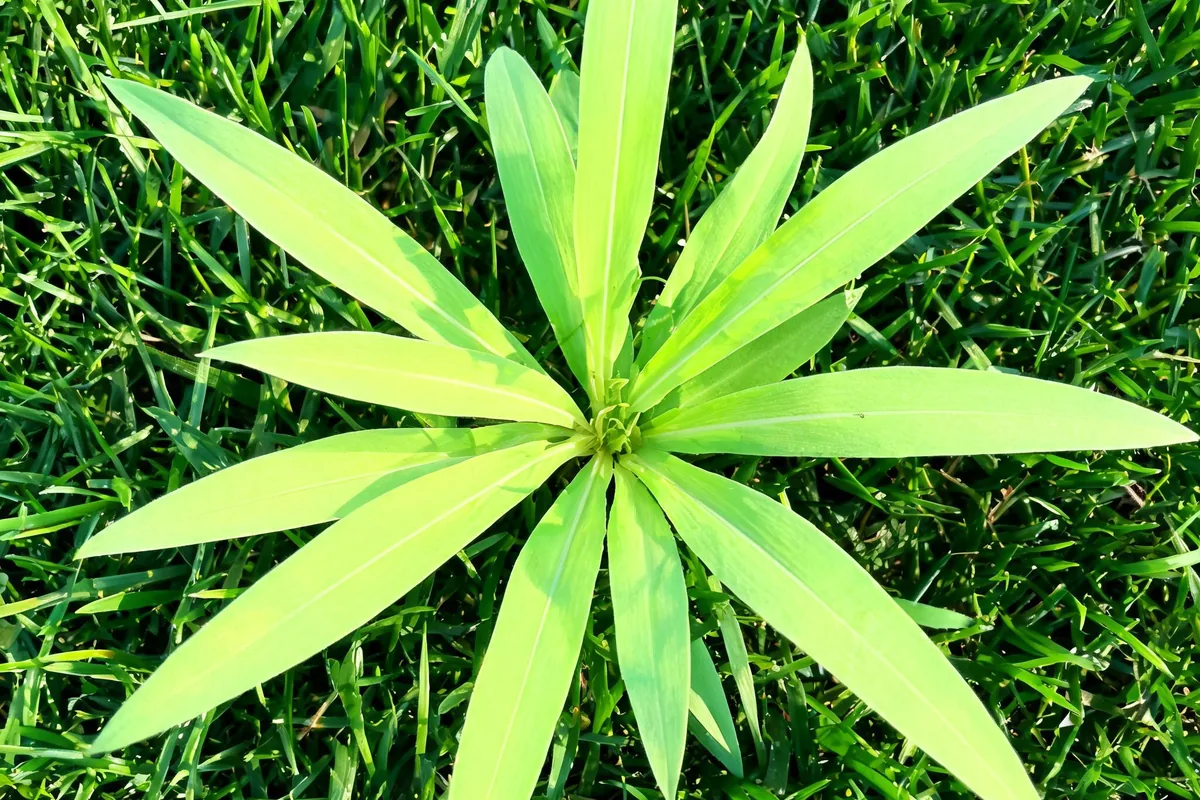
Crabgrass Prevention and Control
Crabgrass (Digitaria sanguinalis and Digitaria ischaemum) is a summer annual — it germinates from seed in spring, grows aggressively through summer, sets seed, and dies with the first frost.
—- title: "Crabgrass Prevention and Control" slug: crabgrass-control hub: lawn category: Lawn guide description: "Crabgrass (Digitaria sanguinalis and Digitaria ischaemum) is a summer annual — it germinates from seed in spring, grows aggressively through summer, sets seed, and dies with the first frost. The." date: 2026-06-10 updated: 2026-06-10 author: "Thomas A." reading_time: 8 —-
Crabgrass (Digitaria sanguinalis and Digitaria ischaemum) is a summer annual — it germinates from seed in spring, grows aggressively through summer, sets seed, and dies with the first frost. The reason it's so persistent is the seed bank it builds: one plant can produce 150,000 seeds. A lawn with a five-year history of crabgrass infestations has an enormous reservoir of viable seed in the top inch of soil that will remain a management challenge for years.
Understanding the crabgrass lifecycle
Digitaria sanguinalis (large crabgrass) and Digitaria ischaemum (smooth crabgrass) are both summer annuals with identical management implications. Per Penn State Extension, crabgrass seed germinates when soil temperatures at 2-inch depth reach 55°F from below for several consecutive days. In most of the Northeast and Mid-Atlantic, this occurs in mid-April to early May — roughly concurrent with forsythia bloom or dogwood bloom, which are commonly used as phenological cues.
The germination window is not a single day — it extends over several weeks. Crabgrass that misses the first germination pulse due to a cold snap can germinate in later warm spells through June. A pre-emergent applied correctly maintains a barrier through this entire window.
Mature crabgrass plants produce seed by midsummer and continue through fall. Per NC State Extension TurfFiles, viable seed from a single plant can remain dormant in the soil for 3—5 years.
Pre-emergent herbicide timing
The soil temperature trigger
Per Penn State Extension, apply pre-emergent crabgrass preventer preventer before soil temperature at 2-inch depth reaches 55°F. This typically means:
| Region | Target application date | Soil temp cue |
|---|---|---|
| Zone 5 (Boston, Chicago) | Mid-April | Forsythia finishing bloom |
| Zone 6 (Philadelphia, Long Island) | Early to mid-April | Forsythia peak to end |
| Zone 7 (Washington DC, Charlotte) | Late March to early April | Dogwood beginning to bloom |
| Zone 8 (Atlanta, Dallas) | Mid to late March | Dogwood or azalea opening |
| Zone 9 (Houston, Phoenix) | February to early March | Soil temps can hit 55°F in February |
Phenological cues (flowering plants as seasonal indicators) are approximate. A a soil thermometer inserted to 2 inches at mid-morning gives a direct reading. Per Purdue University's turfgrass extension, soil temperatures at 2 inches are the standard measurement for timing pre-emergent applications.
Common pre-emergent active ingredients
Per Penn State Extension, the following active ingredients are effective pre-emergent crabgrass preventer preventers in turfgrass:
- Pendimethalin (Scotts Halts, others): Widely available, effective at labeled rates. Requires water activation within 2—3 days of application.
- Prodiamine (Barricade): Longer residual than pendimethalin; often preferred for extended control through the full germination window.
- Dithiopyr (Dimension): Dual-mode — works as both pre-emergent and very-early post-emergent (1—2 leaf stage). Provides flexibility if timing is slightly late.
- Oryzalin (Surflan): Less common in consumer products; effective pre-emergent.
All pre-emergents must be watered into the soil within 48—72 hours of application to activate the herbicide barrier. Per Penn State Extension, "without activation by rainfall or irrigation, the product will degrade on the surface and performance will be compromised."
The overseeding conflict
Pre-emergent herbicides prevent all grass seed germination, not just crabgrass. Per Penn State Extension, you cannot apply pre-emergent and overseed in the same season. The standard approach: overseed in fall, apply pre-emergent the following spring. If you must overseed in spring, skip the pre-emergent and use post-emergent control for crabgrass that germinates.
Exception: Dithiopyr (Dimension) at low rates has been shown to allow perennial ryegrass germination with reduced efficacy impact per some university trials. Consult NC State Extension's specific guidance before attempting this.
Post-emergent crabgrass control
Post-emergent herbicides work on actively growing crabgrass plants, but effectiveness drops sharply as the plant matures.
Per NC State Extension, post-emergent treatment is most effective at the 1—4 leaf stage (cotyledons to small seedling). By the time crabgrass reaches the 5-leaf stage (a substantial rosette), most post-emergent products lose significant efficacy, and by mid-summer, established tillers are effectively uncontrollable with chemical means alone.
Effective post-emergent active ingredients:
- Quinclorac (Drive, Acclaim): Effective on crabgrass from 1—6 leaves when used correctly. May require adjuvant (methylated seed oil or non-ionic surfactant) for maximum efficacy on smooth crabgrass.
- Fenoxaprop (Acclaim Extra): Selective grass herbicide; effective on young crabgrass in cool-season lawns. Do not use on warm-season grasses — it will kill them.
- MSMA (various): Historically effective; now restricted to professional/commercial use in many states. No longer available to homeowners per EPA restrictions.
Per NC State Extension, repeat applications are often needed for quinclorac on crabgrass past the 4-leaf stage.
Organic post-emergent options
Per Rutgers NJAES cooperative extension, corn gluten meal has been promoted as an organic pre-emergent, but field trial results have been inconsistent. Per Rutgers, "the efficacy of corn gluten meal as a weed preventer in established turfgrass has not been consistently demonstrated." It requires very high application rates, has a significant fertilizer effect (it is 10% nitrogen), and performs best only when conditions prevent crabgrass emergence from germinating at all — dry conditions right after application. It is not a reliable substitute for conventional pre-emergent herbicides.
Long-term cultural control: dense lawn management
Chemical management treats symptoms. Sustainable crabgrass suppression requires a dense, thick lawn that denies crabgrass seeds the light they need to germinate.
Per Penn State Extension, "maintaining a dense, vigorous turfgrass stand is the most effective long-term strategy for reducing crabgrass competition." The specific practices:
Mowing height: Maintain cool-season grass at 3—4 inches. Per NC State Extension, a taller canopy shades the soil surface, dramatically reducing crabgrass germination. Scalping — mowing below 2 inches — is the single practice most associated with heavy crabgrass infestations.
Overseeding thin areas: Per Penn State Extension, thin spots in the lawn are crabgrass magnets. Overseed bare and thin areas in fall with appropriate cool-season species. See when to overseed your lawn.
Core aeration: Annual aeration keeps the lawn vigorous. See lawn aeration guide.
Proper fertilization: A well-fed lawn crowds out weeds. See lawn fertilization schedule.
Irrigation: Deep, infrequent watering (1—1.5 inches per week in one or two applications) promotes deep root growth. Frequent shallow watering keeps soil surface moist — ideal for crabgrass seed germination.
Crabgrass vs. other look-alikes
Several common lawn weeds are misidentified as crabgrass:
| Feature | Crabgrass (Digitaria) | Goosegrass (Eleusine indica) | Annual bluegrass (Poa annua) |
|---|---|---|---|
| Leaf width | Medium (5—8mm) | Wide (5—8mm) | Narrow (1—3mm) |
| Leaf color | Yellow-green, sometimes hairy | Dark green, smooth | Light bright green |
| Seedhead | 3—7 finger-like spikes spreading from center | 2—5 spokes in a zipper-like pattern | Triangular, boat-shaped panicle |
| Main problem season | Summer | Summer | Spring |
| Pre-emergent timing | Soil temp 55°F | Soil temp 60°F | Late summer/fall application needed |
Goosegrass (Eleusine indica) germinates 2—3 weeks later than crabgrass (soil temp 60°F per Penn State Extension) and often appears in compacted areas where crabgrass is thinner. It is less responsive to quinclorac than crabgrass.
Common problems table
| Symptom | Cause | Fix |
|---|---|---|
| Pre-emergent didn't work; crabgrass still appeared | Applied after soil reached 55°F; product not watered in; rate too low | Check timing; water in within 48h of application; apply at upper end of labeled rate |
| Post-emergent killed grass as well as crabgrass | Used fenoxaprop on warm-season grass; or over-applied | Match herbicide to grass species; follow labeled rates |
| Crabgrass returns in same spots every year | Compaction, thin turf, scalping in those areas | Aerate; raise mowing height; overseed thin areas in fall |
| Yellow-green hairy plant in lawn — crabgrass or something else? | Could be goosegrass; check seedhead structure | Goosegrass has zipper-like paired spokes; crabgrass has spreading fingers |
| Pre-emergent applied but overseeding failed | Pre-emergent prevented grass germination | Separate pre-emergent and overseeding by season |
Frequently asked
When is it too late to apply pre-emergent for crabgrass?
Once soil temperatures at 2 inches have reached and held 55°F, pre-emergent application is unlikely to be effective — crabgrass seeds have already begun germinating. Per Penn State Extension, application timing is critical and late applications provide only partial control. If you've missed the window, switch to a post-emergent product (quinclorac) and catch seedlings in the 1—4 leaf stage. Applications after late May in the Northeast are essentially futile as pre-emergents.
Will pre-emergent prevent other weeds besides crabgrass?
Yes — pre-emergents prevent germination of all annual weed seeds, including annual bluegrass (Poa annua), goosegrass, foxtails, and others. They do not affect established perennial weeds (dandelion, clover, ground ivy) because those are not germinating — they're already established plants. Per Penn State Extension, pre-emergents "do not affect existing vegetation."
My entire lawn is crabgrass by late August. What now?
At this stage, chemical control is not effective. The plants are mature, seeding, and will die on their own with the first frost. Per NC State Extension, the correct response is to document the problem, plan for fall overseeding of bare areas after frost kills the crabgrass, and apply pre-emergent the following spring at the correct time. Do not try to mow out or chemically treat a fully mature crabgrass stand in August — you'll stress the lawn without meaningful result.
Does crabgrass spread from my lawn to my neighbor's, or vice versa?
Yes. Digitaria seed is light and can travel by wind, by mowing equipment, and by foot traffic. A heavily infested neighboring lawn continuously adds to your seed bank. This is why cultural practices (dense lawn, correct mowing height) that reduce germination success are more sustainable than relying entirely on pre-emergent alone. Per Penn State Extension, building and maintaining a dense lawn stand is "the most effective long-term strategy" precisely because it works regardless of neighbor seed pressure.
—-
Recommended gear: Best evergreen and deciduous azaleas by zone — our buyer's guide covering picks for every budget, ranked by Extension publication consensus and personal use.
Sources
- Penn State Extension — <a href="https://extension.psu.edu/crabgrass-in-lawns">Crabgrass in Lawns</a>.
- NC State Extension TurfFiles — <a href="https://turffiles.ncsu.edu/weeds/crabgrass/">Crabgrass</a>.
- Purdue University Extension — <a href="https://www.extension.purdue.edu/extmedia/AY/AY-22.html">Lawn Establishment and Renovation</a>.
- Rutgers NJAES Cooperative Extension — <a href="https://njaes.rutgers.edu/pubs/publication.php?pid=FS001">Organic Weed Management in Turfgrass</a>.
- UMass Extension Turfgrass — <a href="https://extension.umass.edu/landscape/factsheets/lawn-care">Lawn Care Factsheets</a>.