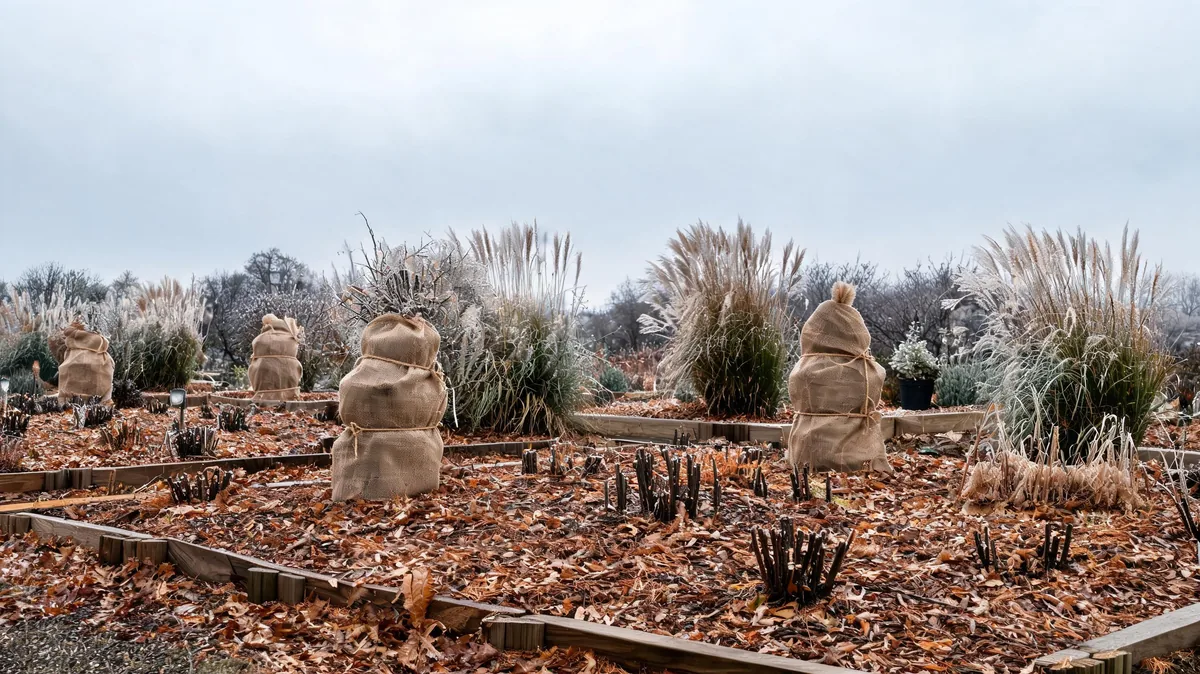
Winter protection for perennials: when mulch matters and when it kills
The standard advice on winter mulch is: mulch your perennials in fall to protect them. This is not wrong.
—- title: "Winter protection perennials" slug: winter-protection-perennials hub: problems category: "Timing guide" description: "The standard advice on winter mulch is: mulch your perennials in fall to protect them. This is not wrong. It is also incomplete in ways that can kill." date: 2026-06-10 updated: 2026-06-10 author: "Thomas A." reading_time: 11 —-
The standard advice on winter mulch is: mulch your perennials in fall to protect them. This is not wrong. It is also incomplete in ways that can kill plants.
Mulch applied at the wrong time, at the wrong depth, or on the wrong plants is not neutral. It creates conditions for crown rot, delays spring emergence, and provides nesting habitat for voles. In zones 7–9, heavy winter mulch on some perennials causes more damage than the winter would cause without it.
The contrarian framing here is warranted by primary sources, not by contrary disposition.
What winter mulch actually does
The purpose of winter mulch is specific. It is not to keep the ground warm indefinitely. It is to prevent rapid, repeated freeze-thaw cycling of the soil — the physical force that heaves plant crowns out of the ground.
Per Missouri Botanical Garden's mulch factsheet: "Mulches reduce heaving of soils from frost. By loosening the soil structure, mulches lessen the tension between water molecules that form ice in the subsurface. Soil ice increases pressure which tears plant crowns and roots."
The mechanism is physical, not thermal. Mulch does not keep the soil from freezing in zones 3–5 — it freezes anyway. Mulch moderates the rate at which the soil freezes and thaws, preventing the repetitive expansion and contraction that would otherwise push shallow-rooted crowns above soil level where they desiccate and die.
The second purpose — insulation for marginally hardy plants — is relevant at zone limits. A plant rated for zones 4–8 being grown at the cold edge of zone 4 benefits from mulch insulation.
Where winter mulch helps: zones 3–5
In zones 3–5, freeze-thaw cycling is severe and repeated across the winter. The ground may freeze 12–18 inches deep; it may thaw partially during January and February warm spells and refreeze. Perennials with shallow crowns — hosta, astilbe, heuchera, many native perennials — are vulnerable.
Per Penn State Extension's dividing perennials guide: "Because I divide my perennials in the fall, I use mulch to prevent the heaving caused by alternating freezing and thawing. A loose mulch such as straw is suitable for winter."
For zones 3–5, the correct approach:
- Apply mulch after the first hard freeze (a night below 28°F that freezes the top inch of soil). Per Missouri Botanical Garden, this is "after the first frost about mid-November" in their zone 6a St. Louis location; earlier in zones 3–5.
- Use loose, airy material: straw, shredded leaves, or pine boughs. These insulate without compacting tightly against crowns.
- Depth: 3–4 inches.
- Critical: keep mulch off the crown center of plants with fleshy crowns (heuchera, astilbe, epimedium). Tuck it around the crown, not over it.
- Remove in spring as temperatures reliably rise above 40°F and before new growth emerges. Removing it too late compresses emerging shoots.
Per University of Minnesota Extension's hosta guide: hostas in Minnesota are "hardy to Zones 3 or 4 depending on the variety." In the coldest zones, a light straw mulch applied after the ground freezes is a common practice for marginally hardy selections.
Where winter mulch is unnecessary or harmful: zones 7–9
In zones 7–9, winter temperatures rarely drop below 0°F and freeze-thaw cycling is less severe. Most established hardy perennials — coneflower, black-eyed Susan, catmint, salvia, sedum, Russian sage — do not need winter mulch. They have evolved to handle moderate winters without assistance.
The problem arises when winter mulch is applied and conditions do not cooperate. A warm December and January in zone 7, followed by a wet February, followed by more warmth, creates exactly the conditions under which mulch becomes a liability. The soil under the mulch stays moist. The crown cannot dry. Fungal disease takes hold.
Crown rot is the specific risk. Crown rot on perennials is primarily caused by Sclerotinia, Phytophthora, and other soil-borne fungi that thrive in wet, anaerobic conditions. A thick mulch layer over a perennial crown in zone 7–9 — especially on a year with a mild, wet winter — is an incubation chamber for crown rot.
The plants most susceptible to winter mulch crown rot in zones 6–9:
- **Lavender (Lavandula spp.):** Lavender is explicitly damaged by mulch held against its woody base over winter in zones 6–7. Per multiple extension sources, lavender requires excellent drainage and open air around the crown base. I learned this at my own yard — the lavender 'Munstead' that I tried to over-mulch in 2021 came out in spring with the center completely rotten. The untouched plants at the end of the row survived.
- **Catmint (Nepeta racemosa):** Similar to lavender, the woody base of catmint resents wet mulch over winter in zones 6+.
- Penstemon: Excellent drainage is critical. Heavy mulch causes crown rot in wet winters.
- Bearded iris: The rhizome must remain exposed or lightly covered — burying it with mulch promotes soft rot. Per multiple extension sources, iris rhizomes should not be covered with more than 1 inch of material.
- **Dianthus and Phlox subulata:** Both require excellent drainage at the crown; winter mulch is detrimental.
The temperature timing problem
The other failure mode of winter mulch in zones 6–7 is early application. Mulch applied in October — before the ground has frozen — creates warmth and moisture around a crown that is still photosynthetically active and not yet dormant. This delays hardening, which is the physiological process by which plants accumulate cold tolerance.
Per the USDA Plant Hardiness Zone Map guidance: "Many species of perennial plants gradually acquire cold hardiness in the fall when they experience shorter days and cooler temperatures. This hardiness is normally lost gradually in late winter as temperatures warm and days become longer."
Interfering with the hardening process by insulating the crown against cold in October leaves the plant less cold-tolerant than if it had been left exposed through the natural hardening period.
The correct timing: after at least one hard freeze in the fall, ideally after the soil surface has frozen. In zone 7a Long Island, that is typically mid-to-late November. Not October.
What to do by zone
Zones 3–5: apply mulch, done carefully
- Apply after first hard freeze.
- Use straw, shredded leaves, or pine boughs. Not bark chips (too dense).
- 3–4 inches.
- Keep off fleshy crowns; tuck around them.
- Remove in spring before growth emerges — early to mid-April in zones 4–5, late April to early May in zone 3.
Zone 6: selective mulch
- Hardy, established perennials (coneflower, black-eyed Susan, hosta, daylily, salvia, sedum): no mulch needed on established plants in typical winters.
- Newly planted perennials (first or second year): light mulch (2 inches of straw) after hard freeze, to prevent heaving while root system is still limited.
- Marginally hardy plants (lavender, some salvias at zone limit, some ornamental grasses): mulch the root zone; leave the crown base clear.
- Spring-planted bulbs (daffodils, tulips): 2–3 inches of mulch per Penn State Extension is beneficial.
Zones 7–9: usually skip the winter mulch
- Most established hardy perennials in zones 7–9 do not benefit from winter mulch and may be harmed by it.
- Leave the growing season mulch layer in place (2–3 inches) but do not add to it in fall.
- Plants at their hardiness limit (a zone 8 plant in zone 7b): light mulch applied over the root zone (not the crown) after hard freeze is appropriate.
- Apply mulch in spring for weed suppression and moisture retention — which is where mulch does its best work in warm zones.
Perennial-specific winter mulch guide
| Perennial | Zones 3–5 | Zone 6 | Zones 7–9 |
|---|---|---|---|
| Hosta | Light straw after freeze | Not needed for established | Not needed |
| Coneflower (Echinacea) | Light straw after freeze | Not needed | Not needed |
| Black-eyed Susan | Light straw after freeze | Not needed | Not needed |
| Catmint (Nepeta) | Light straw around crown | Skip or very light | Skip |
| Lavender | Light straw around (not over) crown | Skip or drainage focus | Skip |
| Bearded iris | Do not mulch crown | Do not mulch rhizome | Do not mulch rhizome |
| Sedum / Hylotelephium | Not needed | Not needed | Not needed |
| Russian sage | Light straw after freeze | Not needed | Not needed |
| Astilbe | Light straw after freeze | Light, if newly planted | Not needed |
| Heuchera | Light straw around crown | Light straw if marginally planted | Not needed |
When spring mulch removal matters
In zones 3–5, the mulch that protected crowns all winter becomes a problem if left in place too long in spring. Compacted straw over a hosta crown in late April traps cold, delays emergence, and can harbor slug eggs.
The general rule: begin removing winter mulch when daytime temperatures consistently reach 40–45°F. Do it gradually over 2 weeks rather than all at once — removing the insulation suddenly exposes crowns to a late frost event that might not have penetrated the mulch. Keep a pile of loose straw nearby to cover emerging shoots if a hard freeze is forecast.
Per Penn State Extension: "You should check weekly and water if dry." The same checking habit applies to spring mulch removal — watch for emergence signs and act accordingly.
Common problems
| Symptom | Cause | Fix |
|---|---|---|
| Perennial crown rotted after winter | Mulch held moisture against crown in wet winter | Remove old mulch; improve drainage; no mulch over crown base |
| Perennial heaved out of soil | Insufficient mulch in cold zone, or mulch applied after freeze-thaw began | Replant; apply earlier next year; deeper mulch in zone 3–5 |
| Lavender dies over winter | Moisture at crown base; winter wet | Do not mulch lavender crown; plant in raised, well-drained site |
| Hosta crown eaten by voles | Voles tunneling under mulch | Reduce mulch depth near crown; use hardware cloth cage around crowns |
| Emerging shoots damaged by late frost | Mulch removed too soon | Keep straw nearby in spring to cover emergent shoots on frost nights |
| Bearded iris with soft rot | Mulch piled over rhizome | Remove mulch from iris; rhizome should be exposed or barely covered |
Recommended gear: Best [coneflower cultivars beyond purple](https://outdoorplantcare.com/plants/best-coneflower-cultivars/) — our buyer's guide covering picks for every budget, ranked by Extension publication consensus and personal use.
Frequently asked
Should I cut back perennials before mulching?
Not necessarily, and in many cases not at all. Standing dead perennial stems provide winter habitat for native bees (hollow stems) and winter food for birds (seed heads from coneflower, black-eyed Susan, and ornamental grasses). Per NC State Extension, "native bees nest in the dead, hollow stems, so gardeners are encouraged to cut back dead stems to 12 to 24 inches and allow them to remain standing until they disintegrate on their own." If disease was present during the growing season (powdery mildew, rust, fungal leaf spots), remove and dispose of the affected foliage — do not compost it. Otherwise, let healthy stems stand through winter and cut them back in early spring before new growth emerges.
Does winter mulch prevent frost from killing marginally hardy plants?
Partially. Mulch moderates soil temperature but cannot prevent extended extreme cold from reaching the root zone. It slows the rate of temperature drop and reduces freeze-thaw cycling. A plant rated for zone 6 being grown at the cold edge of zone 6a (where winter minimums can reach -10°F) may gain 2–3°F of protection from a thick mulch layer. Per USDA Plant Hardiness Zone guidance, plants at zone limits are always at risk in severe winters regardless of protection measures.
How do I know if crown rot has set in?
Per Penn State Extension and Missouri Botanical Garden general plant health guidance: probe the crown in early spring. If the crown tissue is soft, slimy, gray-brown, or has a foul odor, crown rot has occurred. There is no cure — the affected crown is dead. Healthy crowns are firm and white or light tan in color when cut. If only part of the crown is affected, cut away all diseased tissue and replant the healthy portions in a new, well-drained location.
Is straw better than bark mulch for winter protection?
For winter crown protection in zones 3–5, yes. Straw is loose and airy — it insulates without compacting against crowns, allows air circulation, and is easy to remove in spring. Bark chips and shredded hardwood are better for summer mulching (weed suppression, moisture retention) but compact more and retain moisture more persistently in wet winters, which increases crown rot risk. Per Missouri Botanical Garden, straw "provides good insulation" and is "lightweight." The primary downside is aesthetics and the possibility of weed seeds, but for its winter protection function, it is well-suited.
Sources
- Missouri Botanical Garden — Mulches for the Home Garden.
- Penn State Extension — A Guide to Dividing Perennials.
- University of Minnesota Extension — Growing Hostas in Minnesota.
- USDA Agricultural Research Service — How to Use the USDA Plant Hardiness Zone Maps (hardening discussion).
- NC State Extension Plant Toolbox — Echinacea purpurea (stem nesting bees guidance).