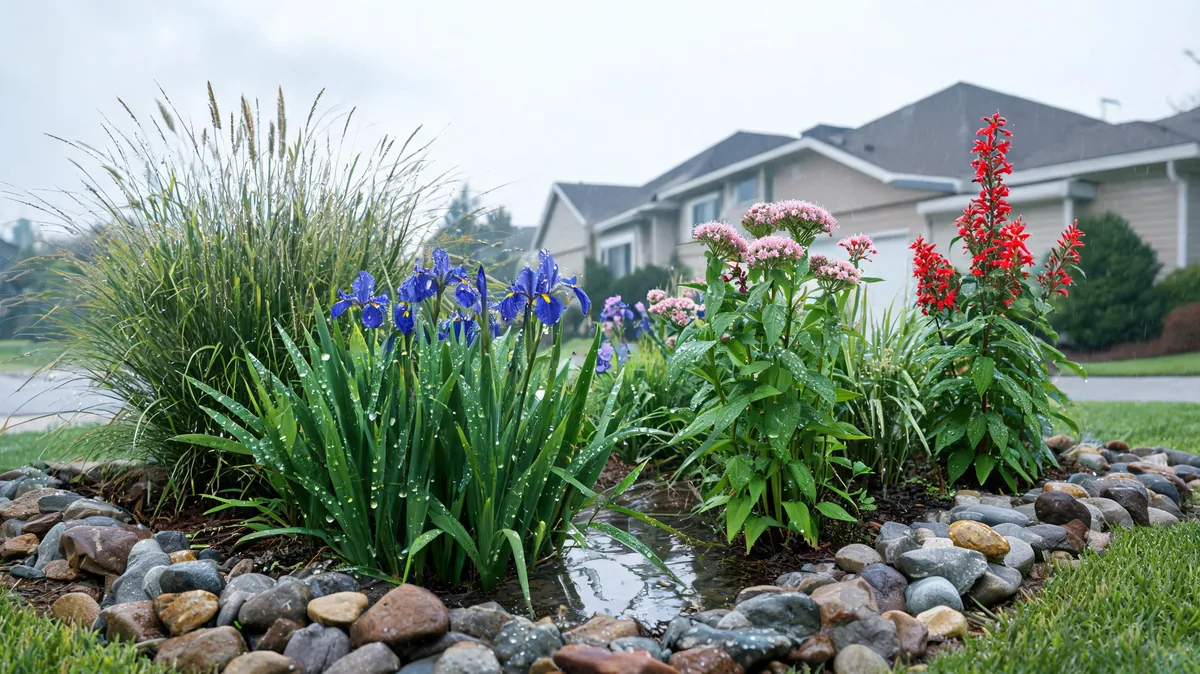
Rain Garden Plants: Species for Wet-Dry Cycles
title: "Rain Garden Plants: Species for Wet-Dry Cycles"
—- title: "Rain Garden Plants: Species for Wet-Dry Cycles" slug: rain-garden-plants hub: care category: Pollinator description: "Best plants for rain gardens: species tolerant of wet and dry cycles, with USDA zones, bloom times, and Extension-backed plant data for designing a functional rain garden." date: 2026-06-10 updated: 2026-06-10 author: "Thomas A." reading_time: 10 —-
A rain garden is not a pond plant. It is not a bog garden. A rain garden is a planted depression that fills with stormwater runoff after rain events and drains — typically within 24—48 hours — back to dry soil between storms. The functional requirement for rain garden plants is therefore tolerance of both conditions: standing water for short periods (6—48 hours) and dry soil between rain events, which in summer can mean drought conditions for weeks at a time.
Per Penn State Extension's rain garden guide, this wet-dry cycling is the most stressful aspect of rain garden conditions, and it eliminates the majority of common garden plants that either can't tolerate wet feet or can't tolerate drought. Strictly upland plants (lavender, coneflower, black-eyed Susan in well-drained soil) are marginal in rain garden bottoms. Strictly aquatic plants can't survive the dry periods. The functional zone is a specific group of native plants adapted to floodplain, wet meadow, and wet prairie conditions.
Rain garden siting and sizing basics
Before plant selection, siting matters. Per UMass Extension's low-impact development guides, a rain garden should be:
- Located at least 10 feet from building foundations, 25 feet from septic systems
- Placed in full sun to part sun (4+ hours) for best plant performance and evapotranspiration rates
- Sited where stormwater naturally flows — a low point that already collects water after rain is usually the right location
- Sized to hold the water from a 1-inch rain event from the roof or impervious area draining into it (calculators available from most state Extension programs)
Soil amendment — mixing in sand and compost to increase drainage rate — is typically needed in clay-heavy soils. Per Penn State Extension, a standard rain garden mix is 50—60% sand, 20—30% compost, and the remaining native topsoil.
Zone 1: the basin floor (tolerates standing water 24—48 hours)
These plants go in the deepest part of the rain garden and must tolerate periodic standing water as well as extended dry periods.
Swamp milkweed (Asclepias incarnata): Zones 3—9. The most versatile native milkweed for wet sites. July—August pink flowers. Significant nectar source and monarch host plant. Per Monarch Watch, it is one of the most recommended milkweeds for rain garden conditions. Grows 3—5 feet; does not spread aggressively.
Swamp rose mallow (Hibiscus moscheutos): Zones 4—9. The largest-flowered native for rain garden conditions — flowers to 12 inches across in white, pink, and red. July—September bloom. Per UF IFAS Extension, it tolerates standing water and periods of drought once established. Dramatic statement plant for the center of the basin.
Blue flag iris (Iris versicolor): Zones 3—9. Native iris of wetland edges throughout the Northeast and upper Midwest. Blue-violet flowers in May—June. Per Cornell Cooperative Extension, it tolerates standing water but will also grow in consistently moist (not waterlogged) garden soil.
Joe Pye weed (Eutrochium purpureum): Zones 4—9. 4—7 feet of purple-pink composite flowers August—September. Per Penn State Extension, it tolerates moist to wet soils in full sun to part shade and is one of the most reliable tall natives for rain garden conditions. Very high butterfly value, especially for swallowtails.
Cardinal flower (Lobelia cardinalis): Zones 3—9. The hummingbird plant for moist and wet conditions. July—September red bloom. Requires consistent moisture — one of the few hummingbird plants that performs well in the rain garden environment. Per the Xerces Society, its flowers are almost exclusively accessible to ruby-throated hummingbirds.
Great blue lobelia (Lobelia siphilitica): Zones 4—8. Blue-flowered companion to cardinal flower, blooming at the same time and in the same conditions. August—September. Provides similar habitat value with different bloom color.
Soft rush (Juncus effusus): Zones 4—9. A native rush for the wettest areas of the basin. Not showy, but provides vertical structure and nesting material. Tolerates prolonged flooding better than most herbaceous plants. Per UMass Extension, it is a functional component of bioretention systems.
Zone 2: the basin sides (tolerates temporary wet with dry periods)
The middle zone — from the bottom of the basin up to the berm edges — experiences the full wet-dry cycle and is where most rain garden plant diversity belongs.
Ironweed (Vernonia fasciculata): Zones 3—8. Intense purple composite flowers August—September. Tolerates both periodic flooding and summer dry conditions. Per University of Minnesota Extension, it is one of the most dependable natives for wet-to-moist prairie conditions and one of the top nectar plants for migrating monarchs.
Wild bergamot (Monarda fistulosa): Zones 3—9. Tolerates a range of soil moisture. July—September bloom, very high native bee value. Spreads by rhizomes into a colony over several years.
Switchgrass (Panicum virgatum): Zones 3—9. One of the most moisture-adaptable native grasses — tolerates wet soils, average soils, and summer drought. Named cultivars like 'Shenandoah' (red fall color, 3—4 ft) are widely available. Per Penn State Extension, it is the most versatile native grass for rain garden plantings.
Virginia iris (Iris virginica): Zones 5—9. Blue-violet flowers similar to blue flag iris but native to the southeastern U.S. coast and midsection. Per NC State Extension, it tolerates seasonal flooding and average soils with periodic dry periods.
New England aster (Symphyotrichum novae-angliae): Zones 4—8. August—October. Tolerates moist soils well. The late-season anchor for the rain garden, providing critical monarch nectar during the fall migration period.
Goldenrod (Solidago rugosa): Wrinkleleaf goldenrod specifically tolerates wet conditions better than most goldenrod species. Zones 3—8. August—October. Per the Lady Bird Johnson Wildflower Center, it is one of the few goldenrods suited to moist to wet conditions.
Zone 3: the berm (well-drained edges)
The raised edges of a rain garden, called the berm or rim, stay dry even during rain events and support standard well-drained native plantings. This zone connects the rain garden to the surrounding landscape.
Little bluestem (Schizachyrium scoparium): Zones 3—9. Drought-tolerant once established. Excellent fall color. The standard native grass for berm planting.
Black-eyed Susan (Rudbeckia hirta): Zones 3—9. Tolerates the dry berm conditions well. Provides visual continuity between the rain garden basin and the surrounding landscape.
Purple coneflower (Echinacea purpurea): Zones 3—9. Adaptable to average well-drained soils. Standard pollinator plant for the berm zone.
Wild bergamot (Monarda fistulosa): Spans both zones 2 and 3 with its soil moisture flexibility.
Plant table
| Common Name | Scientific Name | USDA Zones | Bloom Time | Height | Zone/Value |
|---|---|---|---|---|---|
| Swamp milkweed | Asclepias incarnata | 3–9 | Jul–Aug | 3–5 ft | Zone 1; monarch host |
| Swamp rose mallow | Hibiscus moscheutos | 4–9 | Jul–Sep | 3–7 ft | Zone 1; dramatic; wet |
| Blue flag iris | Iris versicolor | 3–9 | May–Jun | 2–3 ft | Zone 1; bees; wet tolerant |
| Cardinal flower | Lobelia cardinalis | 3–9 | Jul–Sep | 2–4 ft | Zone 1; hummingbird |
| Great blue lobelia | Lobelia siphilitica | 4–8 | Aug–Sep | 2–3 ft | Zone 1; bees; wet |
| Joe Pye weed | Eutrochium purpureum | 4–9 | Aug–Sep | 4–7 ft | Zone 1–2; butterfly |
| Soft rush | Juncus effusus | 4–9 | Jun–Aug | 2–4 ft | Zone 1; structure; wet |
| Ironweed | Vernonia fasciculata | 3–8 | Aug–Sep | 3–6 ft | Zone 1–2; monarch nectar |
| Wild bergamot | Monarda fistulosa | 3–9 | Jul–Sep | 2–4 ft | Zone 2–3; bee magnet |
| Switchgrass | Panicum virgatum | 3–9 | Aug–Sep | 3–6 ft | Zone 2–3; structure |
| Virginia iris | Iris virginica | 5–9 | Apr–May | 2–3 ft | Zone 2; SE native |
| New England aster | Symphyotrichum novae-angliae | 4–8 | Aug–Oct | 3–6 ft | Zone 2; monarch migration |
| Wrinkleleaf goldenrod | Solidago rugosa | 3–8 | Aug–Oct | 2–4 ft | Zone 2; wet-tolerant |
| Blue wild indigo | Baptisia australis | 3–9 | May–Jun | 3–4 ft | Zone 2–3; drought/wet flex |
| Lizard's tail | Saururus cernuus | 4–9 | Jun–Aug | 2–5 ft | Zone 1; deepest wet areas |
| Prairie blazing star | Liatris pycnostachya | 3–9 | Jul–Sep | 3–5 ft | Zone 2; monarch nectar |
| Black-eyed Susan | Rudbeckia hirta | 3–9 | Jun–Oct | 1–3 ft | Zone 3 (berm); dry edge |
| Purple coneflower | Echinacea purpurea | 3–9 | Jul–Sep | 2–4 ft | Zone 3 (berm); pollinators |
| Little bluestem | Schizachyrium scoparium | 3–9 | Aug–Oct | 2–4 ft | Zone 3 (berm); drought |
| Virginia wild rye | Elymus virginicus | 3–9 | Jul–Aug | 2–4 ft | Zone 1–2; native grass wet |
Drainage and plant establishment
Per Penn State Extension's rain garden guide, a rain garden that holds water for more than 48 hours after a storm has a drainage problem — not a plant problem. Planting more water-tolerant species will not fix slow drainage; the underlying soil percolation rate needs to be addressed.
Testing percolation rate before designing a rain garden is standard practice: dig a 6-inch-wide by 12-inch-deep hole, fill it with water, let it drain fully, fill again, and time the second drain. Per Penn State Extension, a drain rate of at least 1 inch per hour is needed for a functional rain garden. Rates below 0.5 inches per hour require soil amendment or an underdrain system.
Ecological benefits beyond stormwater
Native rain garden plants provide ecological services beyond stormwater management. Per the Xerces Society's urban habitat resources, rain gardens in urban and suburban landscapes can serve as stepping-stone habitat connecting larger natural areas. The wet-meadow and floodplain plant community of a rain garden supports a specific guild of native bees adapted to wet conditions, including several Lasioglossum (sweat bee) species that forage preferentially in wet habitats.
Cardinal flower, swamp milkweed, and Joe Pye weed together cover three separate high-value pollinator niches (hummingbirds, monarchs, and bumble bees respectively) in a single rain garden planting — a higher return on ecological investment than most strictly ornamental plantings of the same footprint.
Frequently asked
What if my rain garden still has water in it 72 hours after a storm?
Per Penn State Extension, standing water beyond 48 hours indicates inadequate drainage. Options include: (1) removing plants and amending the basin soil with additional sand to increase percolation, (2) installing an underdrain (a perforated pipe at the base of the amended soil layer that connects to a safe outlet), or (3) redesigning the basin size relative to the contributing drainage area. Planting more flood-tolerant species treats the symptom, not the problem.
Can I plant a rain garden in part shade?
Yes, with adjusted plant selection. Per UMass Extension, part-shade rain gardens should emphasize: cardinal flower (tolerates part shade), great blue lobelia, blue flag iris, Joe Pye weed (part-shade tolerant), Virginia wild rye (shade-tolerant grass), and native ferns (cinnamon fern tolerates wet and shade). Evapotranspiration is lower in shade, so a shaded rain garden may drain more slowly — size it conservatively.
Do deer eat rain garden plants?
Variable. Per the Rutgers NJAES deer resistance publication, Joe Pye weed, ironweed, switchgrass, and goldenrod are B-rated (seldom severely damaged). Cardinal flower and swamp milkweed are occasionally browsed. Joe Pye weed specifically tends to be ignored in most gardens. For high-deer-pressure areas, see the deer-resistant perennials guide for strategies.
How do I prevent mosquitoes in a rain garden?
Per Penn State Extension, a properly designed rain garden — one that drains completely within 24—48 hours — does not provide the standing water that mosquitoes require to breed. Mosquitoes need at least 7 days of standing water to complete their larval cycle. A rain garden that holds water for 3+ days has a drainage problem that needs to be corrected on engineering grounds, not just for mosquito control.
Recommended gear: Best [coneflower cultivars beyond purple](https://outdoorplantcare.com/plants/best-coneflower-cultivars/) — our buyer's guide covering picks for every budget, ranked by Extension publication consensus and personal use.
Sources
- Penn State Extension. Rain gardens. extension.psu.edu
- UMass Extension. Rain gardens and low-impact development. ag.umass.edu
- University of Wisconsin Extension. Rain Garden Manual. clean-water.uwex.edu
- Cornell Cooperative Extension. cals.cornell.edu/cornell-cooperative-extension
- NC State Extension. Virginia iris and SE rain garden plants. plants.ces.ncsu.edu
- UF IFAS Extension. Swamp rose mallow. edis.ifas.ufl.edu
- Monarch Watch. Swamp milkweed for monarch habitat. monarchwatch.org
- University of Minnesota Extension. Ironweed and wet prairie plants. extension.umn.edu
- Lady Bird Johnson Wildflower Center. Rain garden plant database. wildflower.org
- Rutgers NJAES. Deer resistance. njaes.rutgers.edu
- Xerces Society. Urban pollinator habitat. xerces.org