Pollinator

Best Plants for Hummingbirds: Flowers That Draw Them In

title: "Best Plants for Hummingbirds: Flowers That Draw Them In"

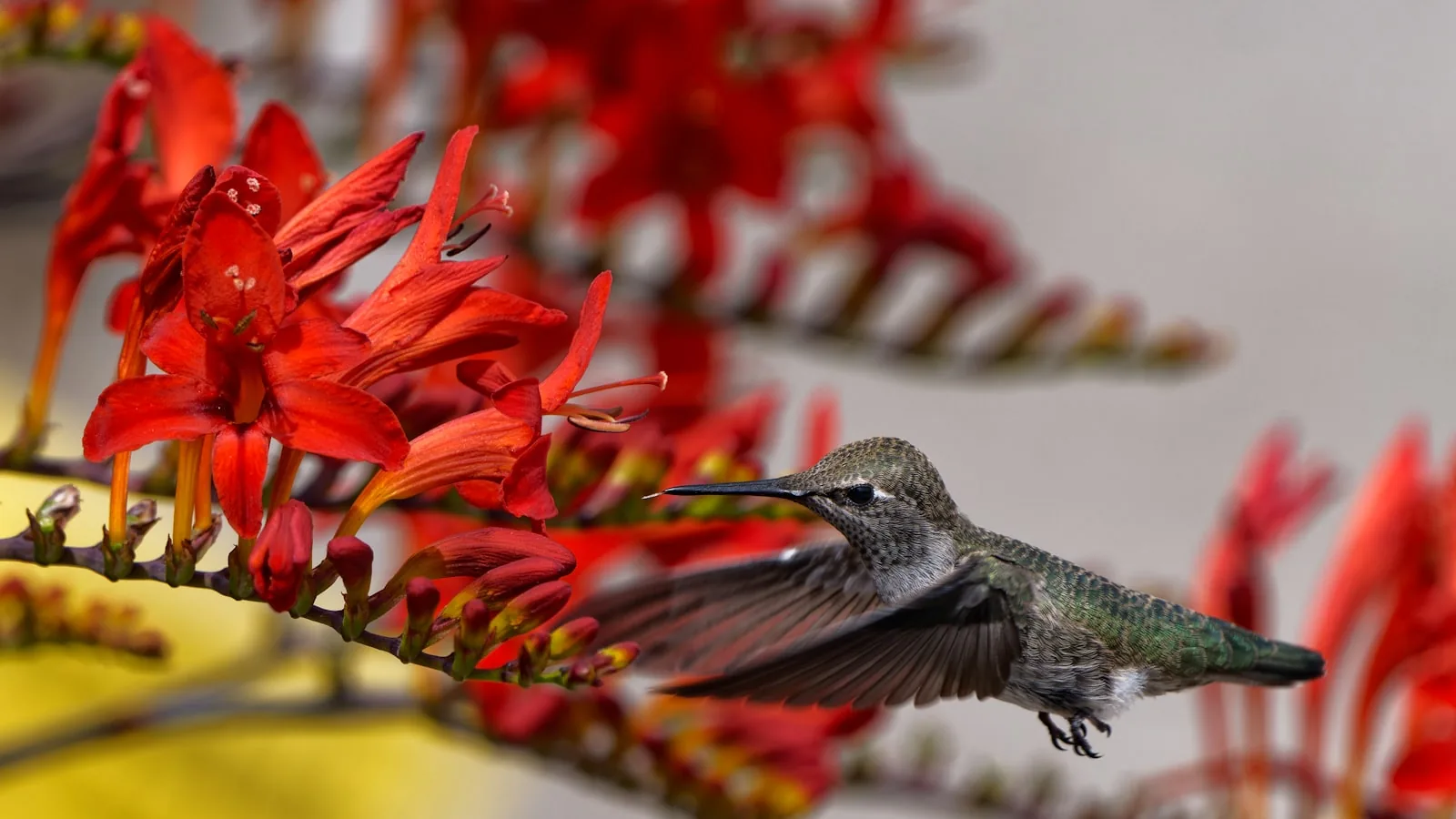
A hummingbird flies near vibrant red flowers
Photo: Unsplash on Unsplash

—- title: "Best Plants for Hummingbirds: Flowers That Draw Them In" slug: plants-for-hummingbirds hub: care category: Pollinator description: "Best plants for hummingbirds: tubular flowers, red and orange bloom colors, and bloom succession tips. Includes a 20-plant table with zones, height, and hummingbird value." date: 2026-06-10 updated: 2026-06-10 author: "Thomas A." reading_time: 9 —-

Hummingbirds are not generalist pollinators. Their bill shape, tongue structure, and visual system have co-evolved with specific flower types over millions of years, and a garden that ignores those preferences will see far fewer birds than one that works with their biology. Per the Cornell Lab of Ornithology's All About Birds resource, the primary attractors are tubular flowers (matching the length and shape of the hummingbird bill), red and orange coloration (hummingbirds see those wavelengths acutely and associate them with high-nectar flowers), and a sequence of bloom that extends from spring migration through fall departure.

Understanding which species you are likely to see also matters. The ruby-throated hummingbird (Archilochus colubris) is the only species that breeds east of the Mississippi. In the West, rufous (Selasphorus rufus), Anna's (Calypte anna), black-chinned (Archilochus alexandri), and several others occur, and their preferences largely overlap but with regional differences in plant availability. This guide focuses primarily on the ruby-throated's range but notes western species where they differ substantially.

What hummingbirds need from a flower

Hummingbirds hover and probe flowers with their bill. The ideal flower is tubular, with a tube length and diameter that matches their bill, and nectaries deep enough that other competitors (bees, other insects) are excluded. Per US Fish & Wildlife Service resources on hummingbird habitat, this co-evolutionary filtering means that many hummingbird-pollinated flowers have evolved specifically to exclude bees, which have short tongues relative to hummingbirds.

Red and orange are the dominant colors because hummingbirds evolved to associate those wavelengths with reward. In controlled studies they learn color-reward associations quickly and will switch to rewarding flowers of any color once trained, but in a novel garden they investigate red and orange flowers preferentially. Per the Xerces Society's hummingbird resources, this means that a garden mixing red-flowered and non-red tubular plants will see initial hummingbird attention concentrated on the red ones.

Nectar sugar concentration matters. Per research published in Functional Ecology, hummingbirds prefer nectar in the 20—25% sucrose range. This is why supplemental feeders work — the standard 4:1 water-to-sugar formula provides approximately this concentration.

Spring: welcoming migrants

Ruby-throated hummingbirds arrive in the eastern U.S. in late April through May, tracking nectar availability northward. In zones 7—8, the first birds typically appear when redbuds and columbines are in bloom.

Wild columbine (Aquilegia canadensis) is the native spring hummingbird flower par excellence in the East. Its red and yellow pendant flowers with long nectary spurs align precisely with ruby-throat bill morphology. Per Penn State Extension, it blooms April—June, grows 1—3 feet, and tolerates part shade — one of the few hummingbird plants that works in non-sunny conditions. Native columbine is strongly preferred over hybrid garden varieties, which often have shorter spurs that reduce nectar volume and accessibility.

Coral honeysuckle (Lonicera sempervirens) is a native vine that blooms in spring and often reblooms. Per the Lady Bird Johnson Wildflower Center, it ranges across the eastern U.S. in zones 4—9. Its red tubular flowers are a classic hummingbird plant, and unlike the invasive Japanese honeysuckle it does not spread aggressively.

Summer: the core season

Summer is when most hummingbird activity occurs in the mid-Atlantic and Northeast. The plants that carry the highest traffic during this period are largely in the sage and mint families.

Native salvias

The genus Salvia contains some of the highest-value hummingbird plants in North America. Native scarlet sage (Salvia coccinea) is a southern native widely grown as an annual in zone 6 and colder. Texas sage (Salvia greggii), hardy in zones 6—9, produces red-pink flowers from spring through frost and is documented by Texas A&M AgriLife Extension as one of the top hummingbird plants in that region.

The tropical sage (Salvia splendens), widely sold as a bedding annual, is the standard red flower in most garden center hummingbird displays. It functions as an annual hummingbird plant throughout the country, and while it is not native, it does provide genuine nectar value.

Trumpet vine

Trumpet vine (Campsis radicans) is a native vine with orange-red tubular flowers that are perfectly sized for ruby-throated hummingbirds. Per NC State Extension, it is native from zones 4—9, blooms July—September, and can grow extremely vigorously — root suckering and self-seeding can make it invasive in garden settings if not managed. It is best used on a structure it can be contained on rather than allowed to spread freely.

Bee balm / bergamot

Scarlet bee balm (Monarda didyma) has red tubular flowers arranged in whorls — an architecture that hummingbirds work efficiently. Per Cornell Cooperative Extension, it attracts both ruby-throated hummingbirds and sphinx moths (hawkmoths), which are visual mimics of hummingbirds in their hovering flight style. Wild bergamot (M. fistulosa) with its lavender flowers is slightly less attractive to hummingbirds than red-flowered scarlet bee balm but still draws visits.

Cardinal flower

Cardinal flower (Lobelia cardinalis) is among the most precisely co-evolved hummingbird plants native to North America. Per the Xerces Society, its intensely red tubular flowers produce nectar that is almost exclusively accessible to ruby-throated hummingbirds — bumblebees can rob it from the base, but are not its primary pollinator. It blooms July—September, grows 2—4 feet, and prefers consistently moist soil. Along stream banks and in rain garden margins it performs excellently.

Late season: supporting fall migrants

Hummingbirds begin their southern migration in July—September. Maintaining late-blooming plants extends the time birds spend in your garden building fat reserves.

Hummingbird mint (Agastache spp.) covers a range of native and hybrid species with tubular flowers in red, orange, and pink. Per Colorado State University Extension, western species like A. rupestris (sunset hyssop) and A. cana (hummingbird mint) are particularly valuable for western hummingbird species. They are drought-tolerant, long-blooming (July through frost), and deer-resistant.

Native salvias in the West, including blue sage (Salvia azurea) in the plains and autumn sage (Salvia greggii), extend late-season forage into October.

Jewelweed (Impatiens capensis) is a native annual that self-seeds prolifically in moist woodland edges. Its orange tubular flowers are a significant hummingbird forage plant in August—September. It grows 3—5 feet in moist shade where few other hummingbird plants survive.

Western hummingbirds: additional considerations

The western U.S. hosts far greater hummingbird diversity. Anna's hummingbird now overwinters year-round in parts of California and the Pacific Northwest, making year-round bloom a realistic and worthwhile goal. Per Oregon State University Extension, native plants that anchor western hummingbird gardens include:

Per University of California ANR resources, California fuchsia (Epilobium canum, formerly Zauschneria) blooms August—October and is specifically adapted to attract rufous and Allen's hummingbirds during their southward migration.

Plant table

Common NameScientific NameUSDA ZonesBloom TimeHeightHummingbird Value
Wild columbineAquilegia canadensis3–8Apr–Jun1–3 ftVery high; ruby-throat specialist
Coral honeysuckleLonicera sempervirens4–9Apr–Sep10–20 ft vineVery high; eastern ruby-throat
Red flowering currantRibes sanguineum5–8Feb–Apr6–12 ftHigh; critical early West
Scarlet bee balmMonarda didyma4–9Jul–Aug2–4 ftVery high; ruby-throat
Cardinal flowerLobelia cardinalis3–9Jul–Sep2–4 ftHighest; co-evolved specialist
Trumpet vineCampsis radicans4–9Jul–Sep30–40 ft vineVery high; tube size match
Native scarlet sageSalvia coccinea8–11 (annual N)May–frost2–3 ftHigh; red tubular flowers
Texas sageSalvia greggii6–9Apr–frost2–4 ftHigh; West/South
Hummingbird mintAgastache cana5–9Jul–Oct2–3 ftVery high; drought-tolerant
Sunset hyssopAgastache rupestris5–9Jul–Oct2–3 ftHigh; western species
JewelweedImpatiens capensis2–11 (annual)Jul–Sep3–5 ftHigh; moist-shade niche
Penstemon (scarlet)Penstemon barbatus3–9Jun–Sep2–3 ftVery high; western generalist
Firecracker penstemonPenstemon eatonii4–9Mar–Jun2–4 ftHigh; early West
California fuchsiaEpilobium canum8–11Aug–Nov1–3 ftHighest; rufous migrant
Scarlet giliaIpomopsis aggregata4–8Jun–Aug1–3 ftHigh; montane West
Standing cypressIpomopsis rubra6–9Jun–Aug4–6 ftHigh; Southeast/South
Red buckeyeAesculus pavia5–9Mar–May8–15 ftHigh; early South/East
Cross vineBignonia capreolata6–9Apr–Jun30–50 ft vineHigh; early tubular
Blue sageSalvia azurea5–9Aug–Oct3–5 ftHigh; late-season plains
Hummingbird sageSalvia spathacea8–10Jan–May1–3 ftVery high; California endemic

Feeder placement: supplement, not replacement

Feeders (4:1 water-to-white-granulated-sugar, per the Cornell Lab of Ornithology's feeder guidance) are a useful supplement to garden plants, especially for maintaining birds through gaps in bloom succession. Red dye additives are unnecessary — the red color of the feeder housing is sufficient to attract birds — and some ornithologists consider unnecessary additives a reason to avoid them. Per Cornell, feeders should be cleaned every 3—4 days in hot weather to prevent fermentation and fungal growth.

Plants provide something feeders cannot: nesting habitat, insects (a critical protein source for hummingbirds and their nestlings), and the bloom structure that stimulates territorial behavior and extended residency. A garden combining feeders with a diverse sequence of native hummingbird plants will hold birds through longer periods than feeders alone.

Frequently asked

Does the color red actually attract hummingbirds?

Partially. Hummingbirds have acute sensitivity to red and orange wavelengths, and in field experiments they investigate red objects preferentially. However, per the Cornell Lab of Ornithology, they make decisions about returning to flowers based on nectar reward, not color alone. They learn quickly and will focus on high-reward flowers of any color. Red coloration functions as an attention signal in a new garden; subsequent visits are driven by reward experience.

Why isn't trumpet vine in my neighbor's yard attracting hummingbirds?

Trumpet vine (Campsis radicans) is reliably used by hummingbirds, but the birds are territorial and may not discover a new planting for a season or two if no established garden territory exists nearby. Ruby-throated hummingbirds follow similar migratory paths year over year. Once a garden is established and birds have found it, return rates are high — the same individuals often return to the same territories year after year per Cornell Lab banding data.

Which hummingbird plants grow in shade?

Cardinal flower (Lobelia cardinalis), wild columbine (Aquilegia canadensis), and jewelweed (Impatiens capensis) all perform in part shade to dappled shade. Coral honeysuckle will grow in part shade but blooms less heavily than in full sun. Most other hummingbird plants require full sun (6+ hours).

How long do hummingbirds stay in the garden?

Ruby-throated hummingbirds are present in most of the eastern U.S. from May through September. Per the Cornell Lab, fall migration begins as early as July in the northern part of the range, with most birds departing by early October. Maintaining bloom succession through late September gives late-season migrants fueling opportunities. In the West, Anna's hummingbirds are year-round residents in California and increasingly in Oregon and Washington.

Recommended gear: English vs French vs Spanish [lavender — which to grow where](https://outdoorplantcare.com/plants/best-lavender-cultivars/) — our buyer's guide covering picks for every budget, ranked by Extension publication consensus and personal use.

Sources

Sources