Arugula Care: Succession Sowing for Year-Round Salads
Succession-sowing Eruca vesicaria for continuous salad greens — why spring arugula bolts in three weeks and fall arugula lasts two months, plus variety comparison for heat tolerance.
USDA hardiness and where arugula grows
Eruca vesicaria (synonym E. sativa) is a Mediterranean annual that grows in all zones 3–11 as a cool-season crop. Per University of Minnesota Extension, arugula "thrives at temperatures between 45–65°F" and "bolts quickly when temperatures exceed 75°F." In zones 3–7, it's best grown in spring (starting as soon as soil is workable, roughly 4 weeks before last frost) and fall (starting in mid-August through September). In zones 8–10, fall through early spring is the productive window.
Arugula is frost-hardy. Established plants survive temperatures down to the mid-20s°F; a light frost (28–32°F) actually concentrates flavor and doesn't damage established plants. Per Penn State Extension, arugula "can withstand light frosts and continues to grow until hard freezing temperatures arrive." In zone 7a, fall-sown arugula regularly produces harvest through November and sometimes into December under a low tunnel.
Varieties
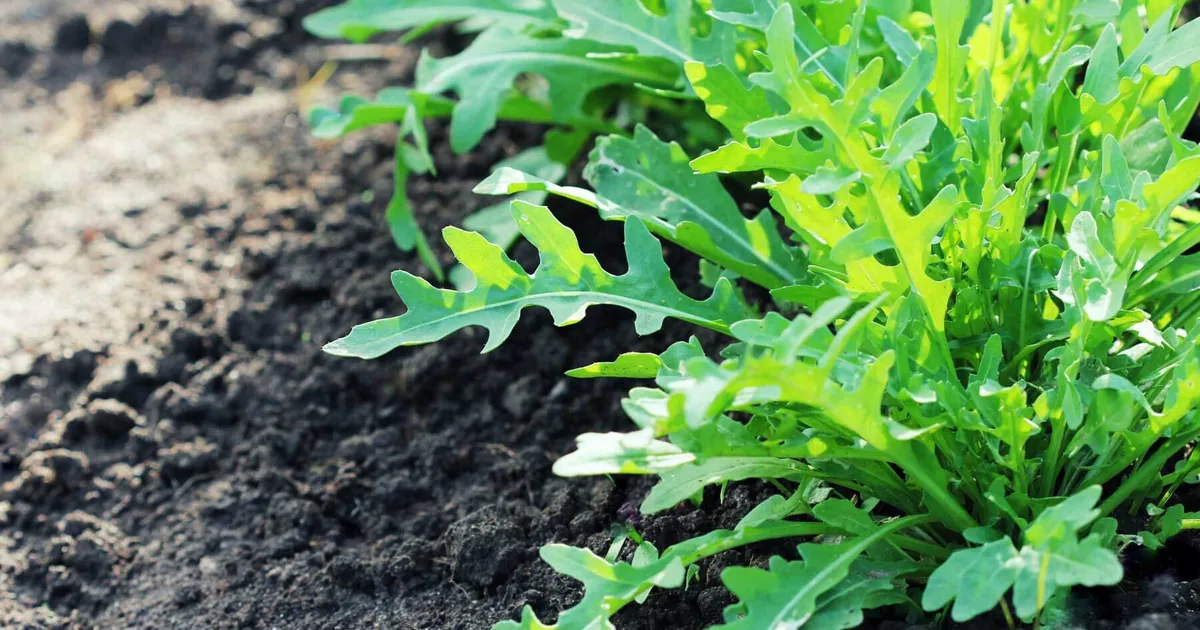
Standard arugula (Eruca vesicaria) has the classic peppery bite. Wild arugula (Diplotaxis tenuifolia) is a different species — more deeply cut, more strongly flavored, slower to bolt, and perennial in zones 6–10. Wild arugula is worth growing alongside standard arugula as it provides harvest when standard arugula has bolted. 'Astro' and 'Slow Bolt' are standard varieties with somewhat better heat tolerance than unnamed varieties. Per University of Minnesota Extension, "slow-bolt varieties extend the harvest season by several weeks."
Light
Arugula grows best in full sun (6+ hours) during cool seasons. In warm weather or as a spring crop extending into May, light shade (3–4 hours of sun) can delay bolting by slowing the rate at which plants experience heat accumulation. A site that gets morning sun but is shaded by taller vegetables or a fence from 1pm onward can extend spring arugula by a week or two. For fall arugula, full sun maximizes growth rate as days shorten.
Watering
Consistent moisture produces the best leaf quality — evenly moist soil grows tender, flavorful leaves; drought stress accelerates bolting and produces tough, excessively pungent leaves. Per Penn State Extension, arugula needs "approximately 1 inch of water per week." Its shallow root system dries out faster than deeper-rooted crops, so monitoring soil moisture in the top 3–4 inches is more relevant than deeper checks.
Overhead watering is fine for arugula. Watering in the morning lets foliage dry before evening, which reduces fungal disease. In containers or raised beds that dry quickly in summer heat, frequent small waterings beat infrequent deep irrigation for keeping this crop in good condition.
Soil and pH
Arugula grows in a wide range of soils. It prefers fertile, well-drained soil with a pH of 6.0–7.0 but is tolerant of somewhat acidic or alkaline conditions without dramatic performance reduction. The key is drainage — waterlogged soils cause root rot and reduce growth rates. Per Penn State Extension, "arugula grows well in most garden soils if drainage is adequate."
Incorporating compost before sowing provides moderate fertility that supports quick leafy growth. Arugula is not a heavy feeder and doesn't require intensive fertilizer programs.
Planting
Direct sowing is the standard approach — arugula germinates in 5–7 days at soil temperatures above 40°F and transplants poorly due to root disturbance sensitivity. Per University of Minnesota Extension, "direct seeding is preferred over transplanting."
Sow seeds 1/4 inch deep, broadcast thickly in wide beds or in rows 6–8 inches apart. Thin to 4–6 inches between plants when seedlings have 2 true leaves; thinnings are edible. The best approach for most gardeners is broadcast sowing in wide blocks and cutting the whole planting with scissors for a "haircut" harvest rather than thinning individual plants.
Spring sowing: Begin as soon as soil can be worked, up to 4 weeks before last frost date. Continue sowing every 2 weeks through early April (zone 7) for a succession of plantings. After mid-April in zone 7, spring arugula becomes increasingly prone to rapid bolting.
Fall sowing: Start in mid-August through mid-September. The fall window is less time-critical — plants will grow slowly but steadily as temperatures drop and can be harvested repeatedly until hard freeze. Covering beds with floating row cover extends harvest significantly by protecting from frost.
Fertilizing
Arugula is a light feeder. A modest amount of compost worked into the planting bed before sowing is usually all that's needed for the fast-growing crop. If plants show pale green or yellowish color, a light nitrogen application (dilute fish emulsion or compost tea) corrects this quickly. Per Penn State Extension, excessive nitrogen produces fast but diluted-flavored leaves — arugula's characteristic pepperiness is partly a function of moderate nutrition.
Harvest
For baby arugula: harvest leaves at 2–3 inches tall, about 21 days after sowing. For full-size leaves: wait until plants reach 4–6 inches, 30–35 days from sowing. Cut 1 inch above the soil line with scissors — plants regrow for 2–3 additional harvests from the same sowing before bolting.
Harvest leaves before bolting (before the central seed stalk elongates). Bolted arugula leaves become extremely sharp and pungent — edible but intense, and not to everyone's taste. Once the flower stalk is 4–6 inches tall, the best approach is to pull the plant and start a fresh sowing.
Arugula flowers are edible — mildly peppery, attractive in salads. Letting a few plants flower produces a pleasant garnish. The seeds can also be saved from dried seed pods for next year's sowing.
Common problems
Bolting
The primary challenge with arugula is bolting — the rapid shift from leafy vegetative growth to flowering and seed production, triggered by high temperatures and long days. Strategies to delay bolting: select slow-bolt varieties, grow in partial shade in late spring, maintain consistent moisture (drought stress accelerates bolting), and harvest regularly. Per University of Minnesota Extension, "regular harvesting delays bolting by removing apical growing points." The most practical solution remains fall growing.
Flea beetles
Tiny jumping beetles chew hundreds of small holes in leaves — the same pest that attacks eggplant. Per UC IPM, row covers over beds immediately after sowing prevents adult beetles from laying eggs. Once established on older plants, flea beetle damage is cosmetically significant but rarely kills arugula. Kaolin clay applied to leaves reduces feeding. For fall crops, flea beetle populations typically decline as temperatures cool, making this less of an issue than in spring.
Downy mildew
Pale yellow patches on upper leaves with gray sporulation underneath. Common in cool, wet fall weather. Per University of Minnesota Extension, improve air circulation (thin dense plantings), avoid overhead evening watering, and remove infected leaves. Copper-based fungicide slows spread if applied at first sign.
Caterpillars
Imported cabbageworm larvae and cabbage loopers occasionally feed on arugula. Bt kurstaki at first sign of feeding is effective. Row covers prevent egg-laying by the adult white butterflies.
Frequently asked
Why does my arugula taste too bitter or sharp?
Heat stress and drought stress both intensify arugula's peppery compounds (glucosinolates). Plants grown in hot weather, with irregular watering, or allowed to mature too long before harvest produce the sharpest flavor. For milder arugula: grow in fall when temperatures are cool, harvest young leaves at 2–3 inches, and maintain consistent moisture. Per Penn State Extension, "cool temperatures produce the best-flavored leaves."
How often can I harvest arugula from the same plants?
Two to four times per planting, using the cut-and-come-again method. Cut 1 inch above soil, allow regrowth, and harvest again when leaves reach 3–5 inches. Each successive harvest is slightly faster-growing but the bolting clock continues ticking regardless — in warm conditions, the third or fourth harvest may come with bolting imminent. Fall plantings are more productive because the bolting trigger is absent.
Can I grow arugula in containers?
Arugula is excellent in containers — it has a shallow root system (6 inches of depth is adequate), grows quickly, and is well-suited to patio growing. A 12-inch pot with good drainage produces several harvests. Container arugula dries out faster than in-ground plants; daily watering may be necessary in summer heat.
Is arugula the same as rocket?
"Rocket" is the common name for arugula used in the UK and much of Europe, and is identical. "Garden rocket," "salad rocket," "roquette" (French), and "rucola" (Italian) are all the same plant, Eruca vesicaria. In nurseries and seed catalogs, you may see it listed under either common name.
