Pieris Care: Andromeda for Acidic Woodland Beds
Japanese andromeda (Pieris japonica) is a four-season broadleaf evergreen for acidic woodland beds — its early spring flowers and red new growth are its best features, but lace bug is nearly universal in the mid-Atlantic and requires active management.
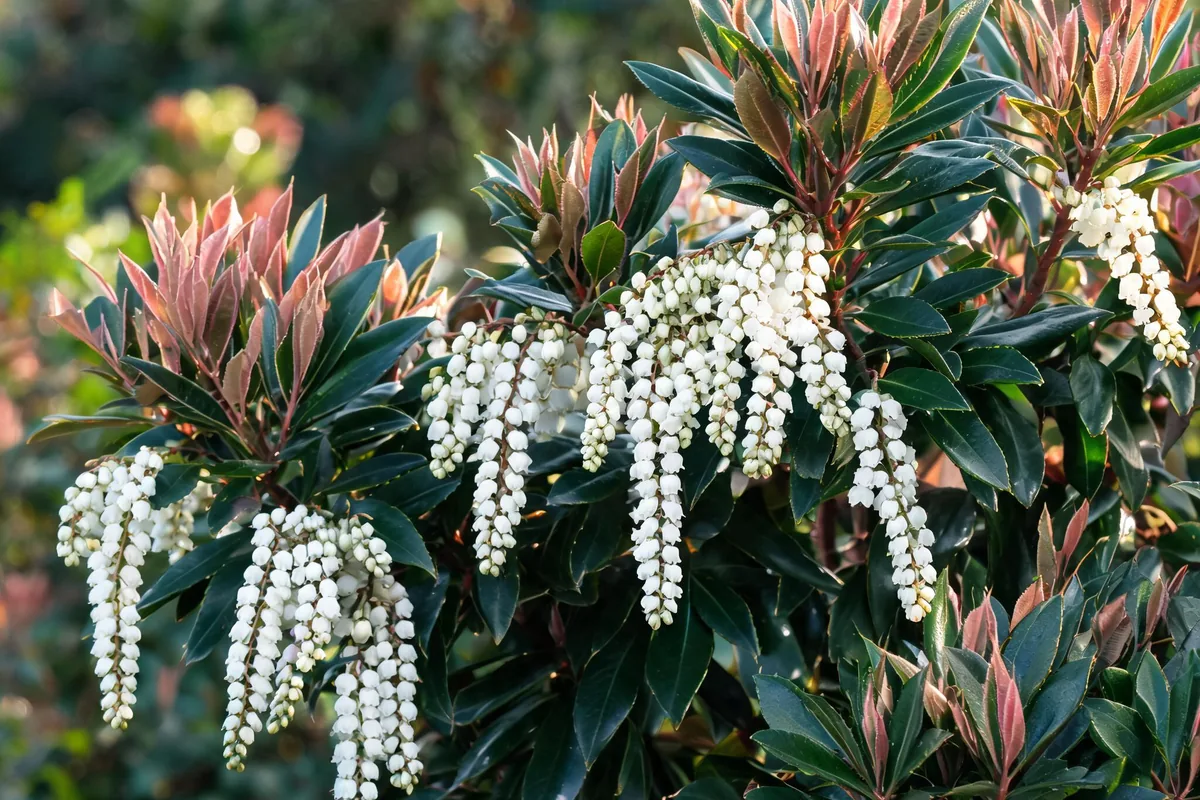
Identification and varieties
Pieris japonica, Japanese andromeda or lily-of-the-valley shrub, is a broadleaf evergreen native to eastern China and Japan. Per Penn State Extension, it is "one of the most ornamental broadleaf evergreen shrubs for acidic-soil gardens in the mid-Atlantic and Pacific Northwest, offering white urn-shaped flowers in early spring, distinctive red-to-pink new growth, and dense dark-green foliage." The flower clusters (racemes) develop in fall as buds and open in late February through April — often at the same time as forsythia and early daffodils, making it one of the earliest flowering shrubs of the season.
Key cultivars cover a range of sizes and new-growth colors:
- 'Mountain Fire': Brilliant fire-red new growth, one of the most ornamental selections. 6–8 feet at maturity.
- 'Dorothy Wyckoff': Compact at 4–5 feet, deep red flower buds that open to pink-white. Better cold hardiness than many selections.
- 'Cavatine': Dwarf at 2–3 feet. A scale-appropriate selection for small foundation beds.
- 'Flaming Silver': Silver-variegated foliage with red new growth — one of the most distinctive foliage plants in this genus. 4–5 feet.
- 'Valley Valentine': Deep rose-pink flowers. Hardy to zone 5 with protection. Most pieris selections have white flowers; this is the leading pink-flowered form.