Species guide

Oak Tree Care: Long-Lived Natives for Landscapes

Native Quercus oaks are the highest-wildlife-value landscape trees available in North America, supporting over 500 caterpillar species — this guide covers species selection, transplant establishment, oak wilt prevention, and the patience these trees require in the first decade after planting.
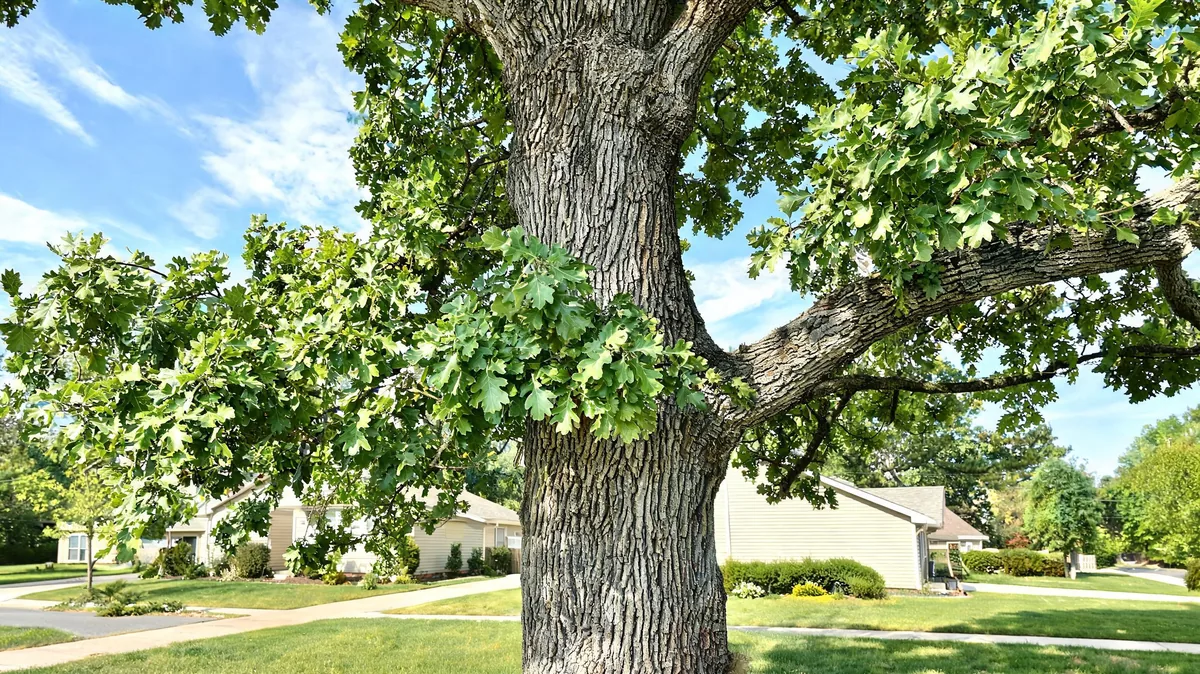
Mature red oak tree with deeply lobed leaves in fall color against an October sky
Photo: Unsplash

Oak species for landscapes

The genus Quercus contains roughly 400 species in North America. For residential landscapes, the most commonly planted include:

White oak group

White oak (Q. alba): The quintessential eastern North American oak. Round-lobed leaves, massive spreading crown at maturity (60–100 feet), acorns ripen in a single year. Per Penn State Extension, white oak "is considered the most ecologically important hardwood tree in the eastern United States" and is exceptionally long-lived (centuries in ideal conditions). Hardy in zones 3–9. Slow to establish but outstanding long-term.

Bur oak (Q. macrocarpa): Extremely drought-tolerant and adaptable to alkaline soils — the oak for the Midwest and Great Plains. Large, distinctive acorns with a fringed cap. Hardy in zones 3–8. Per University of Minnesota Extension, bur oak is "the most drought-tolerant and cold-hardy of the native oaks" and is the recommended species for zone 3–4 landscapes.

Red oak group

Northern red oak (Q. rubra): The fastest-growing native oak — 1–2 feet per year. Pointed-lobed leaves, exceptional red-to-bronze fall color. Hardy in zones 3–8. Per Penn State Extension, northern red oak "is the recommended oak for residential landscapes because its relatively fast growth produces a significant tree within a homeowner's lifetime." Highly susceptible to oak wilt (see below).

Scarlet oak (Q. coccinea): Brilliant scarlet fall color, one of the most ornamental oaks. Zones 4–9. More tolerant of poor, dry, sandy soil than red oak. Per Missouri Botanical Garden, scarlet oak "provides outstanding fall color and is well-adapted to dry, sandy, acidic soils where other oaks struggle."

Smaller landscape oaks

Swamp white oak (Q. bicolor): Adapts to wet or poorly drained sites — useful where white oak would fail. Exfoliating bark. Hardy zones 3–8.

Pin oak (Q. palustris): Pyramidal when young, fast-growing, widely planted in urban landscapes. Often develops iron chlorosis on alkaline soils. Per Penn State Extension, "pin oak should not be planted on alkaline soils because chlorosis is persistent and significantly reduces tree health and appearance."

USDA hardiness and where oaks grow

Collectively, native North American oaks span zones 3–10. White oak, bur oak, and northern red oak are the northern workhorses at zones 3–8. Southern live oak (Q. virginiana) grows in zones 7–10. Per University of Minnesota Extension, oaks are "the backbone of the eastern deciduous forest" and native oak species occur in virtually every state east of the Rockies at some elevation and climate.

Light

All oaks require full sun — 6 or more hours of direct sunlight per day. Per Penn State Extension, "oaks are intolerant of shade and will not develop into proper tree form under a canopy." Young oaks suppress in shade and may survive for years without establishing proper crown development. Site oaks where they will have full sun clearance above and to the south; adjacent trees that will eventually shade a young oak are a common cause of oak decline and poor form.

Watering

Established oaks are among the most drought-tolerant landscape trees available. Per Penn State Extension, "established oaks require no supplemental irrigation and survive drought conditions that kill most other landscape trees." The first 3–5 years after planting are the critical establishment period during which oaks need regular watering. Young oaks invest most of their energy in root development, not top growth — a 1-year-old oak sapling that barely grew above ground may have developed a root system 3–4 times the volume of its visible top. Water weekly to 12 inches of depth during the establishment period, reducing watering as the tree matures. After 5–7 years in the ground, most oak species need no supplemental water in the eastern U.S.

Soil and pH

Soil requirements vary significantly by species. Most oaks prefer slightly acidic, well-drained soil at pH 5.5–6.5. Per Penn State Extension, "northern red oak and scarlet oak require acidic soils and develop iron chlorosis on alkaline sites above pH 7.0." Pin oak is even more sensitive to high pH. Bur oak is the exception — it tolerates pH up to 7.5 and is the best choice for the Midwest's often-alkaline prairie soils.

Soil compaction is one of the most common causes of urban oak decline. Per University of Minnesota Extension, "oaks in compacted urban soils develop shallow root systems, are drought-stressed even with irrigation, and are predisposed to disease and pest problems." Protect the root zone (the area under the tree's drip line) from compaction during construction and renovation projects.

Planting

Per Penn State Extension, "planting depth is the single most common cause of oak decline — the root flare (the transition between trunk and root system) must be at or slightly above soil grade." Oaks planted 2–4 inches too deep (an unfortunately common occurrence at nurseries and during landscape installation) develop girdling roots, crown rot, and long-term decline that may not become apparent for 10–20 years.

Plant in spring or fall. Container-grown oaks establish significantly faster than balled-and-burlapped stock. Allow adequate space for the mature crown — a white oak or red oak needs 40–60 feet of clearance from buildings, power lines, and adjacent trees for full development. Do not plant large oak species near sewer lines, foundations, or septic systems.

Fertilizing

Established oaks in natural woodland settings need no fertilization — annual leaf litter accumulation provides all the nutrients they need. In managed landscapes, per Penn State Extension, "young oaks in poor urban soil may benefit from a slow-release balanced fertilizer in the first 3–5 years, but established oaks rarely need fertilization." Avoid high-nitrogen fertilization of mature oaks — it can push excessive growth at the expense of root development and may increase susceptibility to some diseases.

Pruning

Oak pruning has one critical restriction in the red oak group: do not prune red oaks between April and July in the upper Midwest and mid-Atlantic. Per University of Minnesota Extension's oak wilt guidance, "fresh pruning wounds in spring and early summer attract the bark beetles that vector oak wilt fungus." The safe pruning window for red oaks is late summer through early spring — roughly August through February in zones 5–7.

White oaks are less susceptible but the same timing rule applies as good practice. For all oaks, prune only to remove dead, damaged, or structurally compromised branches. The natural form of an open-grown oak is its best form.

Common problems

Oak wilt (Bretziella fagacearum, formerly Ceratocystis fagacearum)

A fatal fungal disease that kills red oaks in a single season and white oaks over several years. Per University of Minnesota Extension, oak wilt "has killed millions of oaks in the upper Midwest and is spreading eastward." It spreads by root grafts between adjacent oaks of the same species and by nitidulid beetles attracted to fresh pruning wounds or storm damage. Confirmed diagnoses require laboratory testing. Per UMN Extension, "there is no cure for oak wilt in red oaks — infected trees should be removed and root graft connections to neighboring trees severed with a vibratory plow before the fungus spreads." Prevention: do not prune red oaks in the sap-flow season (April–July in zones 5–6), and immediately paint any fresh wounds with pruning sealer to deter beetles.

Anthracnose

Leaf blight in cool, wet springs. Brown, irregular spots on leaves in May–June. Per Penn State Extension, "oak anthracnose is rarely fatal to healthy trees" and typically does not require treatment beyond removing infected leaves. Repeated severe defoliations over multiple years can weaken trees and predispose them to secondary problems.

Gypsy moth / Spongy moth (Lymantria dispar)

An invasive caterpillar that defoliates oaks across the northeastern U.S. during outbreak years. Per Penn State Extension, "healthy oaks typically survive 1–2 years of defoliation; 3 or more consecutive years can kill the tree." Bt or spinosad applied when caterpillars are small (May) is effective for single-tree protection. Tree-banding with sticky tape in spring captures egg masses. Monitor for populations and treat proactively in known outbreak areas.

Iron chlorosis

Yellow leaves with green veins on pin oak, scarlet oak, and other acidic-soil oaks planted on alkaline sites. Per University of Minnesota Extension, "the fix is to choose a pH-tolerant species (bur oak, swamp white oak) for alkaline sites rather than attempting to acidify large areas of soil." Chelated iron applications provide temporary improvement but do not solve the underlying pH problem.

Frequently asked

How long does it take for an oak to mature?

In residential landscapes, northern red oak (the fastest-growing large oak) reaches 25–35 feet in 20 years. White oak takes longer — 30–40 years to reach similar size. The old saying "the best time to plant an oak was 20 years ago" is a fair characterization. Per Penn State Extension, "oaks are a long-term investment in ecological value" — their full wildlife benefit develops over decades as the bark develops structure for nesting and the canopy becomes large enough to support diverse insect communities.

Are oaks good for wildlife?

Oaks are the highest-value wildlife trees in North American horticulture. Per University of Minnesota Extension, "a single oak tree supports over 500 caterpillar species compared to fewer than 5 for most non-native landscape trees, and those caterpillars are the primary food source for 96% of North American songbirds." Acorns feed deer, turkey, squirrels, jays, and many other species. Oaks are the ecological anchor of the eastern forest ecosystem.

Should I mulch around my oak?

Yes — a wide mulch ring (3–4 inches of shredded wood chips, not dyed mulch) extending to the drip line and kept away from the trunk is one of the best things you can do for an oak's long-term health. Per Penn State Extension, mulch "suppresses grass competition, retains soil moisture, improves soil biology, and protects surface roots from mower damage." Avoid the "mulch volcano" practice of piling mulch against the trunk — this promotes crown rot and disease.

Can I plant a young oak from an acorn?

Yes — growing oaks from acorns is a rewarding and ecologically important practice. Per University of Minnesota Extension, "collect fresh acorns in fall, cold-stratify at 40°F for 30–60 days in a moist paper towel, and plant in a pot or directly in the ground in spring." Red oak group acorns need 90 days of cold stratification; white oak group often sprout immediately after collection in fall. Acorn-grown trees of the same species as existing neighboring oaks are particularly valuable because they are locally adapted.

Sources