Native Plants for the Pacific Northwest: Wet-Side Picks
Native plants for the Pacific Northwest in zones 7–9 — wet-climate rainforest species, Mediterranean summer-dry natives, and the distinct ecotypes of Western Washington vs. Oregon's valley floors.
Two climates, two plant palettes
West of the Cascades, the Pacific Northwest receives most of its precipitation from October through April, with dry summers. Per Oregon State University Extension, this "Mediterranean-like summer drought" means many Pacific Northwest natives are not adapted to regular summer irrigation — in fact, summer irrigation can kill plants like camas (Camassia spp.) and native bunchgrasses that evolved to go dormant in dry summers. Understanding which plants want summer water and which are harmed by it is the defining skill for PNW native gardening.
East of the Cascades is a different world — colder winters, lower rainfall, and drier conditions year-round. Plants native to the wet west slope will fail in the inland Pacific Northwest without irrigation; true eastern-slope natives should be used for dry inland gardens.
The cultivar question in the PNW
The PNW native plant community is among the most sophisticated in the country regarding cultivar ethics. Per OSU Extension, "using locally sourced, straight-species plants whenever possible provides the best ecological outcomes and best establishment success." Regional ecotypes of plants like Douglas fir and camas are adapted to local photoperiod and rainfall patterns — plants grown from seed collected elsewhere may not thrive or may behave invasively.
What NOT to call native in the PNW: Nandina domestica, Mahonia japonica (Japanese mahonia, different from native Oregon grape), or Cotoneaster species. English ivy (Hedera helix) is an extremely damaging invasive in PNW forests — removal from any property contemplating a native garden is a priority before planting begins.
Top 14 native plants for Pacific Northwest gardens
1. Red flowering currant (Ribes sanguineum)
Zones 5–9. The PNW's premier native shrub for pollinators. Deep pink to red flower clusters emerge in February–March just as Anna's hummingbirds are beginning their nesting season — a critical early nectar relationship. Per OSU Extension, this is "one of the most valuable native shrubs for year-round wildlife." Grows 6–10 feet, full sun to part shade, tolerates summer drought once established. Dark blue berries in fall feed birds.
2. Oregon grape (Mahonia aquifolium)
Zones 5–9. Evergreen native shrub with glossy, holly-like leaves, fragrant yellow flowers in early spring, and blue berries in summer. Highly adaptable — tolerates deep shade, dry soil under conifers, and various soil types. Per OSU Extension, it is "one of the most useful native shrubs for difficult shaded sites." State flower of Oregon. Birds eat the berries; early native bees visit the flowers.
3. Oceanspray (Holodiscus discolor)
Zones 5–9. Arching shrub to 10 feet with cascading plumes of creamy white flowers in June–July. Adaptable to dry, rocky, or disturbed soils — one of the PNW's most drought-tolerant native shrubs. Per OSU Extension, it "supports multiple specialized native bee species." Excellent for slopes, native meadow edges, and shrub borders.
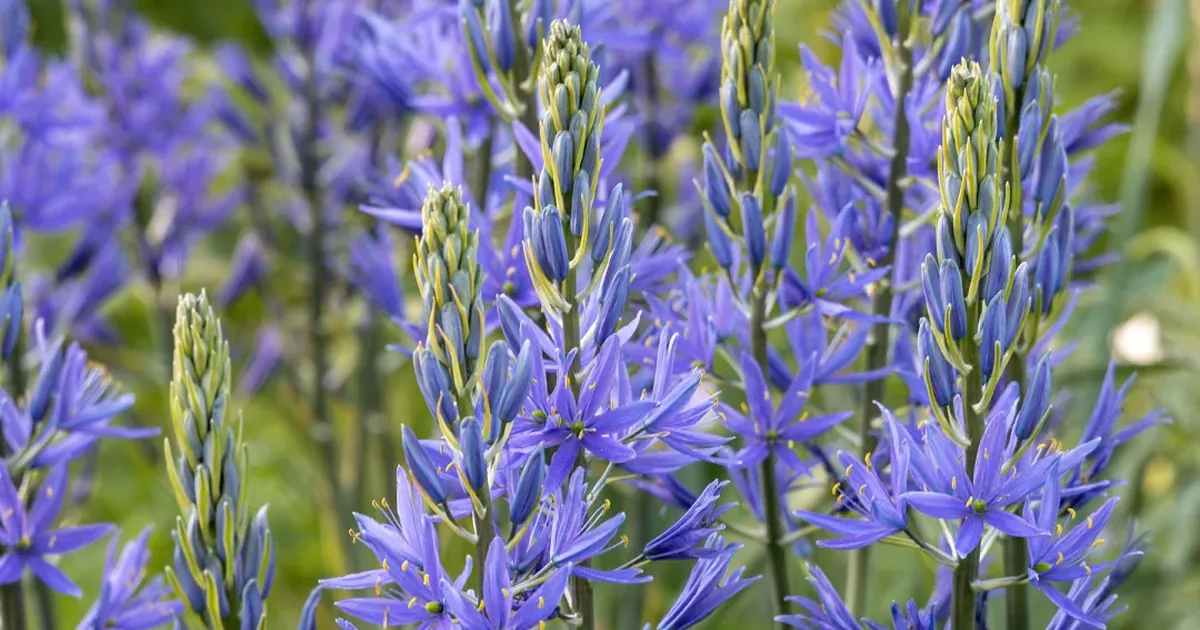
4. Camas (Camassia quamash)
Zones 3–9. Deep blue to violet flowers on 18-inch stems in May. Bulbous perennial that naturalizes in moist meadows and grasslands — historically an important food plant for many Pacific Northwest tribes. Critical early-season nectar source for native bees emerging from dormancy. Plant in areas that will be dry in summer (under deciduous trees, away from irrigation zones). Per OSU Extension, "summer drought is essential to the natural life cycle" of camas — do not irrigate in summer.
5. Sword fern (Polystichum munitum)
Zones 3–9. The most abundant native fern of the Pacific Northwest coastal forest. Evergreen, 2–4 feet tall, extraordinarily tough — tolerates deep shade, dry summer conditions under conifers, and poor soils. Per OSU Extension, sword fern is "essential structure for woodland garden design in the PNW and one of the best plant choices for dry shade."
6. Western bleeding heart (Dicentra formosa)
Zones 4–9. Pink heart-shaped flowers, April–June. Spreads by rhizomes under deciduous trees, filling the moist forest floor. Goes dormant in dry summers. Hummingbirds and bumblebees visit the flowers. Part to full shade, moist humus-rich soil. More vigorous than the eastern species (D. eximia) in PNW conditions.
7. Native columbine (Aquilegia formosa)
Zones 3–9. Red and yellow flowers, May–July. The western counterpart to the eastern wild columbine. Key hummingbird nectar plant. Self-sows in appropriate conditions. Part shade to full sun, tolerates dry summer soils once established.
8. Osoberry / Indian plum (Oemleria cerasiformis)
Zones 6–9. One of the earliest native shrubs to flower in the PNW — small white flowers appear as early as February–March, providing critical early nectar. Per OSU Extension, it is "often the first plant to leaf out and bloom in PNW woodlands." Grows to 15 feet in moist soils. Small plum-like fruits in summer eaten by birds. Part shade to full sun.
9. Native penstemons (Penstemon cardwellii, P. rupicola)
Zones 4–9. Low-growing, cliff-dwelling native penstemons with vivid blue-purple to rose-pink flowers in June–July. Require perfect drainage — rocky walls, gravel gardens, and elevated beds. Per OSU Extension, PNW native penstemons are "among the most drought-tolerant and garden-worthy native perennials" but "must have sharp drainage to survive."
10. Salal (Gaultheria shallon)
Zones 5–9. Evergreen groundcover to 3–4 feet in part shade, lower in dry sunny conditions. White urn-shaped flowers in May followed by dark purple berries consumed by multiple bird species. Spreads by rhizomes to form dense colonies. Per OSU Extension, it is "the dominant understory shrub in many PNW coastal forests." Tolerates deep shade under conifers where little else will grow.
11. Douglas fir (Pseudotsuga menziesii)
Zones 5–8. The iconic PNW conifer. Supports over 200 associated insect species. In a large yard or acreage, planting a Douglas fir is one of the highest-value ecological investments possible. Grows fast — 1–2 feet per year — and is very long-lived. Full sun. Per OSU Extension, Douglas fir "provides nesting habitat, food sources, and structural diversity that no ornamental tree can approximate."
12. Pacific ninebark (Physocarpus capitatus)
Zones 5–9. Large native shrub to 12 feet with white flower clusters in May–June, red seed clusters in fall, and exfoliating bark providing winter interest. Tolerates wet soils and is excellent for stream banks and rain gardens. Per OSU Extension, it is "one of the most valuable native shrubs for riparian plantings."
13. Twinberry (Lonicera involucrata)
Zones 4–9. Native honeysuckle shrub with yellow flowers attended by hummingbirds, followed by twin black berries surrounded by dramatic red-purple bracts. Tolerates wet soils and heavy shade. Full sun to deep shade. Per OSU Extension, it is "exceptional for moist woodland gardens and stream margins."
14. Native grasses: blue wildrye and Idaho fescue
Blue wildrye (Elymus glaucus) tolerates partial shade under conifers and is excellent for woodland edges. Idaho fescue (Festuca idahoensis) is the dry-site bunchgrass of open hillsides and oak savanna habitats — perfect for dry, sunny slopes requiring no summer irrigation. Both provide nesting structure for ground-nesting native bees.
Site preparation for PNW native gardens
The critical first step: kill or remove invasive ivy, Himalayan blackberry, and English hawthorn before establishing native plantings. Per OSU Extension, these invasives "will outcompete native plantings within a few years if not fully removed" prior to installation. Multiple seasons of control effort may be needed before a site is ready for native planting.
Summer drought management: establish native plants in fall (October–November is ideal in the PNW), when rains resume and plants can root in before summer drought. First-season summer irrigation (once or twice a week) supports establishment; by year two most PNW natives can transition to no supplemental irrigation. Per OSU Extension, "fall planting is always preferable to spring planting in the Pacific Northwest."
Common mistakes
Watering native plants in summer after establishment — many PNW natives (camas, oceanspray, native bunchgrasses) are actively harmed by summer irrigation and will develop root rot or disease. The summer-dry adaptation is part of their natural cycle. Mark summer-drought-tolerant areas and resist the urge to irrigate.
Sources
- Oregon State University Extension: Native Plants for Pacific Northwest Gardens
- Washington State University Extension: Native Plants and Pollinators
- Lady Bird Johnson Wildflower Center: Pacific Northwest Native Plant Database
- Xerces Society: Pacific Northwest Pollinator Plant Guide
- Audubon Society: Native Plants Database by Zip Code
