How-to guide

How to Fix Compacted Soil: Broadforks, Aeration, and Cover Crops

How to fix compacted soil — diagnosing compaction severity, when to use a broadfork vs. core aeration vs. cover crops, and the long-term biology that keeps soil structure open.
Core aeration plugs on a lawn surface showing dark soil cylinders extracted from compacted ground
Original brand image — Outdoor Plant Care

When to do this

Address compaction in spring or fall, when soil is moist but not waterlogged — the best time for aeration equipment to penetrate and for cover crops to establish. Per Penn State Extension, "aerating when soil is too wet causes smearing of pores rather than opening them." A fall core aeration followed by overseeding and organic matter application is the standard first-season approach for mild to moderate compaction.

What you need

For core aeration

For broadforking / manual decompaction

For cover cropping

Diagnosing compaction severity

The screwdriver test: push a standard screwdriver or steel rod into the soil with your hand (not striking it). If it goes in 6 inches without significant resistance, compaction is mild. If you can only push it 3–4 inches, compaction is moderate. If you can't push it 2 inches, compaction is severe. Per Penn State Extension, a penetration resistance equivalent to 300 psi — roughly what it takes to push a standard screwdriver in with firm hand pressure — is "the threshold at which root growth is significantly restricted." Construction-grade compaction near foundations or in areas trafficked by equipment is often at 600–800 psi, essentially impenetrable to most plant roots.

Step-by-step: Core aeration for mild to moderate compaction

Step 1: Mow and water first

If aerating a lawn, mow to normal height and water the area 1–2 days before aerating so soil is moist to 4 inches. Dry soil resists penetration; waterlogged soil smears and compacts the pore walls.

Step 2: Run the aerator

Make two passes at right angles to each other. The aerator pulls cylindrical cores (plugs) from the soil — these should be 3–4 inches long for effective decompaction. Shorter plugs mean the soil is too hard or too dry. Per Penn State Extension, "core aeration removes approximately 10% of soil volume with each pass" — two passes in perpendicular directions are significantly more effective than one pass alone.

Step 3: Leave the plugs

Leave pulled cores on the surface. They break down in 1–2 weeks, returning the soil and organic matter to the bed. For lawns, they can be broken up by running the mower over them a few days after aerating, blending them into the surface.

Step 4: Top-dress with compost

Apply 1/4 inch of finished compost or topdressing mix over the aerated area and drag it into the holes with the back of a rake. Per Penn State Extension, "compost addition after aeration dramatically improves the long-term effectiveness" by increasing organic matter, which supports the microbial community that maintains soil structure.

Broadfork method for garden beds

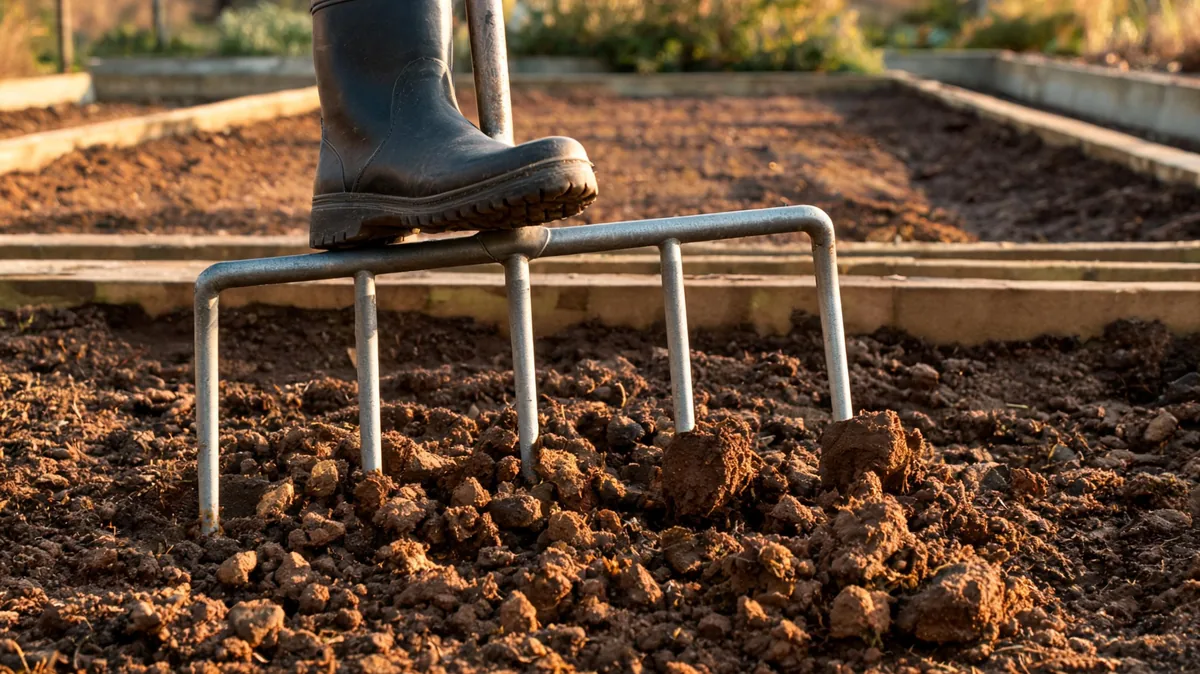
For vegetable and perennial beds that can't be core-aerated without disturbing plants: the broadfork is the right tool. Push the tines vertically into the soil to their full depth (10–12 inches), press back on the handles to gently lift and fracture the soil without fully inverting it, then release. Work in rows across the bed at 8–10 inch intervals. Per Penn State Extension, this method "breaks compaction without destroying soil structure" — unlike tilling, which can create a hardpan just below till depth. The broadfork is particularly useful in no-till gardens where conventional tillage is avoided as a principle.

Cover crops for biological decompaction

Tillage radish and daikon radish are the most effective cover crops for breaking compaction biologically. Their large taproots penetrate 12–18 inches into compacted soil, then die in winter, leaving channels that subsequent crop roots can follow. Per Penn State Extension, "tillage radish planted in early fall in zones 5–7 produces the most consistent compaction relief of any cover crop for home garden use."

Winter rye and hairy vetch, both winter-hardy cover crops, add organic matter and produce extensive fine root systems that improve soil aggregate stability over time. They won't break deep compaction but build the soil structure that resists future compaction. Sow in early fall, kill by rolling/mowing in spring before tasseling, and plant cash crops into the residue 2–3 weeks later.

Long-term prevention

The cause of compaction is almost always traffic — foot traffic, equipment, or concentrated water (irrigation or rain) impact. Per Penn State Extension, "the most effective permanent solution to soil compaction is eliminating the traffic source." For garden beds: define permanent pathways between beds so that all human traffic occurs on designated paths (which can be mulched heavily to reduce compaction of those areas). Never walk in the growing bed. Raised beds inherently separate traffic from root zones. Apply 3–4 inches of wood chip or straw mulch on all pathways to buffer compaction from foot traffic.

Common mistakes

Tilling to "fix" compaction: conventional tilling can relieve surface compaction temporarily but creates a new hardpan layer just below the till depth (the plow pan), which can be worse than the original compaction. Per Penn State Extension, "tillage is a short-term fix that often creates a long-term problem." Aerating too frequently (every year) when compaction is not severe can over-disrupt soil biology. Aerate when compaction is confirmed, not as annual routine maintenance.

Sources